USuncutMN says: Tax the corporations! Tax the rich! Stop the cuts, fight for social justice for all. Standing in solidarity with http://www.usuncut.org/ and other Uncutters worldwide. FIGHT for a Foreclosure Moratorium! Foreclosure = homelessness. Resist the American Legislative Exchange Council, Grover Norquist and Citizen's United. #Austerity for the wheeler dealers, NOT the people.


We Are The 99% event

USuncutMN supports #occupyWallStreet, #occupyDC, the XL Pipeline resistance Yes, We, the People, are going to put democracy in all its forms up front and center. Open mic, diversity, nonviolent tactics .. Social media, economic democracy, repeal Citizen's United, single-payer healthcare, State Bank, Operation Feed the Homeless, anti-racism, homophobia, sexISM, war budgetting, lack of transparency, et al. Once we identify who we are and what we've lost, We can move forward.


Please sign and SHARE

Tuesday, August 30, 2011

Top ten list of Americans for monetary reform: the most important economic policy in US history

Top ten list of Americans for monetary reform: the most important economic policy in US history


The financial crisis in America today could be over almost instantaneously through monetary reform. Monetary reform is a fundamental shift in how America creates money. The shift is from a Robber Baron-era design of banks creating credit to lend to us at interest and ever-increasing debt, to our community (government) creating it for the direct payment of public goods and services. The benefits of monetary reform are conservatively $1 TRILLION every year, the end of the national debt, and full employment.

Please review the links above to fully understand this idea.

We hold these Truths to be self-evident

The power of monetary reform is evident in history. Napoleonic France quickly became the world’s leading economy and Paris its most beautiful city after ten years of violent revolution that killed or drove-off their economic leadership. Nazi Germany overcame tragic-comic hyperinflation to become the model economy during the Great Depression. These nations were in worse economic conditions than America today (economic power needs to be invested in the public good, not for empire).
This top 10 list of Americans who understood monetary reform deserve your attention. Given our economic condition, you literally have nothing more valuable for your attention. Each of the ten gives unique and added perspective for your learning of this multi-trillion dollar topic.
As always, please share this article with all who say they want to be a competent citizen. If you appreciate my work, please subscribe by clicking under the article title (it’s free). Feel free to peruse my other articles here. Following the list of our top 10 is two short video-clips of Dennis Kucinich and Ron Paul discussing monetary reform in the present.

  1. Thomas Edison (1847-1931) held over 1,000 US patents for his inventions and is considered among the most brilliant minds in American history. Edison understood the engineering of our monetary system and actively spoke for monetary reform. The following seven paragraphs are from an interview with the New York Times in 1921 from a publicity tour Edison took with his friend and fellow inventor Henry Ford to discuss monetary reform at a potential site for a hydroelectric dam at Muscle Shoals, Alabama. He discusses with the reporter how the US government should directly create the money for this public good.
  1. Thomas Jefferson (1743-1826) was the primary author of the Declaration of Independence, a foundation of American ideals. He was a scholar of the Enlightenment, including religious tolerance and freedom. Jefferson’s written work is extensive. He communicates strong understanding of banks creating credit that cause inflation to devalue everyone’s currency, the gambling of created credit such as we see today in credit default swaps and exotic derivative trading, and states, “Bank paper must be suppressed, and the circulating medium must be restored to the nation to whom it belongs.” My personal analysis is that Mr. Jefferson did not fully understand the power of creating money directly for the public good. However, he was quite eloquent to the dangers of the banking system creating and gambling with credit, the monetary and financial system we still have today.

  1. Andrew Jackson (1767-1845) is the last US President to pay-off the national debt. He did so only after ending the Federal Reserve of his day, the privately-owned Second Bank of the United States. The story is told in the 10-minute video below from the Money Masters. As did Thomas Jefferson, Jackson understood the subversive act and perpetual national debt with banks creating money to lend to the government. He did not understand the positive policy response of the government creating money directly for the payment of public goods and services.

  2. Peter Cooper (1791-1883) was one of America’s leading inventors and businessmen. He designed and built the first US locomotive in 1830, the “Tom Thumb.” Cooper was the first to introduce anthracite coal into iron production in 1845, resulting in the US’ first wrought iron beams for construction. In 1854, Cooper was a founder in the telegraph company that created the first trans-Atlantic cable. He patented Jell-O. In 1859, he founded The Cooper Union for the Advancement of Science and Art, a university in New York City that grants full scholarships to the nation’s brightest students with express admittance to all regardless of race, religion or sex. Peter Cooper was the newly-formed National Greenback Party candidate for President in 1876. Cooper learned about monetary policy from Albert Gallatin, US Secretary of the Treasury from 1801-1814.

  1. John F. Hylan (1868-1936) was Mayor of New York City from 1918 to 1925. New York has long been the US banking and financial headquarters, with the mayor’s office about a half-mile from the New York Stock Exchange. Hylan has two revealing communications in strong argument for monetary reform. The first is four paragraphs from a speech he made in Chicago on March 26, 1922 and reported in the New York Times the following day in the article titled, “HYLAN TAKES STAND ON NATIONAL ISSUES" (and here with immaterial other commentary). The next are 12 extensive paragraphs reported by the New York Times on Dec. 10, 1922 in the article titled, “HYLAN ADDS PINCHOT TO PRESIDENCY LIST; FORESEES A REVOLT.”
  1. These revealing comments come from two Chairpersons of the House Banking Committee, totaling 24 years of service in that position of comprehensive insight into American banking. Louis McFadden (1876-1936) was Chair from 1919-1931, and Wright Patman (1893-1976) was Chair from 1963-1975. After the two gentlemen’s remarks is a new 10-minute video from “The Secrets of Oz,” the sequel of the acclaimed “Money Masters” documentary.

  1. Benjamin Franklin (1706-1790) was a Founding Father of the United States and one of the most accomplished inventors and brilliant minds in human history. Among his achievements was the discovery of how to fund a government without taxes. Ok, Ben didn't invent this, but he was bright enough to recognize its power, write for it, and act for it's permanency in policy. This article will concisely summarize the method, document its veracity in conservative history, allow Mr. Franklin to explain it to you directly, and finish with a scenic 7-minute video describing Mr. Franklin’s contributions.
  1. William Jennings Bryan (1860-1925) was an attorney, one of the nation’s most popular public speakers, and the Democratic Party’s choice for President in three elections: 1896, 1900, and 1908. Bryan’s political populism centered on American monetary policy. He supported an expansion of the money supply in response to a national depression in the 1890’s by rejecting the gold standard, a limitation on currency based on a fractional reserve of gold holdings. His powerful stand for monetary reform is clearly expressed in his “Cross of Gold” speech in accepting the Democratic Party nomination for President in 1896, quoted below (click here to listen to Bryan’s reading of the speech 25 years later).

  1. Charles Lindbergh Sr. (1859-1924) was a member of the House of Representatives from 1907-1917 (R-MN). Lindbergh became disgusted with the leadership of both Republicans and Democrats, and ran as an unsuccessful third-party candidate for the Senate, Congress, and Governor from 1916 until his death. Lindbergh was among the leading spokespersons against the Federal Reserve and against US involvement in World War 1. Lindbergh’s powerful Congressional speech from his 1917 book Why is Your Country at War?, page 156, that alleges the Money Trust created the privately-owned Federal Reserve banking system to maximize their own profits. This speech is as strong and accurate a message that can be communicated. It is fully worth your investment of under 5 minutes' attention.

  1. The Great Depression in the US (1929-1941) motivated professional economists to comprehensively and creatively address its causes. Upon consideration of previous US economic depressions in 1837, 1873, and 1893, prominent economists led by Henry Simons at the University of Chicago proposed monetary reform as the nation’s most effective and practical policy response, known as the Chicago Plan (and here). This proposal was endorsed by Simons’ colleague, Paul Douglas, Frank Graham and Charles Whittlesley of Princeton, Irving Fisher of Yale, Earl Hamilton of Duke, Willford King of NYU, and sent to a thousand academic economists for their input. Three hundred twenty responded to the mailed proposal and survey (an impressively high number for a cold-call proposal and survey) from 157 universities, with 73% in full agreement with the proposal, 12.5% in approval with various considerations in its implementation, and only 14% in disagreement.


Continue reading on Examiner.com Top ten list of Americans for monetary reform: the most important economic policy in US history - Los Angeles LA County Nonpartisan | Examiner.com http://www.examiner.com/la-county-nonpartisan-in-los-angeles/top-ten-list-of-americans-for-monetary-reform-the-most-important-economic-policy-us-history#ixzz1WZIoa7cL

Jane White: Why Doesn't the Media Cover Grover Norquist's Bloodless Coup?

Jane White: Why Doesn't the Media Cover Grover Norquist's Bloodless Coup?

In India, tens of thousands of corruption-weary citizens have been galvanized by anti-corruption activist Anna Hazare, whose hunger strike forced the government to adopt a resolution Aug. 27th endorsing legislation that would create an independent anti-corruption agency. A 2005 studyshowed that more than 45% of its population were forced to pay bribes or get involved in some other kind of influence peddling to get the public sector to do their jobs.

What a contrast to the U.S., where corruption is king, the king's name is Grover Norquist and bribes go by the euphemism "campaign contributions" from the business lobby. What else would be the reason why President Obama is currently being pressured to REDUCE regulations, including those associated with Dodd-Frank financial services reform and the environment? Because Americans need more pollution, along with those vital jobs in the credit rating agencies that gave triple-A ratings to triple-F securities? This conflict of interest is most likely why Phyllis Borzi, the head of the Department of Labor's Employee Benefit Security Administration, was recently browbeaten by the financial disservices industry when she had the gall to propose requiring that the people who advise 401(k) participants act in their customers' best interests.

In a logical world, Republican members of Congress would be nervous about keeping their jobs given that the angry electorate that routed Congress in the last election is even more disappointed in their Tea Party replacements. According to a recent survey conducted by Associated Press-GfK, approval of Congress has dropped to an all-time low of 12%. Only a quarter of respondents consider themselves tea party supporters -- also an all-time low.

Why aren't these politicians worried? Because the mandate of Norquist's so-called K Street project is that they kowtow to the business lobby so that they get jobs as lobbyists when their constituents fire them. As I pointed out in my book, America, Welcome to the Poorhouse, according to Public Citizen, between 1998 and 2004 some 42% of former House members and 50% of former senators who were available to do so became registered lobbyists.

Ironically in 2006 then-Senator Obama gave a press conference announcing the introduction of the Honest Leadership and Government Act, denouncing the fact that "Medicare legislation has become a piggy bank for lobbyists and lawmakers who travel back and forth through the revolving doors in Washington." Unfortunately, as I pointed out in a previous post, by the time it became law it was watered down to toothlessness -- thanks to lobbyists.

The only way we can defeat the Tea Party traitors is the same way we defeated the Redcoats -- the media needs to rally the public to rout the enemy. Unfortunately, the media has done an abominable job of covering this rout, as Eric Boehlert of Media Matters pointed out in a previous blog.

Even the UK-based weekly, The Economist, which usually does a better job of covering American business and politics than we do, appears to be clueless. A recent article chalked the U.S. partisan divide up to our more-frequent elections, which require politicians to spend more time in their districts wooing the electorate rather than collaborating across the aisle in Capitol Hill. I guess they weren't aware that Norquist collaborator and former House Majority Leader Dick Armey perceive bipartisanship as "another word for date rape," according to the excellent book, The Big Con, The True Story of How Washington Got Hoodwinked and Hijacked by Crackpot Economicsby Jonathan Chait.

We can forgive The Economist for missing the point, since they're headquartered across the pond. But that's not the case with the Washington Post, the inside-the-Beltway publication that apparently has become so accustomed to the stench that they can't smell it. When I did a literature search on their articles on the topic throughout the years, I only came up with four, the last one written in 2007. Not surprisingly, the Post editor I was referred to didn't respond to my phone calls seeking a response.

Shame on ALEC Corporatocracy Racket

Shame on ALEC Corporatocracy Racket

My paper that deals specifically with privatization and, of course, ALEC !!

You can subscribe. Might take hours off your day ...


Shame on ALEC Corporatocracy Racket

Shame on ALEC Corporatocracy Racket

My paper that deals specifically with privatization and, of course, ALEC !!

You can subscribe. Might take hours off your day ...


Minnesota extends costly credit line

Minnesota extends costly credit line

Font Size:
Default font size
Larger font size

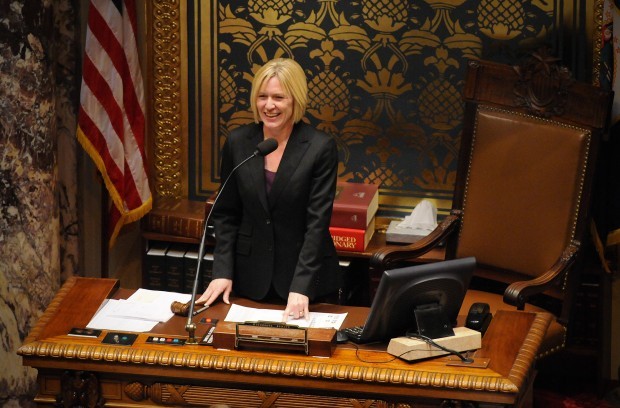
Sen. Michelle Fischbach, R-Paynesville, assumes her role at the front of the Senate after being elected Senate president, at the state Capitol in St. Paul, Tuesday, Jan. 4, 2011. (AP Photo/St. Cloud Times, Jason Wachter)

ST. PAUL — Deficit-plagued Minnesota is spending nearly $4 million in credit line fees over two years to make sure state government doesn’t bounce checks.

Finance officials earlier this summer extended a never-used $600 million line of credit, as state workers prepared for what turned into the nation’s longest state government shutdown in a decade. On Monday, Management and Budget Commissioner Jim Schowalter, the state’s top budget official, said in an interview with The Associated Press that Minnesota might need to borrow against the credit within months to get through at least one tight financial spot.

“It’s going to be close this fall,” Schowalter said in an interview. “We anticipate low balances even this fall and this coming spring, and that’s before we take into account any possible shocks that are going through the system right now.”

The credit isn’t free.

In an era of deep budget cuts, figures from Minnesota Management and Budget show that it will cost $2 million to keep the credit available for another year, through June 2012, even if it’s not used.

That’s enough to sustain higher service levels for anything from legal aid for the poor to early childhood programs — both cut in the latest budget — and it comes on top of $1.8 million spent to open the credit line last year under former Gov. Tim Pawlenty’s administration.

Minnesota isn’t alone in turning to borrowing to make it through tight financial times. States including Arizona and Pennsylvania have turned to banks in recent years as state budgets have been squeezed.

Minnesota hasn’t resorted to short-term borrowing to pay its bills since 1985. But the state has relied on other temporary fixes, including payment delays and accounting shifts, as leaders have grappled with deficit after deficit. The state’s reserves are gone and there’s less than $100 million left in a cash-flow account that serves as a day-to-day financial cushion. The latest budget from Democratic Gov. Mark Dayton and the Republican-controlled Legislature siphoned off nearly two-thirds of the money left in the cash flow account.

That means the credit could be essential in a cash crunch.

Schowalter said the low levels left in Minnesota’s rainy-day funds are “well beyond the comfort zone” and will need to be rebuilt over time. He said he expects the three major rating agencies to look at the state’s cash reserves during meetings next month before the state issues new bonds to pay for construction projects. Minnesota has the top rating from Standard & Poor’s and the second-highest rating from Moody’s Investors Service and Fitch Ratings.

Moody’s cited the diminished rainy-day accounts when it lowered its outlook for Minnesota’s credit to “negative” from “stable” earlier this month. Its report said “significantly strained liquidity” was one factor that could lead it to downgrade the state’s rating. The report said, “... available reserves have been substantially depleted. This leaves the state facing the challenge of addressing ongoing structural imbalance with limited resources in an uncertain economic environment.”

Moody’s also noted that the credit line bolstered the state’s liquidity.

Schowalter exercised the state’s option to extend the credit in a May 31 letter after Gov. Mark Dayton signed off on the move. The extension included nearly $850,000 in closing costs plus $1.2 million in interest. The cost could go up if the state borrows against the credit.

Pawlenty’s administration set up the credit last year after projections showed the state running dangerously low on cash. It originally ran through June without being tapped, while costing the state $1.8 million.

The scramble for money at the Capitol has been fierce in recent budget cycles, as the state has cut spending to deal with repeated deficits.

For example, state-funded legal services that help the poor with everything from eviction defenses to orders for protection for battered women are taking a $1.6 million cut, or nearly 7 percent, over two years. That means more people will be turned away and forced to deal with the courts on their own. And it’s not the first cut to hit the program.

“These are cuts on top of cuts at a time when demand has never been higher,” said Peter Knapp, a law professor who heads a legal services planning committee for the Minnesota Supreme Court.

Schowalter said the cost of the line of credit is part of the state’s guarantee to school districts and other funding recipients that it will make good on its obligations.

Copyright 2011 winonadailynews.com. All rights reserved. This material may not be published, broadcast, rewritten or redistributed.


Read more: http://www.winonadailynews.com/news/local/article_0a4c3a02-d2bd-11e0-9374-001cc4c03286.html#ixzz1WXO1N6rw