USuncutMN says: Tax the corporations! Tax the rich! Stop the cuts, fight for social justice for all. Standing in solidarity with http://www.usuncut.org/ and other Uncutters worldwide. FIGHT for a Foreclosure Moratorium! Foreclosure = homelessness. Resist the American Legislative Exchange Council, Grover Norquist and Citizen's United. #Austerity for the wheeler dealers, NOT the people.


We Are The 99% event

USuncutMN supports #occupyWallStreet, #occupyDC, the XL Pipeline resistance Yes, We, the People, are going to put democracy in all its forms up front and center. Open mic, diversity, nonviolent tactics .. Social media, economic democracy, repeal Citizen's United, single-payer healthcare, State Bank, Operation Feed the Homeless, anti-racism, homophobia, sexISM, war budgetting, lack of transparency, et al. Once we identify who we are and what we've lost, We can move forward.


Please sign and SHARE

Showing posts with label corporate ethics. Show all posts

Saturday, December 17, 2011

This County Needs a few Good Communists by Chris Hedges

by Chris Hedges
Featured Writer
Dandelion Salad
Truthdig
May 31, 2010
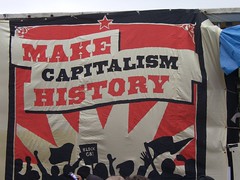
Make Capitalism History *
Image by Sterneck via Flickr

The witch hunts against communists in the United States were used to silence socialists, anarchists, pacifists and all those who defied the abuses of capitalism. Those “anti-Red” actions were devastating blows to the political health of the country. The communists spoke the language of class war. They understood that Wall Street, along with corporations such as British Petroleum, is the enemy. They offered a broad social vision which allowed even the non-communist left to employ a vocabulary that made sense of the destructive impulses of capitalism. But once the Communist Party, along with other radical movements, was eradicated as a social and political force, once the liberal class took government-imposed loyalty oaths and collaborated in the witch hunts for phantom communist agents, we were robbed of the ability to make sense of our struggle. We became fearful, timid and ineffectual. We lost our voice and became part of the corporate structure we should have been dismantling.

Hope in this age of bankrupt capitalism will come with the return of the language of class conflict. It does not mean we have to agree with Karl Marx, who advocated violence and whose worship of the state as a utopian mechanism led to another form of enslavement of the working class, but we have to speak in the vocabulary Marx employed. We have to grasp, as Marx did, that corporations are not concerned with the common good. They exploit, pollute, impoverish, repress, kill and lie to make money. They throw poor families out of homes, let the uninsured die, wage useless wars to make profits, poison and pollute the ecosystem, slash social assistance programs, gut public education, trash the global economy, loot the U.S. Treasury and crush all popular movements that seek justice for working men and women. They worship only money and power. And, as Marx knew, unfettered capitalism is a revolutionary force that consumes greater and greater numbers of human lives until it finally consumes itself. The nightmare in the Gulf of Mexico is the perfect metaphor for the corporate state. It is the same nightmare seen in postindustrial pockets from the old mill towns in New England to the abandoned steel mills in Ohio. It is a nightmare that Iraqis, Pakistanis and Afghans, mourning their dead, live each day.

Capitalism was once viewed in America as a system that had to be fought. But capitalism is no longer challenged. And so, even as Wall Street steals billions of taxpayer dollars and the Gulf of Mexico is turned into a toxic swamp, we do not know what to do or say. We decry the excesses of capitalism without demanding a dismantling of the corporate state. The liberal class has a misguided loyalty, illustrated by environmental groups that have refused to excoriate the Obama White House over the ecological catastrophe in the Gulf of Mexico. Liberals bow before a Democratic Party that ignores them and does the bidding of corporations. The reflexive deference to the Democrats by the liberal class is the result of cowardice and fear. It is also the result of an infantile understanding of the mechanisms of power. The divide is not between Republican and Democrat. It is a divide between the corporate state and the citizen. It is a divide between capitalists and workers. And, for all the failings of the communists, they got it.

Unions, organizations formerly steeped in the doctrine of class warfare and filled with those who sought broad social and political rights for the working class, have been transformed into domesticated partners of the capitalist class. They have been reduced to simple bartering tools. The social demands of unions early in the 20th century that gave the working class weekends off, the right to strike, the eight-hour day and Social Security have been abandoned. Universities, especially in political science and economics departments, parrot the discredited ideology of unregulated capitalism and have no new ideas. Artistic expression, along with most religious worship, is largely self-absorbed narcissism. The Democratic Party and the press have become corporate servants. The loss of radicals within the labor movement, the Democratic Party, the arts, the church and the universities has obliterated one of the most important counterweights to the corporate state. And the purging of those radicals has left us unable to make sense of what is happening to us.

The fear of communism, like the fear of Islamic terrorism, has resulted in the steady suspension of civil liberties, including freedom of speech, habeas corpus and the right to organize, values the liberal class claims to support. It was the orchestration of fear that permitted the capitalist class to ram through the Taft-Hartley Act in 1948 in the name of anti-communism, the most destructive legislative blow to the working class until the North American Free Trade Agreement (NAFTA). It was fear that created the Patriot Act, extraordinary rendition, offshore penal colonies where we torture and the endless wars in the Middle East. And it was fear that was used to see us fleeced by Wall Street. If we do not stop being afraid and name our enemy we will continue toward a state of neofeudalism.

The robber barons of the late 19th century used goons and thugs to beat up workers and retain control. The corporations, employing the science of public relations, have use actors, artists, writers, scholars and filmmakers to manipulate and shape public opinion. Corporations employ the college-educated, liberal elite to saturate the culture with lies. The liberal class should have defied the emasculation of radical organizations, including the Communist Party. Instead, it was lured into the corporate embrace. It became a class of collaborators. National cohesion, because our intellectual life has become so impoverished, revolves around the empty pursuits of mass culture, brands, consumption, status and the bland uniformity of opinions disseminated by corporate-friendly courtiers. We speak and think in the empty slogans and clichés we are given. And they are given to us by the liberal class.

The “idea of the intellectual vocation,” as Irving Howe pointed out in his essay “The Age of Conformity,” “the idea of a life dedicated to values that cannot possibly be realized by a commercial civilization—has gradually lost its allure. And, it is this, rather than the abandonment of a particular program, which constitutes our rout.” The belief that capitalism is the unassailable engine of human progress, Howe added, “is trumpeted through every medium of communication: official propaganda, institutional advertising and scholarly writings of people who, until a few years ago, were its major opponents.”

“The truly powerless people are those intellectuals—the new realists—who attach themselves to the seats of power, where they surrender their freedom of expression without gaining any significance as political figures,” 
Howe wrote. 
“For it is crucial to the history of the American intellectuals in the past few decades—as well as to the relationship between ‘wealth’ and ‘intellect’—that whenever they become absorbed into the accredited institutions of society they not only lose their traditional rebelliousness but to one extent or another they cease to function as intellectuals. The institutional world needs intellectuals because they are intellectuals but it does not want them as intellectuals. It beckons to them because of what they are but it will not allow them, at least within its sphere of articulation, either to remain or entirely cease being what they are. It needs them for their knowledge, their talent, their inclinations and passions; it insists that they retain a measure of these endowments, which it means to employ for its own ends, and without which the intellectuals would be of no use to it whatever. A simplified but useful equation suggests itself: the relation of the institutional world to the intellectuals is as the relation of middlebrow culture to serious culture, the one battens on the other, absorbs and raids it with increasing frequency and skill, subsidizes and encourages it enough to make further raids possible—at times the parasite will support its victim. Surely this relationship must be one reason for the high incidence of neurosis that is supposed to prevail among intellectuals. A total estrangement from the sources of power and prestige, even a blind unreasoning rejection of every aspect of our culture, would be far healthier if only because it would permit a free discharge of aggression.”

The liberal class prefers comfort to confrontation. It will not challenge the decaying structures of the corporate state. It is intolerant within its ranks of those who do. It clings pathetically to the carcass of the Obama presidency. It has been exposed as a dead force in American politics. We must find our way back to the old radicals, to the discredited Marxists, socialists and anarchists, including Dwight Macdonald and Dorothy Day. Language is our first step toward salvation. We cannot fight what we cannot describe.

Copyright © 2010 Truthdig

Chris Hedges spent two decades as a foreign reporter covering wars in Latin America, Africa, Europe and the Middle East. He has written nine books, including Empire of Illusion: The End of Literacy and the Triumph of Spectacle (2009) and War Is a Force That Gives Us Meaning (2003).
see
Michel Chossudovsky: The Homeland Security State and the Economical Crisis
The Greeks Get It by Chris Hedges
Theology and Neoliberal Economics by Prof. Michael Hudson
John Bellamy Foster: The Crisis of Capital: Economy, Ecology and Empire (must-see)
The Economy Sucks and or Collapse 2

Friday, November 11, 2011

The Comfort Of Other People: Inequality Then And Now

Posted: 11 Nov 2011 02:00 AM PST

This is the last day of Naked Capitalism fundraising week. Don’t miss the chance to participate. So far, over 840 donors have already invested in our efforts to shed light on the dark and seamy corners of finance. Join us and participate via our Tip Jar or read about why we’re doing this fundraiser and other ways to donate, such as by check or another credit card portal, on our kickoff post and one discussing our current target.

Welcome to our new guest blogger Susan of Texas, who writes at The Hunting of the Snark. Follow her on Twitter at SusanofTexas.


John and Fanny Dashwood, 1805

John and Fanny Dashwood, 2011

Mrs. John Dashwood had never been a favourite with any of her husband’s family; but she had had no opportunity, till the present, of shewing them with how little attention to the comfort of other people she could act when occasion required it.

It is a truth universally acknowledged that rising inequality and social unrest go hand in hand. Wealth and therefore power in the US are becoming concentrated in fewer and fewer hands, and the deliberate exercise of this power has created one of the highest levels of inequality in the world.
The Congressional Budget Office breaks down the facts on inequality.
CBO finds that, between 1979 and 2007, income grew by:
275 percent for the top 1 percent of households,
65 percent for the next 19 percent,
Just under 40 percent for the next 60 percent, and
18 percent for the bottom 20 percent.

Two hundred years ago, in 1805, the US had less income inequality.
While the top 1% of American households earn 20% of all the income today, say Lindert and Williamson, in 1774 the top 1% earned less than 4% of total income in New England and under 9% of total income in the 13 colonies as a whole.
[...]
Even by 1805, roughly a dozen years after stocks began trading on Wall Street, the distribution of income was nowhere near as unequal as it is today, report Lindert and Williamson.
So just how do the elite justify out of control inequality to themselves and to the growing ranks of newly poor? Some say that inequality is not that bad, some say it is irrelevant, and some say that it’s no more than the poor deserves.
Times may change, but people do not. In 1805 a middle class Englishwoman with a merciless understanding of humanity and a cutting wit sliced open and laid bare the selfish elite of her time for all to enjoy. In Sense and Sensibility, Jane Austen describes the considerable fortunes of Mr. and Mrs. John Dashwood, both of whom inherited large fortunes, and the more straitened circumstances of Mr. Dashwood’s step-mother and half sisters. Most of the family wealth went to the males in their line and the Dashwood women were utterly dependent on the good will of John Dashwood for the little inheritance they were due. Unfortunately for them, when the 99% depend on the charity of the 1%, the 99% is usually out of luck.
Mr. John Dashwood had not the strong feelings of [his sisters and step-mother ...]. He was not an ill-disposed young man, unless to be rather cold hearted, and rather selfish, is to be ill-disposed: but he was, in general, well respected; for he conducted himself with propriety in the discharge of his ordinary duties.
Mr. Dashwood would have made a fine libertarian. Wealthy through no effort of his own, not intelligent enough to imagine how others might think or feel, and certain that inheriting advantages was the same as earning them, he was considered perfectly acceptable by a society that demanded nothing more than money and a personable demeanor. But he did have glimmers of a conscience.
Had he married a more amiable woman, he might have been made still more respectable than he was:—he might even have been made amiable himself; for he was very young when he married, and very fond of his wife. But Mrs. John Dashwood was a strong caricature of himself;—more narrow-minded and selfish.
Mrs. Dashwood did her very best to convince her husband to ignore his family’s plight. Mr. Dashwood had intended to live up to the promise he had made to the previous generation of Dashwoods to help provide for others in his family. After Mrs. Dashwood went to work on him, his sisters were lucky to escape with their household furnishings intact.
Mrs. John Dashwood did not at all approve of what her husband intended to do for his sisters. To take three thousand pounds from the fortune of their dear little boy, would be impoverishing him to the most dreadful degree. She begged him to think again on the subject. How could he answer it to himself to rob his child, and his only child too, of so large a sum?
 Won’t John think of the children? He shouldn’t deprive the next generation, should he?
Our elite also warn that the children will suffer if the wealthy are forced to help the less fortunate. Our One Percenter President Obama told Americans that cuts in “programs like Medicare” would have to be made for the sake of future generations, as did John McCain, also of the 1%. GOP.gov warned, “According to CBO and Census Bureau long-term estimates, the amount of debt placed on the backs of children born today is about to explode.
The Heritage Institute tried its best to whip up fears of toddlers crushed by a mountain of debt. The Cato Institute said the same thing with numbers. Both Cato and Heritage were founded by the 1%, including the Kochs, and worked valiantly at trying to eliminate regulation and taxation that might bother those who hold their purse strings.
Why ask what you can do for your country when you can refuse to do anything at all? The current generation benefits greatly from sacrifices made by earlier generations but why dwell on old-fashioned notions like “duty” and the Golden Rule. To be sure, the “it’s my money and I want it now” middle classes, upper and lower, would instantly “discover” that Social Security is not insolvent if they were interested in the subject. They might even realize that a European-style national health care program would be possible in the US if they were to agree to lower their standards of living to save enough money for health care in their old age.
Just because one has benefitted from the generosity of others doesn’t mean one should hand over one’s inherited hard-earned money to people who are practically strangers. As John Dashwood said:
“Perhaps, then, it would be better for all parties if the sum were diminished one half. — Five hundred pounds would be a prodigious increase to their fortunes!”
[Fanny] “Oh! beyond any thing great! What brother on earth would do half so much for his sisters, even if really his sisters! And as it is—only half blood!—But you have such a generous spirit!”
“I would not wish to do any thing mean,” he replied. One had rather, on such occasions, do too much than too little. No one, at least, can think I have not done enough for them: even themselves, they can hardly expect more.”
“To be sure […] and, indeed, it strikes me that they can want no addition at all. They will have ten thousand pounds divided amongst them. If they marry, they will be sure of doing well, and if they do not, they may all live very comfortably together on the interest of ten thousand pounds.”
After all, the poor already have so much! As Jonah Goldberg tells us:
To understand how subjective poverty in America is, one need only recognize the fact that most rich people from a century ago would be considered poor by today’s standards and today’s poor would be considered rich by the standards of 1900. In 1900, 2 percent of homes had electricity and 1 out of 10 homes had flush toilets. Today, pretty much all of them do. In other words, the tangible goods that defined wealth have been democratized.
Sen. Rand Paul said:
Robert Rector of the Heritage Foundation has profiled the typical poor household in America. The average poor household has a car, air conditioning, two color televisions, cable or satellite TV, a DVD player, and an Xbox. Its home is in good repair and bigger than the average (non-poor) European home. They report that in the past year they were not hungry, were able to obtain medical care as necessary, and could afford all essential needs….
The Atlantic blogger Megan McArdle also believes that income inequality is no big deal–after all, rich people have televisions and so do poor people.
I broadly agree with Will [Wilkinson] that consumption inequality, not income inequality, is what matters. If the rich have access to broad classes of goods that the poor can’t have, I find this worrying. On the other hand, if the problem is that Bill Gates has a really awesome 80 inch flat panel television, while the poor have to be content with a 32 inch CRT, well, I can’t say my heartstrings are plucked very tight by this injustice. So it’s important to know what the real differences are.
If the poor have bread and circuses, why would they need anything else?

It’s true that many poor people have a television. They can pick out any of dozens of televisions at the local Goodwill. They can buy an X-box for $50 online. They might not be able to buy their children orange juice or a chicken but they can buy them spaghetti or a fast food hamburger. If they have a raging fever, they can take them to the emergency room. What the poor cannot do is protect themselves from corporations that eliminate jobs to increase profits or that pay politicians to write laws that will let them pollute the environment, charge exorbitant fees for credit, and ignore safety and health laws. Our society is very wealthy and the poor can always live on the crumbs of the rich. However, it takes a very selfish, mean sort of person to measure out the crumbs we allot to the poor and deem it abundance.
1805 the selfish were constrained by Christian teachings on duty and charity. Fortunately for their bank accounts, modern economic conservatives like Goldberg and McArdle feel comfortable ignoring religious teachings because they can appeal to the authority of a failed screenwriter. When they are not sure what to say, they can drag out their worn copy of Atlas Shrugged and tell themselves that Ayn Rand was right: the poor are looting and mooching scum.
Rand believed that the world should be ruled by the elite, a tiny group of genetically superior men and women whose drive for excellence in the business world would inevitably lead to world domination. The only thing that hampered their rise to greatness was the mediocrity and weakness of the rest of the world. The scum, looters and moochers who made up the other 99% of the population obviously wanted to bring down the wealthy because of jealousy and shame.
Understandably, this philosophy became extremely popular in the business world. The elite saw Rand’s fairy tales of inherent superiority and personal glorification as a permission slip to denigrate and dismiss the poor. Rand taught the elite to be proud of being greedy and callous. She dreamed up a million reasons to be cold and selfish, why the emotions that were natural to her should be natural to everyone else.
Even though altruism declares that “it is more blessed to give than to receive,” it does not work that way in practice. The givers are never blessed; the more they give, the more is demanded of them; complaints, reproaches and insults are the only response they get for practicing altruism’s virtues (or for their actual virtues).
In other words, forget the poor–what about ME? Rand ignores reality, in which the rich and successful are fawned over by every segment of society. She prefers to take personal affront at any complaints, reproaches and insults directed towards cold, selfish people.
After reducing the amount he planned to give his step-mother and sister, John Dashwood decided that perhaps it would be a good idea to set up a little annuity for them. He could put money aside now for his poor relations and his step-mother would be through her declining years. Fanny goes to work on John with an enthusiasm and skill that would make a Peterson Foundation propagandist weep with envy.
Do but consider, my dear Mr. Dashwood, how excessively comfortable your mother-inlaw and her daughters may live on the interest of seven thousand pounds…. They will have no carriage, no horses, and hardly any servants; they will keep no company, and can have no expences of any kind! Only conceive how comfortable they will be! Five hundred a year! I am sure I cannot imagine how they will spend half of it; and as to your giving them more,, it is quite absurd to think of it.
Money is wasted on the poor. The undeserving masses do not provide jobs by inheriting factories and farms or stimulate the economy by ordering jewels and carriages. They can’t even sell bad CDOs and bet against them. Where would the 99% be without the 1% to run the world for them? Obviously the elite are rich because they work harder, are smarter, and are more moral.
If suggesting that the middle class doesn’t need anything doesn’t work, the propagandists take a more menacing tone. If the 99% are unhappy with inequality they should remember that what the 1% gives, the 1% can take away.
Some on Wall Street viewed the [Occupy Wall Street] protesters with disdain […]. If anything, they say, people should show some gratitude.
“Who do you think pays the taxes?” said one longtime money manager. “Financial services are one of the last things we do in this country and do it well. Let’s embrace it. If you want to keep having jobs outsourced, keep attacking financial services.”
It’s no wonder that this money manager did not give his name; his outburst is threatening but also illogical. The financial service industry has crippled the economy. Productivity has been rising while wages have been falling. Tax rates on the rich are getting lower; when the rich are paying more taxes it is because they are growing richer. Yet the rich say that they are groaning under their burden of taxation and are almost ready to shrug off the unbearable weight.
John Dashwood is eagerly persuaded to ignore the pledge he made to his dying father to care for his sisters.
“It is certainly an unpleasant thing,” replied Mr. Dashwood, “to have those kind of yearly drains on one’s income. One’s fortune, as your mother justly says, is not one’s own. To be tied down to the regular payment of such a sum, on every rent day, is by no means desirable: it takes away one’s” independence.”
Helping others is not just unnecessary; it’s also a loss of freedom, the freedom to refuse to help others in need. Judge Andrew Napolitano, commentator at One Percenter Roger Ailes’ Fox Network, feels just as put upon as John and Fanny Dashwood at the thought of being forced to help their less fortunate relations.
In Ayn Rand’s remarkable and famous novel, “Atlas Shrugged”, the producers of wealth got so sick and tired of the government taking their wealth that they stopped producing. What would the government do then?
[…T]here is no such thing as a free lunch. Everything must be paid for. And I am not just talking about paying in high taxes. I am talking about paying in the loss of freedom.
We know […] that government goodies come with strings attached. At one end of that string is the government, and at the other end is the recipient. In other words, we pay a price for this cradle to grave utopia not only in lost money, but also in lost freedom.
A great many of our leaders and their little helpers are cold and selfish. They are satisfied to say the right thing and hope someone else actually does the right thing. As the middle class grows poorer and the poor grows more desperate, protests against inequality and austerity are growing larger and more numerous. Occupy Wall Street has grown from dozens of protesters in New York to thousands across the country. The very wealthy are attempting to convince the masses that not only are the lower classes not growing poorer, the top 1% aren’t really growing richer, and so all those dirty, noisy protesters should just pack up and go home before something unfortunate happens. Waging a class war is not nearly as much fun when the lower classes stop listening to propaganda and start fighting back.
When the 1% and their minions finally noticed the Occupy Wall Street protesters, they immediately began defending their financial and political interests. Barack Obama, president of the 1%, tried to show just enough enthusiasm to convince the protesters that he stood with them but not enough enthusiasm to send the wrong message to the rest of the 1%.
In a call previewing Obama’s upcoming bus tour through North Carolina and Virginia, […] Obama will make it clear that he is fighting to make certain that the “interests of 99 percent of Americans are well represented,” the first time the White House has used the term to differentiate the vast majority of Americans from the wealthy.
The last time Obama represented the 99% he gave away millions of their tax dollars to the 1%, but a fact can be safely ignored. As the number of liberal hopefully Democratic voters protestors grew, Obama grew more supportive. Both Obama and Joe Biden compared the OWS protesters to Tea Party protesters, saying that both movements feel their government is favoring the banks over them and is “not looking out for them.” Obama and Biden did not assume any responsibility for their own actions, which have included helping to use taxpayer funds to bail out the banks and refusing to prosecute Wall Street criminals.
Obama and his reelection team have decided to use the anger against Wall Street for his reelection campaign, according to the Washington Post. “We intend to make it one of the central elements of the campaign next year,” Obama senior adviser David Plouffe told the paper. “One of the main elements of the contrast will be that the president passed Wall Street reform, and our opponent and the other party want to repeal it.”
House Leader and One Percenter Nancy Pelosi was equally supportive of the idea of speaking out against things that somehow happened when she wasn’t looking, such as high unemployment and bank bailouts.
Naturally Republicans were a little less supportive of Occupy Wall Street and a little more supportive of paranoid invective directed towards it. Mitt Romney, also a member of the 1%, took a dignified position–as dignified as he could manage.
[…] Mitt Romney was asked about the protests, and said that he had spoken to the people involved.
“I think it’s dangerous — this class warfare,” Mr. Romney said.
Mr. Romney, whose professional career consists of eliminating jobs instead of creating them, evidently thinks that increasing economic inequality is not class warfare—real class warfare is protesting against economic inequality. After the protests continued to grow, Romney became more sympathetic to the shrinking middle class and announced that he understood how “those people” feel, declaring “I worry about the 99 percent in America.”
Republicans seemed to think that accusing Democrats of class warfare was a crushing blow and took every opportunity to drill in the words through sheer repetition. Representative and Ayn Rand fan Paul Ryan (R-1%) tells us what class warfare actually is:
Sowing social unrest and class resentment makes America weaker, not stronger. Pitting one group against another only distracts us from the true sources of inequity in this country.
Ironically, equality of outcome is a form of inequality — one that is based on political influence and bureaucratic favoritism.
That’s the real class warfare that threatens us: a class of bureaucrats and connected crony capitalists trying to rise above the rest of us, call the shots, rig the rules and preserve their place atop society.
Mr. Ryan seems to think that trying to make the elite act ethically can only be a cover for a more nefarious agenda: helping dishonest, all-powerful civil servants to preserve “their place atop society.” Majority Leader Eric Cantor is increasingly concerned about the growing mobs occupying Wall Street and other cities across our country while “W. W.” at The Economist called the protesters extremists.
CNN’s Erin Burnett, soon to be one of the 1% by marriage, mocked the OWS protesters. At Forbes, FreedomWorks’s Matt Kibbe, another Koch employee, Ayn Rand fan and lackey of the 1%, said the dirty hippies at OWS were hypocrites for supporting Obama’s government bailouts, as opposed to the clean, hard-working Tea Party protesters who had supported Bush’s government bailouts.
If the 1% is not waging class warfare on the 99%, why are the elite spending so much money on propaganda designed to undercut the middle and lower classes, telling them they do not need, want or deserve relief from nearly unprecedented levels of inequality?

Tuesday, November 8, 2011

Finding Freedom in Handcuffs


Posted on Nov 7, 2011
AP / Bebeto Matthews

Police arrest Occupy Wall Street protesters as they staged a sit-down at Goldman Sachs headquarters on Thursday in New York.

Truthdig columnist Chris Hedges, an activist, an author and a member of a reporting team that won a 2002 Pulitzer Prize, wrote this article after he was released from custody following his arrest last Thursday. He and about 15 other participants in the Occupy Wall Street movement were detained as they protested outside the global headquarters of Goldman Sachs in lower Manhattan.
 

Faces appeared to me moments before the New York City police arrested us Thursday in front of Goldman Sachs. They were not the faces of the smug Goldman Sachs employees, who peered at us through the revolving glass doors and lobby windows, a pathetic collection of middle-aged fraternity and sorority members. They were not the faces of the blue-uniformed police with their dangling cords of white and black plastic handcuffs, or the thuggish Goldman Sachs security personnel, whose buzz cuts and dead eyes reminded me of the East German secret police, the Stasi. They were not the faces of the demonstrators around me, the ones with massive student debts and no jobs, the ones whose broken dreams weigh them down like a cross, the ones whose anger and betrayal triggered the street demonstrations and occupations for justice. They were not the faces of the onlookers—the construction workers, who seemed cheered by the march on Goldman Sachs, or the suited businessmen who did not. They were faraway faces. They were the faces of children dying. They were tiny, confused, bewildered faces I had seen in the southern Sudan, Gaza and the slums of Brazzaville, Nairobi, Cairo and Delhi and the wars I covered. They were faces with large, glassy eyes, above bloated bellies. They were the small faces of children convulsed by the ravages of starvation and disease.


I carry these faces. They do not leave me. I look at my own children and cannot forget them, these other children who never had a chance. War brings with it a host of horrors, including famine, but the worst is always the human detritus that war and famine leave behind, the small, frail bodies whose tangled limbs and vacant eyes condemn us all. The wealthy and the powerful, the ones behind the glass at Goldman Sachs, laughed and snapped pictures of us as if we were a brief and odd lunchtime diversion from commodities trading, from hoarding and profit, from this collective sickness of money worship, as if we were creatures in a cage, which in fact we soon were.


A glass tower filled with people carefully selected for the polish and self-assurance that come with having been formed in institutions of privilege, whose primary attributes are a lack of consciousness, a penchant for deception and an incapacity for empathy or remorse. The curious onlookers behind the windows and we, arms locked in a circle on the concrete outside, did not speak the same language. Profit. Globalization. War. National security. These are the words they use to justify the snuffing out of tiny lives, acts of radical evil. Goldman Sachs’ commodities index is the most heavily traded in the world. Those who trade it have, by buying up and hoarding commodities futures, doubled and tripled the costs of wheat, rice and corn. Hundreds of millions of poor across the globe are going hungry to feed this mania for profit. The technical jargon, learned in business schools and on trading floors, effectively masks the reality of what is happening—murder. These are words designed to make systems operate, even systems of death, with a cold neutrality. Peace, love and all sane affirmative speech in temples like Goldman Sachs are, as W.H. Auden understood, “soiled, profaned, debased to a horrid mechanical screech.”


We seemed to have lost, at least until the advent of the Occupy Wall Street movement, not only all personal responsibility but all capacity for personal judgment. Corporate culture absolves all of responsibility. This is part of its appeal. It relieves all from moral choice. There is an unequivocal acceptance of ruling principles such as unregulated capitalism and globalization as a kind of natural law. The steady march of corporate capitalism requires a passive acceptance of new laws and demolished regulations, of bailouts in the trillions of dollars and the systematic looting of public funds, of lies and deceit. The corporate culture, epitomized by Goldman Sachs, has seeped into our classrooms, our newsrooms, our entertainment systems and our consciousness. This corporate culture has stripped us of the right to express ourselves outside of the narrowly accepted confines of the established political order. It has turned us into compliant consumers. We are forced to surrender our voice. These corporate machines, like fraternities and sororities, also haze new recruits in company rituals, force them to adopt an unrelenting cheerfulness, a childish optimism and obsequiousness to authority. These corporate rituals, bolstered by retreats and training seminars, by grueling days that sometimes end with initiates curled up under their desks to sleep, ensure that only the most morally supine remain. The strong and independent are weeded out early so only the unquestioning advance upward. Corporate culture serves a faceless system. It is, as Hannah Arendt writes, “the rule of nobody and for this very reason perhaps the least human and most cruel form of rulership.” 

Our political class, and its courtiers on the airwaves, insists that if we refuse to comply, if we step outside of the Democratic Party, if we rebel, we will make things worse. This game of accepting the lesser evil enables the steady erosion of justice and corporate plundering. It enables corporations to harvest the nation and finally the global economy, reconfiguring the world into neofeudalism, one of masters and serfs. This game goes on until there is hardly any action carried out by the power elite that is not a crime. It goes on until corporate predators, who long ago decided the nation and the planet were not worth salvaging, seize the last drops of wealth. It goes on until moral acts, such as calling for those inside the corporate headquarters of Goldman Sachs to be tried, see you jailed, and the crimes of financial fraud and perjury are upheld as lawful and rewarded by the courts, the U.S. Treasury and the Congress. And all this is done so a handful of rapacious, immoral plutocrats like Lloyd Blankfein, the CEO of Goldman Sachs who sucks down about $250,000 a day and who lied to the U.S. Congress as well as his investors and the public, can use their dirty money to retreat into their own Forbidden City or Versailles while their underlings, basking in the arrogance of power, snap amusing photos of the rabble outside their gates being hauled away by the police and company goons.

It is vital that the occupation movements direct attention away from their encampments and tent cities, beset with the usual problems of hastily formed open societies where no one is turned away. Attention must be directed through street protests, civil disobedience and occupations toward the institutions that are carrying out the assaults against the 99 percent. Banks, insurance companies, courts where families are being foreclosed from their homes, city offices that put these homes up for auction, schools, libraries and firehouses that are being closed, and corporations such as General Electric that funnel taxpayer dollars into useless weapons systems and do not pay taxes, as well as propaganda outlets such as the New York Post and its evil twin, Fox News, which have unleashed a vicious propaganda war against us, all need to be targeted, shut down and occupied. Goldman Sachs is the poster child of all that is wrong with global capitalism, but there are many other companies whose degradation and destruction of human life are no less egregious.

It is always the respectable classes, the polished Ivy League graduates, the prep school boys and girls who grew up in Greenwich, Conn., or Short Hills, N.J., who are the most susceptible to evil. To be intelligent, as many are at least in a narrow, analytical way, is morally neutral. These respectable citizens are inculcated in their elitist enclaves with “values” and “norms,” including pious acts of charity used to justify their privilege, and a belief in the innate goodness of American power. They are trained to pay deference to systems of authority. They are taught to believe in their own goodness, unable to see or comprehend—and are perhaps indifferent to—the cruelty inflicted on others by the exclusive systems they serve. And as norms mutate and change, as the world is steadily transformed by corporate forces into one of a small cabal of predators and a vast herd of human prey, these elites seamlessly replace one set of “values” with another. These elites obey the rules. They make the system work. And they are rewarded for this. In return, they do not question.

Those who resist—the doubters, outcasts, renegades, skeptics and rebels—rarely come from the elite. They ask different questions. They seek something else—a life of meaning. They have grasped Immanuel Kant’s dictum, “If justice perishes, human life on Earth has lost its meaning.” And in their search they come to the conclusion that, as Socrates said, it is better to suffer wrong than to do wrong. This conclusion is rational, yet cannot be rationally defended. It makes a leap into the moral, which is beyond rational thought. It refuses to place a monetary value on human life. It acknowledges human life, indeed all life, as sacred. And this is why, as Arendt points out, the only morally reliable people when the chips are down are not those who say “this is wrong,” or “this should not be done,” but those who say “I can’t.”

“The greatest evildoers are those who don’t remember because they have never given thought to the matter, and, without remembrance, nothing can hold them back,” Arendt writes. “For human beings, thinking of past matters means moving in the dimension of depth, striking roots and thus stabilizing ourselves, so as not to be swept away by whatever may occur—the Zeitgeist or History or simple temptation. The greatest evil is not radical, it has no roots, and because it has no roots it has no limitations, it can go to unthinkable extremes and sweep over the whole world.”

There are streaks in my lungs, traces of the tuberculosis that I picked up around hundreds of dying Sudanese during the famine I covered as a foreign correspondent. I was strong and privileged and fought off the disease. They were not and did not. The bodies, most of them children, were dumped into hastily dug mass graves. The scars I carry within me are the whispers of these dead. They are the faint marks of those who never had a chance to become men or women, to fall in love and have children of their own. I carried these scars to the doors of Goldman Sachs. I had returned to living. Those whose last breaths had marked my lungs had not. I placed myself at the feet of these commodity traders to call for justice because the dead, and those who are dying in slums and refugee camps across the planet, could not make this journey. I see their faces. They haunt me in the day and come to me in the dark. They force me to remember. They make me choose sides. As the metal handcuffs were fastened around my wrists I thought of them, as I often think of them, and I said to myself: “Free at last. Free at last. Thank God almighty, I am free at last.”

Chris Hedges is a weekly Truthdig columnist and a fellow at The Nation Institute. His newest book is “The World As It Is: Dispatches on the Myth of Human Progress.”

Saturday, September 24, 2011

Book Review: The Trouble with Billionaires by Linda McQuaig and Neil Brooks « Earnest and Jest

Book Review: The Trouble with Billionaires by Linda McQuaig and Neil Brooks « Earnest and Jest


Book Review:


Posted on March 2, 2011 by 


Have you ever been in an argument with an economic libertarian? One of the most predictable things is that sooner or later they will paraphrase Margaret Thatcher:
“Socialist governments traditionally do make a financial mess. They [socialists] always run out of other people’s money. It’s quite a characteristic of them.”
I think that economic libertarians see this quote as a kind of anti-socialist trump card. Never mind that the woman who said it used that logic to crush labour unions and usher in an era of privatization that is only now starting to be opposed; modern-day Thatcherites see any appropriation of “other people’s money” to be not just bad fiscal policy but ethically wrong, regardless of the potential good of the public services that said money could potentially buy.
The real strength of The Trouble with Billionaires is that it effectively shreds this claim on every level. McQuaig and Brooks bring the best in hard statistics together with convincing ethical analysis to show not only that countries which place greater financial constraints on their upper class tend to have generally better quality of life, but also that the upper class really has no good ethical reason to demand that they be able to hang onto their wealth at the expense of society at large.
I picked up this book at a book tour event in Halifax last fall, and so I had the benefit of Neil Brooks’ speech to further illuminate the issues as I read it. He said that his co-author had absolutely ruled out the inclusion of any lists or graphs in the book. I found this unfortunate, because his seven premises, which he presented at the book tour event but was unable to explicitly include in the book itself, are quite compelling:
  1. Economic equality matters. Brooks and McQuaig bring up a whole series of compelling statistics to demonstrate that life in nations with a lower index of inequality is better in nearly every way. Most amazingly: There is an extremely well-established correlation between index of inequality and average height. There is a reason that Swedes, Danes and Norwegians have a reputation for height and it has more to do with their economic policies than with their viking heritage. If you live in a country with a lot of billionaires, you’re more likely to be a little guy like me.
  2. Inequality has increased dramatically. The statistics here are absolutely terrifying, but I’ll leave you to look them up yourself (or read the book!)
  3. This increase is the result of political decisions. Specifically, political decisions made during the academic reign of Milton Friedman and the political reigns of Ronald Reagan and the aforementioned Margaret Thatcher.
  4. The rich do not deserve their income or wealth. This is, in my opinion, the most important and effective premise of the book.
  5. Inequality has huge social and economic costs. This is similar to the first point. To be honest, I’m not entirely sure why it is made distinct in this list. Maybe because it bears repeating. From a quality of life perspective, economic inequality is a really really bad thing.
  6. The pursuit of social justice is consistent with high levels of material well-being. Material well-being is actually more strongly correlated with equality than it is with more traditional economic measures like growth or Gross Domestic Product. Social justice policies, despite their supposedly detrimental economic effects, are still conducive of general well-being.
  7. The Tax system is an appropriate and necessary policy instrument for reducing the economic dominance of the rich. Aside from a few practical concerns (more on those later), this follows pretty logically from the preceding premises.
I think that point number three is the one that is most effectively argued in this book. McQuaig and Brooks go over each of the ethical arguments used to defend our present state of economic inequality, and tear each one to shreds in turn. The first one they consider is the contention that billionaires repay society through innovation and initiative which benefits us all, and for which there must be a large financial incentive. This is destroyed when the case of Bill Gates, who profited most handsomely off the computer revolution without actually contributing to it in any meaningful way, is recounted. Once this is done, the rest of their work is fairly easy. Brooks and McQuaig go through a series of ethical arguments, most of which are variations on the somewhat whiny theme of “But I earned it fair and square!”. Even if the system were fair and square, they argue, there is no ethical reason why those who have the skills or, more importantly, luck, to amass huge fortunes should be allowed to do it at the expense of those who are not so blessed.
These arguments are especially potent when applied to the ubiquitously cited case of the Wall Street sub prime mortgage peddlers whose specter seems to haunt every nonfiction book about economics from the past few years. I was admittedly on their side from the beginning, but I can attest that by this point in the book I was fully on board their argument. They run into a little bit of a roadblock on one practical point, however when they discuss the inevitable counter that if we overtax the rich, they will simply flee the country and take all their money with them. Brooks and McQuaig argue that we should let them do no such thing, but the mechanism proposed is a bit unclear. They suggest a kind of international system, modeled after passports, for the tracking of currency. I failed to see how this would stop the Cayman Islands from opting out and continuing to undercut all the other countries that need the taxes of the Cayman Islands’ current inhabitants. Maybe I’m just not well-versed enough in the relevant tax law to understand their proposal, but this is a popular book. They could have made it more clear.
The second half of the book is mainly a catalog of the various kinds of harm that large inequality inflicts on society. They bring up a lot of compelling evidence about how billionaires are bad for both your health and democracy, but these are all less dramatic and somewhat disorganized points. Despite the valid arguments presented in its second half, the book peaks early with its devastating critique of Thatcher’s claim.
I have reviewed one other book on this blog: Economyths by David Orrell. Any liberal who wants to arm themselves against the patronizing popular economics of libertarians should read both. Any libertarian who earnestly wants to understand their opposition should read both. While Orrell takes apart the supposed objectively scientific grounding of neoliberal policy, Brooks and McQuaig demolish its ethical foundations. Taken together, the books make an extremely compelling case that socialists are not actually using other peoples’ money, they are in fact using money that rightfully belongs to us all. Read this book.

Thursday, September 22, 2011

The Great Bank Robbery

http://www.project-syndicate.org/commentary/taleb1/English


The Great Bank Robbery

 and 


2011-09-02
NEW YORK – For the American economy – and for many other developed economies – the elephant in the room is the amount of money paid to bankers over the last five years. For banks that have filings with the US Securities and Exchange Commission, the sum stands at an astounding $2.2 trillion. Extrapolating over the coming decade, the numbers would approach $5 trillion, an amount vastly larger than what both President Barack Obama’s administration and his Republican opponents seem willing to cut from further government deficits.
That $5 trillion dollars is not money invested in building roads, schools, and other long-term projects, but is directly transferred from the American economy to the personal accounts of bank executives and employees. Such transfers represent as cunning a tax on everyone else as one can imagine. It feels quite iniquitous that bankers, having helped cause today’s financial and economic troubles, are the only class that is not suffering from them – and in many cases are actually benefiting.
Mainstream megabanks are puzzling in many respects. It is (now) no secret that they have operated so far as large sophisticated compensation schemes, masking probabilities of low-risk, high-impact “Black Swan” events and benefiting from the free backstop of implicit public guarantees. Excessive leverage, rather than skills, can be seen as the source of their resulting profits, which then flow disproportionately to employees, and of their sometimes-massive losses, which are borne by shareholders and taxpayers.
In other words, banks take risks, get paid for the upside, and then transfer the downside to shareholders, taxpayers, and even retirees. In order to rescue the banking system, the Federal Reserve, for example, put interest rates at artificially low levels; as was disclosed recently, it also has provided secret loans of $1.2 trillion to banks. The main effect so far has been to help bankers generate bonuses (rather than attract borrowers) by hiding exposures.
Taxpayers end up paying for these exposures, as do retirees and others who rely on returns from their savings. Moreover, low-interest-rate policies transfer inflation risk to all savers – and to future generations. Perhaps the greatest insult to taxpayers, then, is that bankers’ compensation last year was back at its pre-crisis level.
Of course, before being bailed out by governments, banks had never made any return in their history, assuming that their assets are properly marked to market. Nor should they produce any return in the long run, as their business model remains identical to what it was before, with only cosmetic modifications concerning trading risks.
So the facts are clear. But, as individual taxpayers, we are helpless, because we do not control outcomes, owing to the concerted efforts of lobbyists, or, worse, economic policymakers. Our subsidizing of bank managers and executives is completely involuntary.
But the puzzle represents an even bigger elephant. Why does any investment manager buy the stocks of banks that pay out very large portions of their earnings to their employees?
The promise of replicating past returns cannot be the reason, given the inadequacy of those returns. In fact, filtering out stocks in accordance with payouts would have lowered the draw-downs on investment in the financial sector by well over half over the past 20 years, with no loss in returns.
Why do portfolio and pension-fund managers hope to receive impunity from their investors? Isn’t it obvious to investors that they are voluntarily transferring their clients’ funds to the pockets of bankers? Aren’t fund managers violating both fiduciary responsibilities and moral rules? Are they missing the only opportunity we have to discipline the banks and force them to compete for responsible risk-taking?
It is hard to understand why the market mechanism does not eliminate such questions. A well-functioning market would produce outcomes that favor banks with the right exposures, the right compensation schemes, the right risk-sharing, and therefore the right corporate governance.
One may wonder: If investment managers and their clients don’t receive high returns on bank stocks, as they would if they were profiting from bankers’ externalization of risk onto taxpayers, why do they hold them at all?  The answer is the so-called “beta”: banks represent a large share of the S&P 500, and managers need to be invested in them.
We don’t believe that regulation is a panacea for this state of affairs. The largest, most sophisticated banks have become expert at remaining one step ahead of regulators – constantly creating complex financial products and derivatives that skirt the letter of  the rules. In these circumstances, more complicated regulations merely mean more billable hours for lawyers, more income for regulators switching sides, and more profits for derivatives traders.
Investment managers have a moral and professional responsibility to play their role in bringing some discipline into the banking system. Their first step should be to separate banks according to their compensation criteria.
Investors have used ethical grounds in the past – excluding, say, tobacco companies or corporations abetting apartheid in South Africa – and have been successful in generating pressure on the underlying stocks. Investing in banks constitutes a double breach – ethical and professional. Investors, and the rest of us, would be much better off if these funds flowed to more productive companies, perhaps with an amount equivalent to what would be transferred to bankers’ bonuses redirected to well-managed charities.
Nassim Nicholas Taleb is Professor of Risk Engineering at New York University and the author of The Black Swan. Mark Spitznagel is a hedge-fund manager. The authors own positions that profit if bank stocks decline in value.
You might also like to read more from  and  or return to our home page.


Saturday, August 6, 2011

EXPOSED: The Corporations Funding The Annual Meeting Of The Powerful Right-Wing Front Group ALEC

By Zaid Jilani on Aug 5, 2011 at 1:15 pm


This week, the American Legislative Exchange Council (ALEC) is holding itsannual meeting in New Orleans, Louisiana. ALEC is a powerful corporate front group that allows big corporations to help write legislation that it then delivers to state legislators across the country. The organization is so influential that as many as a third of all state legislators nationwide, mostly Republicans, are members of its legislative outreach network. Much of the nation’s most dangerous right wing legislation, like laws decimating collective bargaining and promoting climate denial, have come from ALEC.
Now, a source who attended ALEC’s annual meeting has passed on a list of its corporate financiers. The documents detail different levels of funding, ranging from “Presidential” to “Trustee” level sponsors. According to the source, “If the funding levels have not changed since last year’s meeting,” then that means that Presidential sponsors gave $100,000, Chairman sponsors gave $50,000, Vice-Chairman gave $25,000 and Director sponsors gave $10,000. Trustee-level sponsors appear to be new this year.
The following are the documents showing the large list of corporations financing the meeting. As you can see, they run the gamut from big polluters like BP to online retailers like Amazon.com to drug industry representatives from PhRMA to Koch Industries:
To learn more about ALEC, see the Center for Media and Democracy’s new websiteALEC Exposed, which provides an easy way to search through the legislation that the front group has been promoting and passing in states around the country.
Financiers Of ALEC’s 38th Annual Meeting:
PRESIDENT LEVEL
BP
Reynolds American
Takeda Pharmaceutical
CHAIRMAN LEVEL
Allergan
Altria
American Coalition for Clean Coal Electricity
American Electric Power
AT&T
Bayer
Chevron
ExxonMobil
EZCorp
Lumina Foundation
Peabody
PhRMA
Shell
State Farm
State Policy Network
UnitedHealthcare
Visa
Walmart
Walton Family Foundation
VICE-CHAIRMAN LEVEL
CashAmerica
Entergy
FedEx
Franklin Center for Government and Public Integrity
Freepont-McMoran Copper & Gold
Intuit
Johnson & Johnson
Koch Industries
LouisDreyfus Commodities
Louisiana Seafood
McMoran Exploration
National Rifle Association
Pfizer
Sanofi
TogetherRX Access
UPS
DIRECTOR LEVEL
Amazon.com
Atmos Energy
BlueCross BlueShield Association
CenturyLink
Chesapeake Energy
ConocoPhillips
Dow
Encana
Energy Transfer
Gulf States Toyota
International Paper
Jacobs Entertainment
LouisianaTravel.com
NetChoice
QEP Resources
StateNet
TimeWarner
WellPoint
TRUSTEE LEVEL
American Federation for Children
BlueCross Blue Shield of Lousiana
BNSF
Cleco
CN
Cox
CSX
Genesee & Wyoming Inc.
Harris Deville & Associates
HP
Kansas City Southern
Kraft Foods
Lilly
Louisiana Clerical Associates
Louisiana Railroads Association
Louisiana Realtors
Merck
Norfolk Southern
RestoringFreedom.org
Society of Louisiana CPAs
Southern Strategy Group
Spectra Energy
The Capitol Group
Union Pacific
USAA
Walgreens