Narrated by Danny Glover.
Copyright 2005 by Grassroots Leadership.
For more information, please visit GrassrootsLeadership.org
Copyright 2005 by Grassroots Leadership.
For more information, please visit GrassrootsLeadership.org

This Republic had its beginning, and grew to its present strength, under the protection of certain inalienable political rights . . . . They were our rights to life and liberty.
As our nation has grown in size and stature, however—as our industrial economy expanded—these political rights proved inadequate to assure us equality in the pursuit of happiness.
The right to a job;
The right to earn enough to pay for food and clothing;
The right of businessmen to be free of unfair competition and domination by monopolies;
The right to a decent home;
The right to adequate medical care and the opportunity to enjoy good health;
The right to adequate protection from the economic fears of old age, sickness, accident, and unemployment;
The right to a good education.
To me, the telltale with the JippyMo ‘donation’ is that it was _publicly_ announced. Jamie the Demon and his top heads want the public to know that the banksters LIKE the police, as opposed to those daft, sloppy, protestors.
The bankster/Kochster assault on unions was excruciatingly badly timed. It aims directly at public service unions. At their pensions. At their staffing levels. At their equipment. One of the most cogent remarks coming out of the intitial Wisconsin action (before the org-heads diverted it into failing to elect more Democrats) came from the police there, to the effect that lower staffing levels threatened _their_ safety. The local police were markedly sympathetic to the capitol building occupation in Madison. Some of this has clearly been whispered in the ear of the financial oligarchs by their paid consultants to the effect that alienating the police is not in the interests of the 1%. I don’t think that the sum of money is especially relevant or substantial. What matters is that it is a public demonstration that the banksters _like_ the police, with the implication that they will be prepared to drop a little more loose change on them if they’ll clap the rabble into Rikers like good fellows.
If you’re a Wall Street behemoth, there are endless opportunities to privatize profits and socialize losses beyond collecting trillions of dollars in bailouts from taxpayers. One of the ingenious methods that has remained below the public’s radar was started by the Rudy Giuliani administration in New York City in 1998. It’s called the Paid Detail Unit and it allows the New York Stock Exchange and Wall Street corporations, including those repeatedly charged with crimes, to order up a flank of New York’s finest with the ease of dialing the deli for a pastrami on rye.
The corporations pay an average of $37 an hour (no medical, no pension benefit, no overtime pay) for a member of the NYPD, with gun, handcuffs and the ability to arrest. The officer is indemnified by the taxpayer, not the corporation.
New York City gets a 10 percent administrative fee on top of the $37 per hour paid to the police. The City’s 2011 budget called for $1,184,000 in Paid Detail fees, meaning private corporations were paying wages of $11.8 million to police participating in the Paid Detail Unit. The program has more than doubled in revenue to the city since 2002.
The taxpayer has paid for the training of the rent-a-cop, his uniform and gun, and will pick up the legal tab for lawsuits stemming from the police personnel following illegal instructions from its corporate master. Lawsuits have already sprung up from the program.
On September 8, 2004, Robert Britz, then President and Co-Chief Operating Officer of the New York Stock Exchange, testified as follows to the U.S. House Committee on Financial Services:
“…we have implemented new hiring standards requiring former law enforcement or military backgrounds for the security staff…We have established a 24-hour NYPD Paid Detail monitoring the perimeter of the data centers…We have implemented traffic control and vehicle screening at the checkpoints. We have installed fixed protective planters and movable vehicle barriers.”Military backgrounds; paid NYPD 24-7; checkpoints; vehicle barriers?..In his testimony, the NYSE executive Britz states that “we” did this or that while describing functions that clearly belong to the City of New York.
The State and Local Budget Crisis
By Michael Hudson
|
|
URL of this article: www.globalresearch.ca/index.
|
|
Global Research, September 6, 2011
|
|
The
cost of the 2011 cutbacks in federal spending will fall most directly
on consumers and retirees by scaling back Social Security, Medicare,
Medicaid and social spending programs. The population also will suffer
indirectly, by lower federal revenue sharing with U.S.
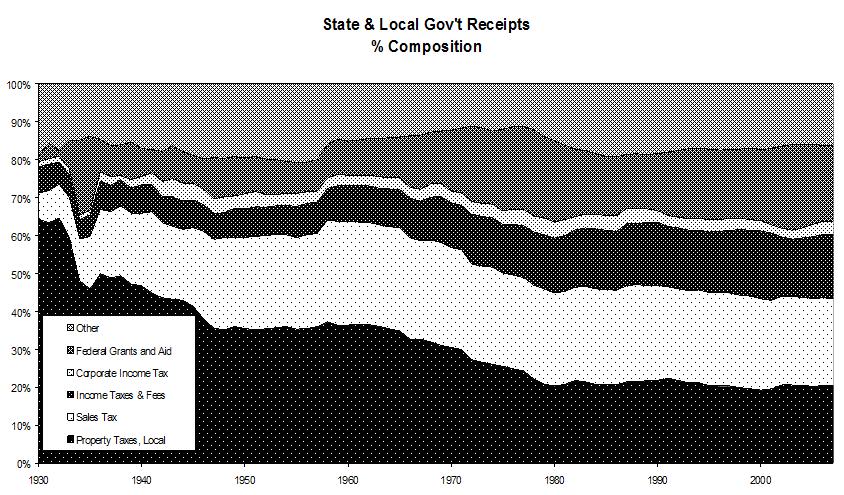
states and cities. The following chart from the National Income and
Product Accounts (NIPA, Table 3.3) shows how federal financial aid has
helped cities shift the tax burden off real estate, although the main
shift has been off property taxes onto income – and onto consumption
(sales) taxes.
State and local revenue, 1930-2007.
 Untaxing real estate has served mortgage bankers by freeing more rental income (the land’s site value) to be paid as interest. Property taxes have not absorbed anywhere near the rise in debt-leveraged housing and commercial prices. However, this has not lowered the cost of housing for most people. New buyers must pay a price that capitalizes the property’s rental value. Less and less of this payment has taken the form of local property taxes. More and more has been paid to mortgage lenders as interest. So cutting property taxes has simply left more revenue to be capitalized into higher debt-financed prices. While homeowners saw their carrying charges rise, they nonetheless felt more affluent as real estate prices rose – inflated on easier and easier credit terms. Prices rose faster than mortgage debt as long as (1) interest rates were declining; (2) loan maturities were stretched out (ultimately reaching the point of zero amortization rather than the old-fashioned 30-year self-amortizing mortgages); (3) down payments were shrinking toward zero (rather than requiring 20 percent equity as used to be the case) and indeed as “liars’ loans” led prices to be bid up recklessly; and finally (4) cities refrained from raising property taxes as fast as market prices were rising. This left more revenue to be capitalized into higher prices, providing capital gains that home owners were encouraged to treat like “money in the bank” – by taking out home equity loans. This rising mortgage debt was increasingly important in enabling people to maintain their living standards, especially as they had to pay more for housing. So what appeared to be affluence and rising net worth from the value of one’s home on the asset side of the balance sheet found its counterpart in debt on the liabilities side. From the local fiscal vantage point, these debt-leveraged price gains represented uncollected user fees for the site value provided by public infrastructure and rising prosperity. The bankers ended up with the rising flow of rental value, not the cities. This obliged tax collectors to look to other sources of revenue. So homeowners paid out what they seemed to be saving in modest property taxes in the form of rising sales taxes and income taxes. By 2008 these financial system’s easing of credit terms had reached its limit. No more room for credit inflation remained, so speculators began to withdraw from the market. (They accounted for about one-sixth of demand for housing.) When the credit spigot was turned off, prices plunged – leaving the debts in place. (So taking out a home-equity mortgage was not really like drawing down money from a piggy bank after all. Years of future income had to be diverted to spend for past shortfalls.) Now that federal aid is falling – along with revenue from sales and income taxes – local budgets are falling into deficit. But for many cities and states, their constitutions and regulations prevent them from running deficits. So they face a number of hard choices. It is hard to raise property taxes back toward earlier rates, because the rental income already has been pledged to the mortgage bankers. To tax heavily indebted property would lead to more foreclosures and abandonment. And the Obama Administration’s hope that banks somehow will use the Federal Reserve’s tsunami of cheap (0.25%) reserves and credit to re-inflate a new real estate bubble is in vain, because bankers have little interest in lending to property that is still sinking in market price. It is easier to speculate on interest-rate arbitrage with the BRICS and get a foreign-exchange premium as well, or simply to play the market. Banks report winnings in the derivatives trade day after day, with nary a loss – an indication of how poorly their hapless customers and other outsiders must be doing! So the path of least resistance for most cities and states is to cut back spending on public services, and above all on pension plan contributions. The ultimate sacrifice (and the aim of financial predators) is to sell off public land and buildings, roads and other transportation services, sewer systems and other basic infrastructure. In this aim, the investment bankers are being aided and abetted by the credit ratings industry, threatening to downgrade cities that do not sell off their public domain. In this respect the financial end-game of privatization is similar in the United States to pressures by the European Central Bank to force the indebted PIIGS economies to engage in privatization sell-offs, Third World and post-Soviet style. Just as in Europe, when revenues are squeezed and something must give – either debt service, payment to pensioners or current payments to labor – the financial sector is seeking to take all the available surplus for itself. This puts creditors in the forefront of today’s class war against labor. On the eve of the September 2008 financial crash, cities such as Birmingham, Alabama and Chicago already were looking for ways to cope with the fiscal squeeze imposed by political pressures from the major local campaign contributors – the real estate and banking sectors – to cut property taxes. One seeming path of little resistance was to gamble in the Wall Street financial casino, hoping to make easy gains rather than making landlords, wage earners or consumers pay higher taxes. Landlords and bankers encouraged this speculation as an alternative to taxing property. Landlords wanted to pay less in property taxes, and banks knew that whatever rental value buyers could save in the form of lower taxes would end up being used to bid up prices to capitalize into debt service for mortgages to buy properties up for sale. Here is the dilemma that states and cities now face: So much urban property is sinking into negative equity territory that a rise in property taxes will lead to even more foreclosures and abandonments, and hence even lower fiscal returns. To avoid this, cities are seeing Chapter 9 bankruptcy as the main route to free themselves, especially from problems that stem from an unwarranted trust in bankers to help them out of the earlier fiscal squeeze by putting them into losing financial gambles. Orange County in California successfully sued Merrill Lynch to recover damages, and Birmingham also was awarded recovery payments from JP Morgan Chase.
Birmingham and Chicago as microcosms of the national debt squeeze
Now that financial fraud has been decriminalized for all practical purposes, most financial victims are obliged to sue for reimbursement in civil court without much help from prosecutors. Alabama’s state capital Birmingham is a case in point. After a predatory financing arrangement to upgrade its sewers in 2008 forced its Jefferson County into bankruptcy, the Securities and Exchange Commission (S.E.C.) negotiated $75 million in fines and reimbursement of fees to be paid by JP Morgan Chase as lead lender and negotiator for the complex interest-rate swaps they had advised the country to take, ostensibly to protect its economic interest. The banks also forfeited nearly ten times this sum ($647 million) in termination fees. But the court-appointed receiver grabbed the $75 million settlement for payment on the debts the country still owed. As usual, the banks had paid the fine and made reimbursement without admitting any wrongdoing. To the financial sector, deception and fraud is part of the game, after all, not a tactic that can be prosecuted as criminal. They paid their fines without admitting any wrongdoing, and without even admitting the S.E.C. charges. They merely paid up and kept silent – while the Justice Department and Internal Revenue Service were still in the time-taking process of ruling on legal claims brought by Jefferson County. The case prompted bankers and bondholders to bring pressure on the state of Alabama to take responsibility (that is, take on the debt liability) all on behalf of statewide taxpayers, and to demand that all lawsuits brought for financial fraud to be dropped.[1] “Responsibility” is supposed to be only for debtors, not for the financial sector itself. This is how the banks have managed to rewrite the laws, after all. Jefferson County is now debating whether to declare Chapter 9 bankruptcy to free itself from debts that can be paid only at the cost of disrupting economic continuity and living standards. The city’s debt quandary is a microcosm for the U.S. economy as a whole. Its lowest-income residents are burdened with financialized charges for sewer-system debt payments so far beyond their ability to pay that they face the same fate as Latvians, Irish and Greeks: As the local economy shrinks, they must move in order to find jobs – in places less debt-burdened and hence lower-cost. The “free market” choice is to emigrate to flee the debts imposed on their economies and on themselves personally. Well-to-do Birmingham families have yards large enough to have their own septic tanks as an alternative to paying for access to sewers, but lower-income families living in small houses or apartment buildings lack this option. One county commissioner asked: “Why should the poor have to pay for the ill-gotten gain of some of these banks who poisoned the well in the very first place?”[2] Other commissioners demanded that bondholders “bear the entire cost of a $20 million fund that is being created to help low-income residents pay their sewer bills.”[3] But the government usually provides relief only for creditors – above all, relief from criminal prosecution for their business plan that involved making loans beyond the debtors’ ability to pay. Some states have fraudulent conveyance laws to prevent this, as well as to prevent banks from misrepresenting the quality of their loans to outside investors. There are laws to punish appraisers who give false appraisals, and mortgage brokers who fill in false income reports to qualify for loans. But the S.E.C. has seen its staff and budget slashed and deregulators appointed to oversee its affairs. It has no authority to prosecute, only to make recommendations to the Justice Department, where Attorney General Eric Holder has followed the Obama Administration’s support of Wall Street, feeling no obligation to live up to the promises to make that a change from the Bush Administration’s similar lax behavior. The financial sector recognizes a dimension of economic behavior that textbooks politely refrain from citing: the ability to capture regulatory agencies, gain control of the courts and buy control of politics. The Supreme Court has ruled that corporations have the same rights as individuals to contribute to campaigns, a euphemism for buying the loyalty of politicians and judges, and obtaining veto power over regulatory appointees. Corporations pay lower income-tax rates and are free of value-added and excise or other sales taxes paid by consumers. Unlike real people, corporations cannot be sent to jail. Corporate shells shield owners and managers from criminal prosecution for the wholesale frauds that have left Countrywide Financial, Bank of America, Citibank, JP Morgan Chase and other pillars of the banking community free to make civil settlements for deceptive policies without admitting wrongdoing. And whereas individual crooks need to pay their own lawyers, corporations pick up the tab for their managers, while contributing generously to politicians who rewrite the laws to decriminalize fraud and deceptive business dealing. The corporate-backed media applaud politicians who insist that families “take responsibility” for their unemployment risk, debts and health care – while bailouts free the wealthy from having to suffer losses on bad loans. Rhode Island recently rewrote its laws to place bondholders ahead of other creditors, including pension recipients. Under the new law, “city officials who intentionally fail to pay bondholders can be removed from office or held personally liable for the payments.”[4] In contrast to the pro-debtor trend of legislation since the 13th century, wealth at the top of the pyramid takes precedence over retired schoolteachers and other public employees. The effect has been for the city of Central Falls, Rhode Island, to seek Chapter 9 bankruptcy protection to avert a 34 percent cut in pensions to its retirees in order to pay bondholders. Rhode Island is not alone in giving legal priority to bondholders. “Illinois has some of the strongest bondholder protections anywhere, which explains how a state that began its fiscal year with $3.8 billion in unpaid bills from last year – and whose pension system has less than half of the money it needs – is able to keeping selling bonds. State law requires Illinois to make ‘an irrevocable and continuing appropriation’ of tax revenues into a special fund every month that can be used only to pay bondholders.”[5] Chicago has balanced its budget not by taxing finance and real estate gains, but by selling off its roads and other basic infrastructure. Much as in feudal Europe, the leverage is financial. Privatizers are charging tolls and even installing parking meters on the city’s sidewalks to charge cars for parking by the minute. New York City has slashed is public subway and bus service, extending commuting times and making life harder. It has privatized its television and radio, replacing public airtime with commercial advertising. The ending of federal revenue sharing will exacerbate local budget constraints. The fact that many cities and states have constitutional requirements of balanced budgets – just as Republicans advocated for the federal government in the 2011 debt-ceiling agreement – requires that taxes be raised, public services cut, or assets sold off. California’s Proposition 13 prevents the state from raising property taxes in keeping with market prices, tying its hands fiscally and obliging it to commercialize its once-great university system. Students must now take on enormous education debt for what formerly was free or subsidized. New York City’s real estate tax likewise favors large investors and wealthy homeowners, at the expense of co-ops and condominium owners in apartment buildings. The rising rental value that local tax collectors relinquish does not lower housing costs; it merely enables the land’s site value to be paid to bankers. Rising debt-inflated housing prices have priced the city out of the market as the manufacturing center it formerly was. Its textile buildings and other industrial properties have been gentrified, leaving it a one-industry (finance) town focused on Wall Street. At the international level, Irish voters confirmed the policy of taking bad European Central Bank advice to put the interest of bondholders first by taking bad bank loans onto the government’s balance sheet and taxing the population to make up the losses, even at the cost of imposing a generation of debt-strapped depression on their economy. This is the self-destructive road to debt peonage that the IMF and World Bank forced Third World countries to follow for many decades. The fact that this ethic reverses centuries-long social values promises to make the great debate of the 21st century over the issue of which debts are paid and which will not be – and how much debts should be written down. Notes [1] Mary Williams Walsh, “A County in Alabama Puts Off Bankruptcy,” The New York Times, August 13, 2011.
[2] Michael Corkery and Kelly Nolan, “Alabama Bankruptcy Fight Hinges on Sewer-Rate Increase; Impact on Poor Bedevils Deal,” Wall Street Journal, August 11, 2011.
[3] Michael Corkery and Michael Aneiro, “Alabama County Rejects Creditor Plan but Delays Bankruptcy Decision,” Wall Street Journal, August 13, 2011.
[4] Michael Corkery, “Bondholders Win in Rhode Island,” Wall Street Journal, August 4, 2011.
[5] Mary Williams Walsh and Michael Cooper, “Faltering Rhode Island City Tests Vows to Pensioners,” The New York Times,
August 13, 2011. The article adds that: “The federal bankruptcy code
says pensioners and general-obligation bondholders are both unsecured
creditors, stuck at the back of the line and treated as equals. But
there is maneuvering room in the welter of state and federal laws.”
| |
ALEC Recommendation: The legislature should require each agency to have a mission statement with goals and objectives linked to the state’s core functions of government.
ALEC Recommendation: States should adopt a Budgeting for Outcomes (BFO) approach to bring sanity and fiscal sustainability to the state budget process.
ALEC Recommendation: States should create a permanent sunset review commission to recommend ways the state can cut costs, reduce waste, and improve efficiency and service levels.
ALEC Recommendation: Adopt a state hiring freeze encompassing all departments.
ALEC Recommendation: Policymakers should delay automatic pay increases for state employees until the rising costs of government are brought under control.
ALEC Recommendation: Increase the use of privatization and competitive contracting to execute tasks to lower costs and improve the quality of service provided.
ALEC Recommendation: Develop a program (or programs) for state employees to allow them to be rewarded for savings generated by new innovations or re-engineering of existing business practices.
ALEC Recommendation: States should adopt a constitutional revenue or spending limit. Such a limit would impose much needed discipline on profligate spending patterns.
ALEC Recommendation: Pass a balanced budget requirement, mandating that the expenditures included in the budget for the next fiscal year shall not exceed estimated revenues, and create a protected emergency reserve account.
Name | Office | ALEC Task Force |
Carol McFarlane | Minnesota Representative | Education 651 296-3135 |
Chris Gerlach | Minnesota Senator | Commerce, Insurance, and Economic Development Task Force 651 296 4120 (majority whip) 651 296 4120 |
Michael L. Beard | Minnesota Representative | Commerce, Insurance, and Economic Development Task Force 651 296 5377 |
Gen Olson | Minnesota Senator | Education W651 296-1282 H952-472-3306 |
Pat Garofalo | Minnesota Representative | Education 651 296 1069 |
Sondra L. Erickson | Minnesota Representative | Education ) 651 296 6746 |
Gretchen Hoffman | Minnesota Senator | HHS 651 296 6746 |
Paul Anderson | Minnesota Representative | HHS 651 296 4317 (h) 320 239 2726 |
Mary Kiffmeyer | Minnesota Representative | International Relations Task Force (see above) |
Matt Dean | Minnesota Representative | International Relations Task Force 651 296 3018 |
Roger C. Chamberlain | Minnesota Senator | Public Safety and Elections Task Force 651 296 1253 |
Ron Shimanski | Minnesota Representative | Public Safety and Elections Task 651 296 1534, (h) 320 0112 |
Ted Daley | Minnesota Senator | Public Safety and Elections Task Force 651 296 2907 (h) 763 784 8822ce |
Linda Runbeck | Minnesota Representative | Tax and Fiscal Policy Task Force 651 296 2907 (h) 763 784 8822 |
Pam Myhra | Minnesota Representative | Tax and Fiscal Policy Task Force 651 296 2907 |
Bruce D. Anderson | Minnesota Representative | Telecommunications and IT Task Force 651-296 5063 |
Connie Doepke | Minnesota Representative | Telecommunications and IT Task Force 651 296 4315 |
Mike Parry | Minnesota Senator | Telecommunications and IT Task Force- 651 296 9457 |
Steve Drazkowski | Minnesota Representative | Civil Justice ) 651 296 2273, (h) 507 843 3711 |

