USuncutMN says: Tax the corporations! Tax the rich! Stop the cuts, fight for social justice for all. Standing in solidarity with http://www.usuncut.org/ and other Uncutters worldwide. FIGHT for a Foreclosure Moratorium! Foreclosure = homelessness. Resist the American Legislative Exchange Council, Grover Norquist and Citizen's United. #Austerity for the wheeler dealers, NOT the people.


We Are The 99% event

USuncutMN supports #occupyWallStreet, #occupyDC, the XL Pipeline resistance Yes, We, the People, are going to put democracy in all its forms up front and center. Open mic, diversity, nonviolent tactics .. Social media, economic democracy, repeal Citizen's United, single-payer healthcare, State Bank, Operation Feed the Homeless, anti-racism, homophobia, sexISM, war budgetting, lack of transparency, et al. Once we identify who we are and what we've lost, We can move forward.


Please sign and SHARE

Showing posts with label income disparity. Show all posts

Friday, May 4, 2012

DAVID GRAEBER: New police strategy in NYC sex ASSAULT

http://www.nakedcapitalism.com/2012/05/david-graeber-new-police-strategy-in-new-york-sexual-assault-against-peaceful-protestors.html


David Graeber: New Police Strategy in New York – Sexual Assault Against Peaceful Protestors

By David Graeber, a Reader in Social Anthropology at Goldsmiths, University of London, and an author and activist currently based in New York
A few weeks ago I was with a few companions from Occupy Wall Street in Union Square when an old friend — I’ll call her Eileen — passed through, her hand in a cast.
“What happened to you?” I asked.
“Oh, this?” she held it up. “I was in Liberty Park on the 17th [the Six Month Anniversary of the Occupation]. When the cops were pushing us out the park, one of them yanked at my breast.”
“Again?” someone said.
We had all been hearing stories like this. In fact, there had been continual reports of police officers groping women during the nightly evictions from Union Square itself over the previous two weeks.
“Yeah so I screamed at the guy, I said, ‘you grabbed my boob! what are you, some kind of fucking pervert?’ So they took me behind the lines and broke my wrists.”

Actually, she quickly clarified, only one wrist was literally broken. She proceeded to launch into a careful, well-nigh clinical blow-by-blow description of what had happened. An experienced activist, she knew to go limp when police seized her, and how to do nothing that could possibly be described as resisting arrest. Police dragged her, partly by the hair, behind their lines and threw her to the ground, periodically shouting “stop resisting!” as she shouted back “I’m not resisting!” At one point though, she said, she did tell them her glasses had fallen to the sidewalk next to her, and announced she was going to reach over to retrieve them. That apparently gave them all the excuse they needed. One seized her right arm and bent her wrist backwards in what she said appeared to be some kind of marshal-arts move, leaving it not broken, but seriously damaged. “I don’t know exactly what they did to my left wrist—at that point I was too busy screaming at the top of my lungs in pain. But they broke it. After that they put me in plastic cuffs, as tightly as they possibly could, and wouldn’t loosen them for at least an hour no matter how loud I screamed or how much the other prisoners begged them to help me. For a while everyone in the arrest van was chanting ‘take them off, take them off’ but they just ignored them…”
On March 17, several hundred members of Occupy Wall Street celebrated the six month anniversary of their first camp at Zuccotti Park by a peaceful reoccupation of the park—a reoccupation broken up within hours by police with 32 arrests. Later that evening a break-away group moved north, finally establishing itself on the southern end of Union Square, two miles away, even sleeping in park—though the city government soon after decided to defy a century-old tradition and begin closing the park every night just so they would not be able to establish a camp there. Since then, occupiers have taken advantage of past judicial rulings to continue to sleep on sidewalks outside the park, and more recently, on Wall Street itself.
During this time, peaceful occupiers have been faced with continual harassment arrests, almost invariably on fabricated charges (“disorderly conduct,” “interfering with the conduct of a police officer”—the latter a charge that can be leveled, for instance, against those who try to twist out of the way when an officer is hitting them.) I have seen one protestor at Union Square arrested, by four officers using considerable force, for sitting on the ground to pet a dog; another, for wrapping a blanket around herself (neither were given warnings; but both behaviors were considered too close to “camping”); a third, an ex-Marine, for using obscene language on the Federal steps. Others were reportedly arrested on those same steps for singing a satirical version of the “Officer Krumpke” song from West Side Story. Almost no march goes by without one or two protestors, at least, being hurled against vehicles or have their heads bashed against the ground while being arrested for straying off the sidewalk. The message here is clear. Law has nothing to do with it. Anyone who engages in Occupy Wall Street-related activity should know they can be arrested, for virtually any reason, at any time.
Many of these arrests are carried out in such a way to guarantee physical injury. The tone was set on that first night of March 17, when my friend Eileen’s wrists were broken; others suffered broken fingers, concussions, and broken ribs. Again, this was on a night where OWS actions were confined to sitting in a park, playing music, raising one or two tents, and marching down the street. To give a sense of the level of violence protestors were subjected to, during the march north to Union Square, we saw the first major incident of window-breaking in New York. The window in question was broken not by protestors, but by police—using a protestor’s head. The victim in this case was a street medic named José (owing to the likelihood of physical assault and injuries from police, OWSers in New York as elsewhere have come to carry out even the most peaceful protests accompanied by medics trained in basic first aid.) He offered no resistance.
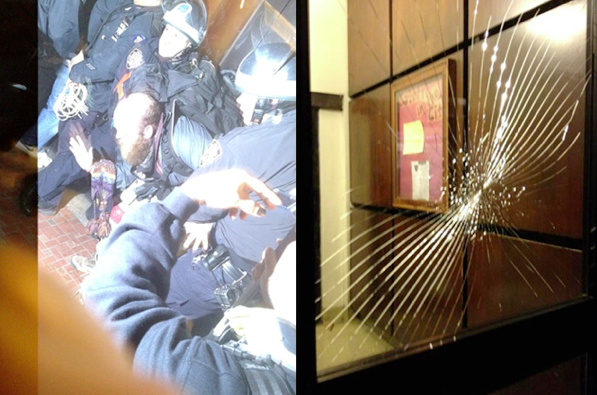
Here is a video of the incident. The window-breaking begins at 3:45.
Police spokesmen later claimed this incident was a response to a bottle that was hurled at a police vehicle used to transport arrestees. Such claims are made almost automatically when videos appear documenting police assaults on non-violent protestors, yet, despite the presence of cameras everywhere, including those wielded by the police themselves, no actual documentation of any such claims ever seems to appear. This is no exception. In fact numerous witnesses confirmed this simply isn’t true, and even if a bottle had been thrown at an armored vehicle, not even the police have suggested they had any reason to believe the medic whose head was smashed into the window was the one who threw it.
Arbitrary violence is nothing new. The apparently systematic use of sexual assault against women protestors is new. I’m not aware of any reports of police intentionally grabbing women’s breasts before March 17, but on March 17 there were numerous reported cases, and in later nightly evictions from Union Square, the practice became so systematic that at least one woman told me her breasts were grabbed by five different police officers on a single night (in one case, while another one was blowing kisses.) The tactic appeared so abruptly, is so obviously a violation of any sort of police protocol or standard of legality, that it is hard to imagine it is anything but an intentional policy.
For obvious reasons, most of the women who have been victims of such assaults have been hesitant to come forward. Suing the city is a miserable and time-consuming task and if a woman brings any charge involving sexual misconduct, they can expect to have their own history and reputations—no matter how obviously irrelevant—raked over the coals, usually causing immense damage to their personal and professional life. The threat of doing so operates as a very effective form of intimidation. One exception is Cecily McMillan, who was not only groped but suffered a broken rib and seizures during her arrest on March 17, and held incommunicado, denied constant requests to see her lawyer, for over 24 hours thereafter. Shortly after release from the hospital she appeared on Democracy Now! And showed part of a handprint, replete with scratch-marks, that police had left directly over her right breast. (She is currently pursuing civil charges against the police department):

I’d like to emphasize this because when I first mention this, the usual reaction, from reporters or even some ordinary citizens, is incredulity. ‘Surely this must be a matter of a few rogue officers!’ It is difficult to conceive of an American police commander directly telling officers to grope women’s breasts—even through indirect code words. But we know that in other countries, such things definitely happen. In Egypt, for example, there was a sudden spate of sexual assaults by security forces against protestors in November and December 2011, and followed a very similar pattern: while women activists affirmed there had been beatings, but relatively few specifically sexual assaults during the height of the protests, starting in November, there were dozens of reports of women being groped or stripped while they were being beaten. The level of the violence in Egypt may have been more extreme, but the circumstances were identical: an attempt to revive a protest movement through re-occupation is met by a sudden ratcheting up of tactics by the security forces, and in particular, the sudden dramatic appearance of a tactic of sexual attacks on women. It is hard to imagine in either case it was a coincidence. In Egypt, no serious observer is even suggesting that it was.
Of course we cannot how such decisions are made, or conveyed; in fact, most of us find it unpleasant even to contemplate the idea of police officials ordering or encouraging sexual assault against the very citizens they are sworn to protect. But this seems to be precisely what is happening here.
.
For many, the thought of police officials ordering or condoning sexual assault—even if just through a nod or a wink—seems so shocking that absolute proof would be required. But is it really so out of character? As Naomi Wolf has recently reminded us, the US security apparatus has long “used sexual humiliation as a tool of control.” Any experienced activist is aware of the delight police officers so often take in explaining just how certainly they will be raped if placed in prison. Strip searches—which the Supreme Court has recently ruled can be deployed against any citizen held for so much as a traffic violation—are often deployed as a tool of humiliation and punishment. And one need hardly remark on well-documented practices at Guantanamo, Bagram, or Abu Ghraib. Why target women in particular? No doubt it’s partly simply the logic of the bully, to brutalize those you think are weak, and more easily traumatized. But another reason is, almost certainly, the hope of provoking violent reactions on the part of male protestors. I myself well remember a police tactic I observed more than once during the World Economic Forum demonstrations in New York in 2002: a plainclothes officer would tackle a young female marcher, without announcing of who they were, and when one or two men would gallantly try to come to her assistance, uniforms would rush in and arrest them for “assaulting an officer.” The logic makes perfect sense to someone with military background. Soldiers who oppose allowing a combat role for women almost invariably say they do so not because they are afraid women would not behave effectively in battle, but because they are afraid men would not behave effectively in battle if women were present—that is, that they would become so obsessed with the possibility of women in their unit being captured and sexually assaulted that they would behave irrationally. If the police were trying to provoke a violent reaction on the part of studiously non-violent protestors, as a way of justifying even greater brutality and felony charges, this would clearly be the most effective means of doing so.
There’s a good deal of anecdotal evidence that would tend to confirm that this is exactly what they are trying to do. One of the most peculiar incidents took place on a recent march in New York where police seem to have simulated such an assault, arresting a young women who most activists later concluded was probably an undercover officer (no one had seen her before or has seen her since), then ostentatiously groping her as she was handcuffed. Reportedly, several male protestors had to physically restrained (by other protestors) from charging in to help her.
Why is all this not a national story? Back in September, when the now famous Tony Bologna arbitrarily maced several young women engaged in peaceful protest, the event became a national news story. In March, even while we were still hearing heated debates over a single incident of window-breaking that may or may not have been by an OWS activist in Oakland four months earlier, no one seems to have paid any significant attention to the first major incident of window-breaking in New York—even though the window was broken, by police, apparently, using a non-violent protestors’ head!
I suspect one reason so many shy away from confronting the obvious is because it raises extremely troubling questions about the role of police in American society. Most middle class Americans see the primary role of police as maintaining public order and safety. Instances when police are clearly trying to foment violence and disorder for political purposes so fly in the face of everything we have been taught that our instinct is to tell ourselves it isn’t happening: there must have been some provocation, or else, it must have just been individual rogue cops. Certainly not something ordered by the highest echelons. But here we have to remember the police are an extremely top-down, centralized organization. Uniformed officers simply cannot behave in ways that flagrantly defy the law, in full public view, on an ongoing basis, without having at least tacit approval from those above.
In this case, we also know precisely who those superiors are. The commander of the First Precinct, successor to the disgraced Tony Bologna, is Captain Edward J. Winski, whose officers patrol the Financial District (that is, when those very same officers are not being paid directly by Wall Street firms to provide security, which they regularly do, replete with badges, uniforms, and weapons). Winski often personally directs groups of police attacking protestors:

Winsky’s superior is Police Commissioner Raymond Kelly, former director of global security of the Wall Street firm Bear Stearns:
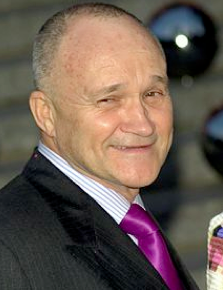
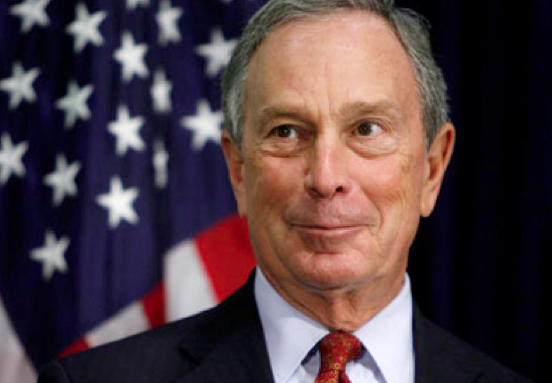
And Kelly’s superior, in turn, is Mayor Michael Bloomberg – the well-known former investment banker and Wall Street magnate. The 11th richest man in America, he has referred to the New York City Police Department as his own personal army:
One of the great themes of Occupy Wall Street, of course, is the death of US democracy—the near-total capture of our political system by Wall Street firms and the financial power of the 1%. In the beginning the emphasis was on political corruption, the fact that both parties so beholden to the demands of Wall Street and corporate lobbyists that working within the political system to change anything has become simply meaningless. Recent events have demonstrated just how much deeper the power of money really goes. It is not just the political class. It is the very structure of American government, starting with the law and those who are sworn to enforce it—police officers who, as even this brief illustration makes clear, are directly in the pay of and under the orders of Wall Street executives, and who, as a result, are willing to systematically violate their oaths to protect the public when members of that public have the temerity to make a public issue out of exactly these kind of arrangements.
As Gandhi revealed, non-violent protest is effective above all because it reveals how power really operates: it lays bare the violence it is willing to unleash on even the most peaceful citizens when they dare to challenge its moral legitimacy. And by doing so, it reveals the true moral bankruptcy of those who claim authority to rule us. Occupy Wall Street has demonstrated this time and time again. What the current spate of assaults shows is just how low, to what levels of utter moral degradation, such men are really willing to sink.
Update (3:40 PM): In comments, a reader asked why I did not go to the media. My response:
To be honest my first impulse was to call a sympathetic Times reporter. He said he was going to see if he could spin a story out of it. Apparently his editors told him it wasn’t news.

Friday, March 30, 2012

Livable4All quicklinks


2012 May 3-5 Toronto - BIEN Congress
See BIEN blog for International Basic Income News
Alberto Cottica - Basic Income as Innovation Policy - Feb. 2012
Basic Income - An Idea to Bring Stability to our Economies - Dec.2011 
Germany - Pirate Party with Basic Income Platform wins 15 seats - Dec.2011
A Basic Income Grant for paupers and vagabonds - NZ Dec.2011
Policy Options Article on Manitoba Mincome pilot project Sept 2011
A Town With No Poverty - 2011
Latin America: Income Security For AllCanadian Senator Hugh Segal on Poverty and guaranteed income (youtube)
The Economics of PROUT (video 2011)
Technological Unemployment - 2011
Through the eyes of a benefit advisor (UK)- 2011
Economic Growth Won't Save Us (IE) - 2011
What is Money - Podcast 2011
Occupy Wall Street Forum on Basic Income - 2011
BINews - OWS sparks BIG Interest -2011
RB Blog - Parsing the Data and Ideology 'we are the 99%'-2011
Favorites
Dr. Martin Luther King Jr. advocates guaranteed income
in his 
1968 book Chaos or Community.
Audio of MLK's speech on youtube -
Getting paid in our Jobless Future - James Hughes 2003
Embrace the End of Work - James Hughes 2004 The Coming Swarm Economy - Rick Falkvinge - 2011Feeding the World is Easy - Colin Tudge (audio)Economic Foundations and Environmental Progress (video 2010)Is the Financial System One Giant Pyramid Scheme? - 2010Bailout for the People Richard C. Cook - 2009Extraordinary Discourse - weekly podcast 2011Separating Survival from Work - Jim Smith 1996In Praise of Idleness - Bertrand Russell 1932
Operation Basic Income - Anonymous 2011
Anxiety Culture 
Livable4All Channel on Youtube
Around the World
ScotlandThe Future of Social Security Policy: Women, Work and
A Citizens Basic Income
 
(book on Basic Income by Ailsa McKay)
Germany
Pirate Party & Basic Income - 2011
Make way for the Pirates - 2011
Grundeinkommen 

German translation of Martin Luther King Jr.
on Guaranteed Annual Income
European Anti-Poverty Network
(guaranteed adequate minimum income)
European Union - GLI
Belgium
Vivant

Automation
Technological Unemployment - 2011
Robotic Nation - Marshal Brain Manna - Marshal Brain Getting paid in our Jobless Future - James Hughes
Embrace the End of Work - James Hughes

Thinking Out Loud (basic income in last paragraph)

Helen Keller: Put your husband in the kitchen 1932
"is it too much to expect that our ingenuity can reorganize our economic system
to take advantage of the machines which we have created?...
if [men] are unable to accomplish the task, we women shall have to send them
into the kitchen for a few lessons in common-sense economics."
See also articles section 

Audio
The World Owes You a Living - 6 CD audio collage challenging the work ethic and the harm that it has caused and advocating guaranteed income.

Video

Interviews with Jacque Fresco (Future by Design)
Green Party Leader Canada -
Archbishop Desmond Tutu on Basic Income -
In Debt we Trust -
Guy Standing on Working TV
(note: even though he is a founder and co-chair of the Basic Income Earth Network, he does not directly mention basic income in his 40 min. speech)
Women and Guaranteed income
Ending Women's Poverty Forum:
Sharon Yandle in segment six, talks about guaranteed livable income. 2004
Related Topics
E.F. SchumacherThe Canadian Clearances: CBC Ideas (no longer online - PDF catalogue - Jan. 4, 06)
Challenges the idea of "productivity" and how small farmers are being pushed off the land.
Winston Churchill on Land Monopoly

Family Allowance (none) - US
 
South Park Episode 1303 Margaritaville
(comic lesson on banks and economics)
Jobs vs. Life
Nowtopia
 

Full Enjoyment not Full Employment
 

"we have no desire to work a single hour producing stupid, useless junk, and that all production needs to be re-examined from the standpoint of our real needs and desires" 


Work is a Four Letter Word
 - Alan B.

Chronic Stress and Coping with Denial

The World Owes You a Living
 (A labyrinthian site full of images, poems & writings and scathing and humourous critiques of the scourge of the "job." See links, what is productiveparasites, otheressays.)

Sunday, March 25, 2012

MIT Economist: Income Inequality In The U.S. Is Crushing The Middle Class’ Political Power


MIT Economist: Income Inequality In The U.S. Is Crushing The Middle Class’ Political Power

By Pat Garofalo on Mar 23, 2012 at 5:55 pm 

Thanks in large part to the Occupy Wall Street movement, the debilitating effects of income inequality have been hoisted into the national spotlight. But in addition to killing economic growthand economic mobility, income inequality also exacerbates political inequality.
Today, ThinkProgress spoke with MIT economistDaron Acemoglu, whose new book, Why Nations Fail(co-written by James Robinson), looks at the effect politics and policy have on economic growth and prosperity. Acemoglu said that he believes the most “pernicious” effect of income inequality is that it drains political power from lower- and middle-class Americans and allows the richest to then begin “changing the rules in their favor”:

I think there’s a lot of debate about the economic impact of income inequality. There’s literature on how greater inequality might slow economic growth because it creates a less conducive environment for consumer demand or credit. But at the end, my view, and that of our book with James Robinson, is that the more pernicious effect of economic inequality comes indirectly through its impact on political inequality. it’s a general pattern throughout history, and we see around today, that when economic inequality increases, the people who have become economically more powerful will often attempt to use that power in order to gain even more political power. And once they are able to monopolize political power, they will start using that for changing the rules in their favor. And that sort of political inequality is the real danger that’s facing the United States.
Watch it:
Acemoglu added that the Supreme Court’s decision in Citizens United and the growth in Super PAC spending are only going to make this problem worse by increasing the importance of money in politics. “We already had a very serious problem,” he said. “Instead of trying to stem that tide, we’ve done the opposite and we’ve now opened the sluice gate and said you can use that money with no restrictions whatsoever.” According to calculations by Council of Economic Advisers chairman Alan Kruegar, the shift in income inequality over the last three decades has been the equivalent of moving $1.1 trillion of income from the 99 percent to the top 1 percent every single year.


Sunday, December 18, 2011

Our Unrepresentative Representation

Our Unrepresentative Representation

Sunday, 18 December, 2011 08:28 Written by Dr. Art Kamm

Summary
The Occupy Wall Street movement has reason to protest.  Special interest-driven deregulation policy was at the heart of the recent economic collapse.  It has been the “99%” that has paid the price for this policy failure with lost employment, devalued housing prices, retirement accounts being cut in half, and increased levels of poverty while the wealthiest in America continued to do well.  A valid question is why our elected representatives are not working together to put a stop to failed policy that has been so damaging to the majority of Americans.  This article will examine the disproportionate number of the wealthy who hold elected office in Washington and the conflict of interest they face in setting policy versus their own financial interests as well as the special interests that finance their campaigns.  And it will explore an incentive that politicians have to stay in office where they can act on non-public information to their own financial benefit.  It examines the issue of whether our Congress has become ‘Our Unrepresentative Representation’.
Policy Was at the Heart of the Great Recession
Alan Greenspan, who presided over the Federal Reserve for 18 years before stepping down in 2006, was one of our nation’s leading voices for deregulation.  He was considered an economic sage whose words affected market direction and, as noted by Bob Woodward, was celebrated as the “Maestro” (ref).   Yet, it was a humbled Alan Greenspan who admitted before Congress in 2008 that his belief in deregulation had been shaken (ref).  ”Those of us who have looked to the self-interest of lending institutions to protect shareholders’ equity, myself included, are in a state of shocked disbelief” he relayed to the House Committee on Oversight and Government Reform.  Henry Waxman, chair of the committee, asked “Do you feel that your ideology pushed you to make decisions that you wish you had not made?”  Mr. Greenspan’s responded “Yes, I’ve found a flaw…I’ve been very distressed by that fact”.
When the Fed cut interest rates to near record lows from 2001 until mid-2004, housing prices climbed far faster than inflation or household income giving rise to concerns of a speculative bubble in both home prices and construction that would go bust; concerns that were ignored and calls for tighter regulation on subprime mortgages and other high risk mortgages were resisted.  Republican lawmakers tried to blame the mortgage meltdown on Fannie Mae and Freddie Mac claiming that Democratic lawmakers blocked measures to reform the companies.  Greenspan disagreed placing far more blame on Wall Street companies that bundled subprime mortgages into pools and sold them as mortgage backed securities.  He stated that demand for these securities was so high that Wall Street companies pressured lenders to lower their standards and produce more “paper” (note the impact of repealing Glass-Steagall below).  Mr. Greenspan stated “The evidence strongly suggests that without the excess demand from securitizers, subprime mortgage originations (undeniably the source of the crisis) would have been far smaller and defaults accordingly far lower”.
A 2008 report published by the Organization for Economic Co-Operation and Development (OECD) agreed with Mr. Greenspan’s testimony.  The report concluded that the financial crisis originated from distortions and incentives created by policy actions and identified 2004 as being critical to causality (ref).
Quoting from that report:
“In 2004 four time specific factors came into play. (1) the Bush Administration ‘American Dream’ zero equity mortgage proposals became operative, helping low-income families to obtain mortgages; (2) the then regulator of Fannie Mae and Freddie Mac, the Office of Federal Housing Enterprise Oversight (OFHEO), imposed greater capital requirements and balance sheet controls on those two government- sponsored mortgage securitisation monoliths, opening the way for banks to move in on their “patch” with plenty of low income mortgages coming on stream; (3) the Basel II accord on international bank regulation was published and opened an arbitrage opportunity for banks that caused them to accelerate off-balance-sheet activity; and (4) the SEC agreed to allow investment banks (IB’s) voluntarily to benefit from regulation changes to manage their risk using capital calculations under the ‘consolidated supervised entities program’. (Prior to 2004 broker dealers were supervised by stringent rules allowing a 15:1 debt to net equity ratio. Under the new scheme investment banks could agree voluntarily to SEC consolidated oversight (not just broker dealer activities), but with less stringent rules that allowed them to increase their leverage ratio towards 40:1 in some cases.) The combination of these four changes in 2004 caused the banks to accelerate off-balance sheet mortgage securitisation as a key avenue to drive the revenue and the share price of banks….
“When OFHEO imposed greater capital requirements and balance sheet controls on Fannie and Freddie, banks that had been selling mortgages to them faced revenue gaps and an interruption to their earnings. Their solution was to create their own Fannie and Freddie look-alikes: the structured investment vehicles (SIVs) and collateralised debt obligation (CDOs). The influence of the controls affecting Federal Mortgage Pools and the corresponding response in private label RMBS is shown in Figure 2 [see report]. This new surge of RMBS caused by the Fannie- Freddie regulator was picked up much too late by Bank regulators to take effective action. ”
In the context of the above it is important to note some other deregulation (also, failure to regulate) policy decisions.  The banking industry had been seeking repeal of the Glass-Steagall Act since at least the 1980′s and it occurred in 1999 (ref).  Glass-Steagall was legislation that was put into place following the Great Depression that, amongst other things, separated commercial from investment banking to remove the conflict of interest inherent to an institution controlling both a commercial bank and an investment bank (note Greenspan’s testimony that investment banks were pressuring commercial lenders to issue more “paper”, i.e. risky mortgages, because of the high demand for mortgage-backed derivatives).  Also, there was CFTC’s failed attempt at regulating and bringing transparency to OTC derivatives in the late 1990′s thus allowing the market for those financial instruments to grow unregulated for the next ten years (ref).  These instruments, backed by risky assets, were at the heart of such dramatic failures as Bear Sterns and AIG.  And there was tax policy that contributed to pushing more income and wealth into a small sliver of our population when our economy is 70% personal consumption.


Reference for above figure (ref)
In both instances where 1% of our population held up to 24% of this nation’s income (prior to the Great Depression and Great Recession) our country experienced a severe economic downturn (ref).
Above figure from Krugman (ref).
And who paid the price for these failed policies?  It was those in what has been called the “99%” by the Occupy Wall Street movement.  Their purchasing power not keep pace with the growth of the economy.

Their homes losing value (most often the middle class’s key investment).  Their retirement accounts being cut in half.  And jobs disappearing as corporations cut back on expense to maintain profitability.  And this pain is being experienced while the richest of Americans quintupled their income during the heart of the Great Recession (ref) and millionaire households (the “1%”) hold a sum of wealth equivalent to almost three times the size of our national economy that is anticipated to double within the next decade as money makes money at historically low tax rates (ref).  And income from that wealth (dividends and capital gains) is not subject to payroll tax that supports programs that the rest of America depends on during their senior years (Social Security and Medicare).
And yet the drumbeat of deregulation and tax policy largely benefitting the wealthiest continues.  We continue to hear that it is not smart to tax our ‘job creators’; yet job creation in large part was anemic during 4 year periods where ‘trickle down’ policy was in place (ref).

* Total Non-Farm Payroll expressed in millions
The money we borrowed to support the tax benefit to the wealthiest (the debt being assumed by America’s taxpayers and future generations) went to support both ‘Wall Street’ and high growth business interests abroad (ref).  We continue to hear that regulation is stifling business, and yet it was deregulation of the financial industry that was at the heart of the financial crisis as noted by both Mr. Greenspan’s testimony as well as the OECD report (see above).  We continue to hear about privatizing Social Security; this after we have witnessed the level corporate risk taking that lead to the financial crisis Mr. Greenspan said left him in ‘shocked disbelief’.  And with an estimated 45,000 Americans dying each year (ref) (including over 2000 military veterans) due to a lack of access to essential care, those who are denied coverage are required to pay tax to support the healthcare benefits of our elected officials, the same officials who are accepting large sums of money from special interests opposed to universal coverage.
And there is question about the emotion underlying the Occupy Wall Street movement?
With these failed policies having caused so much pain for much of America, a fair question is why our elected representatives are not working together in putting a stop to this. They are after all our elected representation.  It is difficult to dismiss that many our elected officials face a conflict of interest regarding their charge to represent ‘the people’ versus their own financial self-interests as well as the special interests that carry them to office. This article will examine the disproportionate number of the wealthy who hold elected office in Washington and the conflict of interest they face in setting policy versus their own financial interests as well as the special interests that finance their campaigns.  And it will explore an incentive the wealthy have had for staying in office where they can act on non-public information to their own financial benefit.  It will explore whether our Congress has become our ‘unrepresentative representation’.

Unrepresentative Representation

Disproportionate Wealth
The Senate has been called a millionaires club (ref) with about half of its members holding that status.  In 2009 244 members of Congress were millionaires – 138 Republicans and 106 Democrats (ref).   However, a picture is worth a thousand words.  The following graphics were sent to me by one of my readers:


A significant imbalance exists (around 40- to 50-fold) regarding the number of millionaires holding elected office in Washington versus the general public.  The median American family had a net worth of $96,000 in 2009 per the Federal Reserve Board while the median net worth for members of the US House of Representatives and Senate was $725,000 and $2.4 million, respectively (ref).  The reference provides a list of the 20 wealthiest members of Congress based on 2009 reports, 10 Republican and 10 Democrats, with Representative Darrell Issa (R-California) holding the top spot with an average net worth of over $300 million dollars.

Special Interest Contributions
There is a high correlation between candidate spending and winning elected office (ref).  In the 2010, candidate spending correlated to success in 85% of House races and 83% of Senate races.  And historically the correlation has even been greater; in 2004; 98% of House seats and 88% of Senate seats went to the candidates who spent the most.  Why does this correlation exist?  Because candidate exposure is expensive.  Elections are won by the expensive tactic of manipulating high probability voters through repeated messaging over TV during prime time hours (information obtained from a political consulting group during my exploration of a Senate run).  The average cost of winning a Senate seat was $8.28 million in 2010 and $1.09 million for a House seat (ref).
Most self-financing candidates faltered in the 2010 cycle and significant investments from outside groups helped to elect more than 200 federal candidates.  ”In two-thirds of races where outside groups spent at least some money on advertisements and other political communications, the dollars spent supporting the winner, coupled with amounts spent opposing the loser, exceeded dollars spent supporting the loser or attacking the winner..” (ref).
As a candidate can not raise near enough within their own district to support an election effort, the vast majority of campaign contributions come from outside sources.  What follows for Representative Issa’s campaign contributions (Jan 2005 – Dec 2007) holds true for most elected officials.  Only 5% of his contributions came from within his district; 54% ($674,370) came from outside his state and 94% ($1,173,693) came from outside his district (ref).  The largest sum of out-of-state contributions came from the Washington DC area where special interest lobbying groups operate.

Conflicting Interests
Personal Wealth vs Tax Policy
Regarding the disproportionate number of the wealthy holding elected office, consider tax policy, especially capital gains and dividends.  Capital gains in the 1970′s were taxed at 35% (ref) and have since been lowered to the current 15% rate (ref).  Capital gains and dividends comprise a disproportionate amount of the income for the wealthy and, as Warren Buffet has noted, is responsible for the lower net income tax paid by the wealthiest (ref).  Additionally, this income is not subject to payroll tax that supports Social Security and Medicare, programs that much of America depends on in their later years.  The president’s plan to raise taxes may include a change in how capital gains are taxed (ref).   Consider that the richest 0.1% of Americans pay 44 percent of all capital gains taxes and the richest 1% pay 68% of that tax.  The bottom 80% of Americans account for less than 3% of all capital gains taxes paid.  About 40% of members of the US House of Representatives and nearly half of all US senators reported capital gains in 2009 (ref).  Many of the GOP presidential candidates have suggested eliminating the capital gains tax all together (ref).  Increasing the tax rate on capital gains, which largely affects the wealthiest and which would help reduce the federal deficit, would directly affect 176 members of the House and 48 US senators (ref).  I submit that many in our Congress face a conflict of interest between their own financial self-interests versus policy that could help reduce our federal deficits to the benefit of our future generations.
Campaign Financing vs Representation
The conflict that exists for politicians whose campaigns are financed largely by money raised outside their districts is apparent and expressed in their behavior.  A few examples are provided below.
During the healthcare reform debate it was found that more that a dozen lawmakers placed comments into the Congressional record that were ghostwritten, in whole or in part, by lobbyists working for Genentech (ref).  This was caught because the remarks made by multiple lawmakers lined up word for word.  Genentech’s PAC had made financial contributions to many House members including some who filed statements into the Congressional Record.  Although the head of Genentech’s Washington office claimed that “there was no connection between the contributions and the statements”, company employees had been among the hosts at fund-raisers for some of those lawmakers.  Additionally there is the example of senator Joe Lieberman’s behavior during that debate.  Consider his position of opposing a public option after he had reportedly accepted $427,644 from insurance companies since 2005 including at the time a recently received sum of $65,200 from Aetna and its employees (ref), this after tax payer money supports his own healthcare benefits.
Consider the attempts to raise taxes on the wealthiest of Americans to help reduce deficits.  A recent poll (ref) showed nearly three-quarters of Americans (including two-thirds of Republicans) favoring such a measure as well as the evidence that when such policy was in place in the 1990′s our country had a strong economy and was paying down its debt.  So a reasonable question is how does 100% of the Republican elected representation in the senate oppose a tax increase when up to two-thirds of their party constituents agree with an increase.  Consider that behavior in light of a substantial level of funding for Karl Rove’s Crossroads GPS reportedly coming from a small circle of extremely wealthy Wall Street hedge fund and private equity moguls “bitterly opposed to a proposal by congressional Democrats – and endorsed by the Obama administration – to increase the tax rates on compensation that hedge funds pay their partners” (ref).  These hedge fund moguls and other wealthy donors contributed tens of millions of dollars (to protect their interests) that helped to secure big GOP victories in the 2010 midterm elections.
Consider CFTC’s Brooksley Born’s failed attempt to regulate and bring transparency to OTC derivatives in the late 1990′s (ref).  These are the financial instruments that were at the heart of dramatic corporate and fund failures that sparked the market collapse at the start of the Great Recession.  In 1998, ten years before the economic crisis, a hedge fund (Long Term Capital Management, LTCM) was near collapse and had used these instruments to leverage $5 billion into more than $1 Trillion while doing business with 15 of Wall Streets largest financial institutions.  At that time the President’s working group was informed that the entire American economy hung in the balance and the Fed intervened to avert the crisis.  Although the attempt to regulate was portrayed as a battle of ideologies between Born (Keynesian) and Greenspan/Rubin (Austrian and neoconservative laissez faire), Wall Street lobbying efforts proved to be powerful.  ”Under heavy pressure from the financial lobby, legislation prohibiting regulation of derivatives by Born’s agency was passed by the Congress”.  This paved the way for ten years of unregulated growth of a market that was highly profitable to Wall Street and ultimately harmful to much of America.

Incentives (Insider Trading)
As reported by 60 Minutes (ref) “members of Congress and their aides have regular access to powerful political intelligence, and many have made well-timed stock market trades in the very industries they regulate”.  Essentially, there is no law prohibiting Congress from ‘Insider Trading’, something that is a criminal offense for corporate insiders.  Consider, for example, the closed door meetings between Congressional leaders and Treasury Secretary Hank Paulson and Fed Chairman Bernanke where lawmakers were being warned that a global financial meltdown could occur within a few days.  These meetings were so secretive that cell phones and Blackberries were confiscated beforehand to prevent leaks.  Literally the day following one such meeting, Alabama representative Spencer Bachus (who was at the time the ranking Republican member on the House Financial Services Committee and now its Chairman), bought option funds that would go up in value if the market went down.  So although publicly he took the position of trying to keep the economy from cratering, he was privately betting that it would.  Consider that it was Congress that enacted financial deregulation policy, and a ranking committee member who supported such policy could act on insider information to profit from its failure while much of America suffered the consequences of its failure.
Before retiring, Congressman Brian Baird (Washington) spent six unsuccessful years trying to get his colleagues to to prohibit insider trading in Congress and establish rules governing conflicts of interests.  Despite outcries from the offices of Democratic Congresswoman Pelosi and Republican Speaker Boehner following the airing of the 60 Minutes report (both were questioned publicly by Steve Kroft about their involvement in the practice), at least 93 members of Congress have signed on as cosponsors of the Stock Act and for the first time the bill has been introduced in the Senate.

Discussion
Republic, Lost
Harvard law professor, Lawrence Lessig, is author of “Republic, Lost: How Money Corrupts Congress – And a Plan to Stop It”.  A point he made in interview (ref) is that the OWS movement has it wrong when it refers to the 99%.  Lessig points out that only 0.05% of America max out Congressional campaign contributions, and only 0.26% give more than $200.  As money provides access to government, it is not OWS’s 99%, but rather the 99.95% that is denied access.  He points out that as 30 – 70% of a politician’s time is spent in fundraising, they become dependent on the funders rather than the people (and it is only worse now as the Citizen’s United ruling gives corporations the rights of a person).  Politicians are therefore responding to a small sliver of our society.  And he notes that politicians also extort business for financial gain by demanding corporate participation in campaign fundraising to get what it wants.
In a separate interview (ref) Dr. Lessig makes the point that in 1980 98% of financial assets traded in our economy were subject to the normal rules of transparency, anti-fraud requirements, and basic exchange-based rules of the New Deal.  By 2008, 90% of traded assets were traded invisibly because they were not subject to such obligations.  But what concerns him is what happened after 2008.  After “every independent analyst had said there was a link between the structure of deregulation and the collapse (and he mentions Greenspan’s Congressional testimony),…Wall Street was able to blackmail the Democrats and the Republicans into handing them essentially a ‘Get Out of Jail Free’ card and effect no fundamental change in the architecture of our financial system”.

The Real Cost of Poverty: Lost American Lives
But the real cost of this special interest-driven policy failure is in the staggering number of American lives it has claimed.  The latest census shows that 1 in 2 Americans have fallen into poverty or are scraping by on earnings that classify them as low income (ref).  ”The new numbers follow years of stagnating wages for the middle class that have hurt millions of workers and families”.  However, what is not discussed is that one of the consequences of poverty is that it claims lives.
As I wrote in a previous article on income/wealth inequality as a moral crisis for this country (ref), a study conducted by Columbia University’s School of Public Health estimated that in 2000 875,000 deaths could be attributed to a cluster of social factors bound up with poverty and income inequality (ref).  The Great Recession has caused an increase in poverty and applying the 2000 mortality rate in the Columbia University report to the number of Americans currently living in poverty an estimated 1,228,169 Americans died in 2009 from the effects of poverty and income inequality (ref).


This estimated annual increase of more than 350,000 lost American lives due to poverty since 2000 (of which failed policy has contributed) dwarfs the total 4484 US military fatalities incurred over the entire course of the Iraq War (ref).  This staggering loss of American lives due to the consequences of poverty is never part of the political dialog and our news sanitizes the picture of poverty in our country.

Consider that Congress just reached a deal that would prevent yet another threatened government shutdown by including a cut of $3.5 billion for low-income heating and utility subsidies (a cut of about 25%) while maintaining the Bush era tax cuts largely favoring the wealthiest.  In striking such a deal, our Congress has placed a higher value on special interest-driven policy than the lives of American citizens – and that does represent a moral crisis for our country.

Beware this Boy
A Christmas Carol is one of my favorite seasonal stories.


In writing the above this holiday season I was reminded of Scrooge saying that if the poor are to die then “they had better do it and decrease the surplus population”.  I could hear the voice of the Marley’s ghost screaming at Scrooge that “Mankind was my business”.  I could see the Ghost of Christmas Present revealing the two wretched children to Scrooge, the girl being ‘Want’, the boy being ‘Ignorance’ and saying to Scrooge: “Beware them both, and all of their degree, but most of all beware this boy, for on his brow I see that written which is Doom, unless the writing be erased.”

Really not a bad time of year to reflect on what has happened to our Congress.  We must erase the writing on the brow of ignorance.   We must not allow our Congress to remain Our Unrepresentative Representation.

http://www.artonissues.com/2011/12/our-unrepresentative-representation/