USuncutMN says: Tax the corporations! Tax the rich! Stop the cuts, fight for social justice for all. Standing in solidarity with http://www.usuncut.org/ and other Uncutters worldwide. FIGHT for a Foreclosure Moratorium! Foreclosure = homelessness. Resist the American Legislative Exchange Council, Grover Norquist and Citizen's United. #Austerity for the wheeler dealers, NOT the people.


We Are The 99% event

USuncutMN supports #occupyWallStreet, #occupyDC, the XL Pipeline resistance Yes, We, the People, are going to put democracy in all its forms up front and center. Open mic, diversity, nonviolent tactics .. Social media, economic democracy, repeal Citizen's United, single-payer healthcare, State Bank, Operation Feed the Homeless, anti-racism, homophobia, sexISM, war budgetting, lack of transparency, et al. Once we identify who we are and what we've lost, We can move forward.


Please sign and SHARE

Showing posts with label social values. Show all posts

Friday, May 4, 2012

DAVID GRAEBER: New police strategy in NYC sex ASSAULT

http://www.nakedcapitalism.com/2012/05/david-graeber-new-police-strategy-in-new-york-sexual-assault-against-peaceful-protestors.html


David Graeber: New Police Strategy in New York – Sexual Assault Against Peaceful Protestors

By David Graeber, a Reader in Social Anthropology at Goldsmiths, University of London, and an author and activist currently based in New York
A few weeks ago I was with a few companions from Occupy Wall Street in Union Square when an old friend — I’ll call her Eileen — passed through, her hand in a cast.
“What happened to you?” I asked.
“Oh, this?” she held it up. “I was in Liberty Park on the 17th [the Six Month Anniversary of the Occupation]. When the cops were pushing us out the park, one of them yanked at my breast.”
“Again?” someone said.
We had all been hearing stories like this. In fact, there had been continual reports of police officers groping women during the nightly evictions from Union Square itself over the previous two weeks.
“Yeah so I screamed at the guy, I said, ‘you grabbed my boob! what are you, some kind of fucking pervert?’ So they took me behind the lines and broke my wrists.”
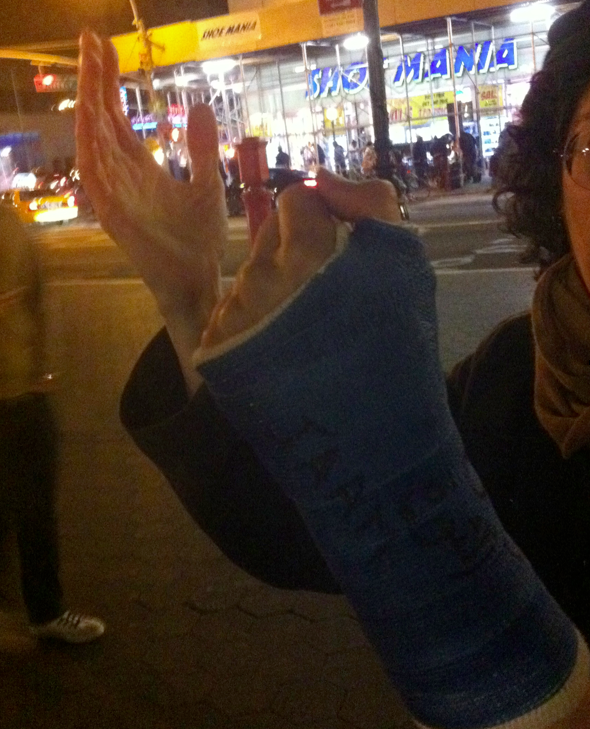
Actually, she quickly clarified, only one wrist was literally broken. She proceeded to launch into a careful, well-nigh clinical blow-by-blow description of what had happened. An experienced activist, she knew to go limp when police seized her, and how to do nothing that could possibly be described as resisting arrest. Police dragged her, partly by the hair, behind their lines and threw her to the ground, periodically shouting “stop resisting!” as she shouted back “I’m not resisting!” At one point though, she said, she did tell them her glasses had fallen to the sidewalk next to her, and announced she was going to reach over to retrieve them. That apparently gave them all the excuse they needed. One seized her right arm and bent her wrist backwards in what she said appeared to be some kind of marshal-arts move, leaving it not broken, but seriously damaged. “I don’t know exactly what they did to my left wrist—at that point I was too busy screaming at the top of my lungs in pain. But they broke it. After that they put me in plastic cuffs, as tightly as they possibly could, and wouldn’t loosen them for at least an hour no matter how loud I screamed or how much the other prisoners begged them to help me. For a while everyone in the arrest van was chanting ‘take them off, take them off’ but they just ignored them…”
On March 17, several hundred members of Occupy Wall Street celebrated the six month anniversary of their first camp at Zuccotti Park by a peaceful reoccupation of the park—a reoccupation broken up within hours by police with 32 arrests. Later that evening a break-away group moved north, finally establishing itself on the southern end of Union Square, two miles away, even sleeping in park—though the city government soon after decided to defy a century-old tradition and begin closing the park every night just so they would not be able to establish a camp there. Since then, occupiers have taken advantage of past judicial rulings to continue to sleep on sidewalks outside the park, and more recently, on Wall Street itself.
During this time, peaceful occupiers have been faced with continual harassment arrests, almost invariably on fabricated charges (“disorderly conduct,” “interfering with the conduct of a police officer”—the latter a charge that can be leveled, for instance, against those who try to twist out of the way when an officer is hitting them.) I have seen one protestor at Union Square arrested, by four officers using considerable force, for sitting on the ground to pet a dog; another, for wrapping a blanket around herself (neither were given warnings; but both behaviors were considered too close to “camping”); a third, an ex-Marine, for using obscene language on the Federal steps. Others were reportedly arrested on those same steps for singing a satirical version of the “Officer Krumpke” song from West Side Story. Almost no march goes by without one or two protestors, at least, being hurled against vehicles or have their heads bashed against the ground while being arrested for straying off the sidewalk. The message here is clear. Law has nothing to do with it. Anyone who engages in Occupy Wall Street-related activity should know they can be arrested, for virtually any reason, at any time.
Many of these arrests are carried out in such a way to guarantee physical injury. The tone was set on that first night of March 17, when my friend Eileen’s wrists were broken; others suffered broken fingers, concussions, and broken ribs. Again, this was on a night where OWS actions were confined to sitting in a park, playing music, raising one or two tents, and marching down the street. To give a sense of the level of violence protestors were subjected to, during the march north to Union Square, we saw the first major incident of window-breaking in New York. The window in question was broken not by protestors, but by police—using a protestor’s head. The victim in this case was a street medic named José (owing to the likelihood of physical assault and injuries from police, OWSers in New York as elsewhere have come to carry out even the most peaceful protests accompanied by medics trained in basic first aid.) He offered no resistance.
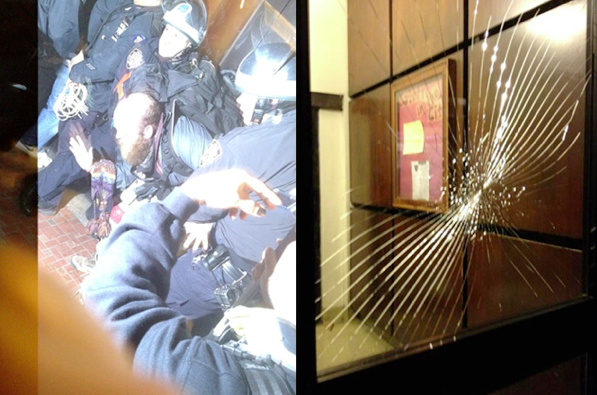
Here is a video of the incident. The window-breaking begins at 3:45.
Police spokesmen later claimed this incident was a response to a bottle that was hurled at a police vehicle used to transport arrestees. Such claims are made almost automatically when videos appear documenting police assaults on non-violent protestors, yet, despite the presence of cameras everywhere, including those wielded by the police themselves, no actual documentation of any such claims ever seems to appear. This is no exception. In fact numerous witnesses confirmed this simply isn’t true, and even if a bottle had been thrown at an armored vehicle, not even the police have suggested they had any reason to believe the medic whose head was smashed into the window was the one who threw it.
Arbitrary violence is nothing new. The apparently systematic use of sexual assault against women protestors is new. I’m not aware of any reports of police intentionally grabbing women’s breasts before March 17, but on March 17 there were numerous reported cases, and in later nightly evictions from Union Square, the practice became so systematic that at least one woman told me her breasts were grabbed by five different police officers on a single night (in one case, while another one was blowing kisses.) The tactic appeared so abruptly, is so obviously a violation of any sort of police protocol or standard of legality, that it is hard to imagine it is anything but an intentional policy.
For obvious reasons, most of the women who have been victims of such assaults have been hesitant to come forward. Suing the city is a miserable and time-consuming task and if a woman brings any charge involving sexual misconduct, they can expect to have their own history and reputations—no matter how obviously irrelevant—raked over the coals, usually causing immense damage to their personal and professional life. The threat of doing so operates as a very effective form of intimidation. One exception is Cecily McMillan, who was not only groped but suffered a broken rib and seizures during her arrest on March 17, and held incommunicado, denied constant requests to see her lawyer, for over 24 hours thereafter. Shortly after release from the hospital she appeared on Democracy Now! And showed part of a handprint, replete with scratch-marks, that police had left directly over her right breast. (She is currently pursuing civil charges against the police department):

I’d like to emphasize this because when I first mention this, the usual reaction, from reporters or even some ordinary citizens, is incredulity. ‘Surely this must be a matter of a few rogue officers!’ It is difficult to conceive of an American police commander directly telling officers to grope women’s breasts—even through indirect code words. But we know that in other countries, such things definitely happen. In Egypt, for example, there was a sudden spate of sexual assaults by security forces against protestors in November and December 2011, and followed a very similar pattern: while women activists affirmed there had been beatings, but relatively few specifically sexual assaults during the height of the protests, starting in November, there were dozens of reports of women being groped or stripped while they were being beaten. The level of the violence in Egypt may have been more extreme, but the circumstances were identical: an attempt to revive a protest movement through re-occupation is met by a sudden ratcheting up of tactics by the security forces, and in particular, the sudden dramatic appearance of a tactic of sexual attacks on women. It is hard to imagine in either case it was a coincidence. In Egypt, no serious observer is even suggesting that it was.
Of course we cannot how such decisions are made, or conveyed; in fact, most of us find it unpleasant even to contemplate the idea of police officials ordering or encouraging sexual assault against the very citizens they are sworn to protect. But this seems to be precisely what is happening here.
.
For many, the thought of police officials ordering or condoning sexual assault—even if just through a nod or a wink—seems so shocking that absolute proof would be required. But is it really so out of character? As Naomi Wolf has recently reminded us, the US security apparatus has long “used sexual humiliation as a tool of control.” Any experienced activist is aware of the delight police officers so often take in explaining just how certainly they will be raped if placed in prison. Strip searches—which the Supreme Court has recently ruled can be deployed against any citizen held for so much as a traffic violation—are often deployed as a tool of humiliation and punishment. And one need hardly remark on well-documented practices at Guantanamo, Bagram, or Abu Ghraib. Why target women in particular? No doubt it’s partly simply the logic of the bully, to brutalize those you think are weak, and more easily traumatized. But another reason is, almost certainly, the hope of provoking violent reactions on the part of male protestors. I myself well remember a police tactic I observed more than once during the World Economic Forum demonstrations in New York in 2002: a plainclothes officer would tackle a young female marcher, without announcing of who they were, and when one or two men would gallantly try to come to her assistance, uniforms would rush in and arrest them for “assaulting an officer.” The logic makes perfect sense to someone with military background. Soldiers who oppose allowing a combat role for women almost invariably say they do so not because they are afraid women would not behave effectively in battle, but because they are afraid men would not behave effectively in battle if women were present—that is, that they would become so obsessed with the possibility of women in their unit being captured and sexually assaulted that they would behave irrationally. If the police were trying to provoke a violent reaction on the part of studiously non-violent protestors, as a way of justifying even greater brutality and felony charges, this would clearly be the most effective means of doing so.
There’s a good deal of anecdotal evidence that would tend to confirm that this is exactly what they are trying to do. One of the most peculiar incidents took place on a recent march in New York where police seem to have simulated such an assault, arresting a young women who most activists later concluded was probably an undercover officer (no one had seen her before or has seen her since), then ostentatiously groping her as she was handcuffed. Reportedly, several male protestors had to physically restrained (by other protestors) from charging in to help her.
Why is all this not a national story? Back in September, when the now famous Tony Bologna arbitrarily maced several young women engaged in peaceful protest, the event became a national news story. In March, even while we were still hearing heated debates over a single incident of window-breaking that may or may not have been by an OWS activist in Oakland four months earlier, no one seems to have paid any significant attention to the first major incident of window-breaking in New York—even though the window was broken, by police, apparently, using a non-violent protestors’ head!
I suspect one reason so many shy away from confronting the obvious is because it raises extremely troubling questions about the role of police in American society. Most middle class Americans see the primary role of police as maintaining public order and safety. Instances when police are clearly trying to foment violence and disorder for political purposes so fly in the face of everything we have been taught that our instinct is to tell ourselves it isn’t happening: there must have been some provocation, or else, it must have just been individual rogue cops. Certainly not something ordered by the highest echelons. But here we have to remember the police are an extremely top-down, centralized organization. Uniformed officers simply cannot behave in ways that flagrantly defy the law, in full public view, on an ongoing basis, without having at least tacit approval from those above.
In this case, we also know precisely who those superiors are. The commander of the First Precinct, successor to the disgraced Tony Bologna, is Captain Edward J. Winski, whose officers patrol the Financial District (that is, when those very same officers are not being paid directly by Wall Street firms to provide security, which they regularly do, replete with badges, uniforms, and weapons). Winski often personally directs groups of police attacking protestors:
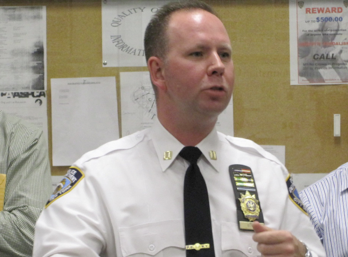
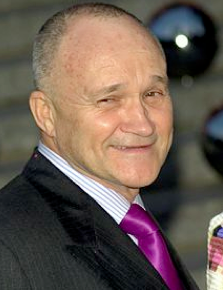
Winsky’s superior is Police Commissioner Raymond Kelly, former director of global security of the Wall Street firm Bear Stearns:
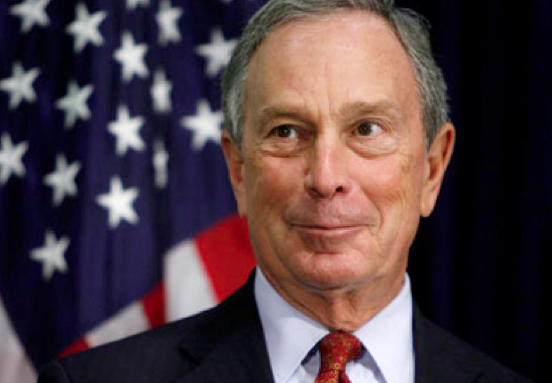
And Kelly’s superior, in turn, is Mayor Michael Bloomberg – the well-known former investment banker and Wall Street magnate. The 11th richest man in America, he has referred to the New York City Police Department as his own personal army:
One of the great themes of Occupy Wall Street, of course, is the death of US democracy—the near-total capture of our political system by Wall Street firms and the financial power of the 1%. In the beginning the emphasis was on political corruption, the fact that both parties so beholden to the demands of Wall Street and corporate lobbyists that working within the political system to change anything has become simply meaningless. Recent events have demonstrated just how much deeper the power of money really goes. It is not just the political class. It is the very structure of American government, starting with the law and those who are sworn to enforce it—police officers who, as even this brief illustration makes clear, are directly in the pay of and under the orders of Wall Street executives, and who, as a result, are willing to systematically violate their oaths to protect the public when members of that public have the temerity to make a public issue out of exactly these kind of arrangements.
As Gandhi revealed, non-violent protest is effective above all because it reveals how power really operates: it lays bare the violence it is willing to unleash on even the most peaceful citizens when they dare to challenge its moral legitimacy. And by doing so, it reveals the true moral bankruptcy of those who claim authority to rule us. Occupy Wall Street has demonstrated this time and time again. What the current spate of assaults shows is just how low, to what levels of utter moral degradation, such men are really willing to sink.
Update (3:40 PM): In comments, a reader asked why I did not go to the media. My response:
To be honest my first impulse was to call a sympathetic Times reporter. He said he was going to see if he could spin a story out of it. Apparently his editors told him it wasn’t news.

Monday, April 2, 2012

The Case Against Passion: Yves Smith


The Case Against Passion

“Passion” became fashionable in business at around the time other forms of emotional overshoot were hot, like “delighting customers.” While there may have been earlier efforts by Tom Peters and other corporate quacks gurus to infuse staid, supposedly rational business behavior with more pizzaz, the passion fashion seemed to take hold in the dot-com era. And that in a perverse way makes perfect sense.
Even though the Internet has proven to be transformative, the Internet bubble was, as Greenspan noted in one of his most acute moments, irrational exuberance. You were a hopeless dinosaur if you dared question the logic of investing in companies run by 22 year olds who admitted their business would never show a profit but were still hugely valuable because they had a lot of eyeballs. Those who timed this momentum trade correctly did spectacularly well, but most investors were left holding the bag.
Weirdly, the passion fashion persists. It’s an odd exhortation of Dionysian impulses when management (at least the professionalized sort) is usually presented as Apollonian: businessleaders as creators of order out of chaos, able stewards of large enterprises. Now one might argue that this is all hogwash, that Keynes was closer to the truth when he talked about animal sprits. He came pretty close to saying if someone was rational, they’d never invest or start a business.
But the real question is who this vogue for romantic attachment to one’s work really serves. Faking passion in job interviews seems to be as necessary as faking orgasms is in some relationships. On the surface, this long-lived fas appeals to the narcissistic tendencies that are ever more common in American society, that we all have some special talent or destiny and we are supposed to go forth and, to use that horrible New Age turn of phrase, manifest it.
But being emotionally invested in career success as the proof of one’s worth makes people exploitable. That’s the secret of elite firms like Goldman and McKinsey, which hire people who were not simply bright, but have a record of achievements that shows that they care deeply about external validation. When an organizational guru came in to give a look over McKinsey in the 1980s, he was famously told by the head of the firm, “Don’t mess with the insecurity.”
Now that isn’t to say that you shouldn’t care about your work, but there is a difference in degree, and I’d hazard it is actually a difference in kind, between seeking to achieve a level of competence or mastery versus the bizarrely idealized passion. That’s a good old fashioned sense of satisfaction in doing a good job, and that can operate at any level, from being a house cleaner or store clerk to someone in a much loftier position. And the idea of valuing. Yet as we’ve become a winner-take-all society, we’ve tended to devalue competence, even though jobs competently done are what keeps the system running. Instead, we’ve created more and more steep payoff curves, with the most extreme being in fields like acting and professional sports, where a very few people do egregiously well, and a lot of people have a go at it for very modest or no pay, because they think they have (or actually may have) some talent, but also do love the process.
What bothers me is that the human potential movement (est and its many derivatives) tended to equate following your dreams with achieving happiness. This is a dangerous formulation; in fact, the Buddhists would likely see this as another version of samsara or suffering (Buddhists welcome to correct me). Wanting something is setting yourself up to be disappointed, either by not getting what you sought, or attaining it and finding the achievement to be less satisfying than you’d envisaged, and most liked supplanted by a new set of wants that you start pursuing.
With this as prologue, I wanted to turn to a post from the Harvard Business Review’s blog, “To Find Happiness, Forget Passion,” that Lambert liked, but I found less than satisfying:
Several years ago, a friend decided she wanted to follow her passion. She loved the liberal arts and academe….So she spent seven years getting a PhD, writing an award-winning dissertation in the process. It was a wonderful ride while it lasted, and she was among the happiest people I knew.
Then the recession hit. The value of university endowments crashed. Teaching and research positions were cut. She moved back in with her family, stopped paying off her student loans, and waited two years before getting a minor teaching role in a small research center. Throughout this time, she suffered the anguish of an uncertain future, became socially withdrawn, and felt a sense of betrayal.
It’s a poster tale for our times. Was following her passion worth it?
Like myself, today’s twentysomethings were raised to find our dreams and follow them. But it’s a different world. And as the jobless generation grows up, we realize the grand betrayal of the false idols of passion. This philosophy no longer works for us, or at most, feels incomplete. So what do we do? I propose a different frame of reference: Forget about finding your passion. Instead, focus on finding big problems.
Putting problems at the center of our decision-making changes everything. It’s not about the self anymore. It’s about what you can do and how you can be a valuable contributor. People working on the biggest problems are compensated in the biggest ways. I don’t mean this in a strict financial sense, but in a deeply human sense. For one, it shifts your attention from you to others and the wider world. You stop dwelling. You become less self-absorbed. Ironically, we become happier if we worry less about what makes us happy.
The good thing is that there are a lot of big problems to go by: climate change, sustainability, poverty, education, health care, technology, and urbanization in emerging markets. What big problem serves as your compass? If you’re a young leader and you haven’t articulated this yet, here are some things you can do.
Develop situational awareness. There’s too much focus on knowing the self. Balance this with knowing the world. Stay in touch. Be sensitive to the problems faced by the unfortunate and marginalized. Get out of the office and volunteer. If you’re in school, get out of the classroom. It’s been a long time coming, but business schools are finally instituting changes that put the real world at the center of their programs.
Look into problems that affect you in a very personal way. We’re more likely to be motivated by problems we can relate to on a personal level. In Passion & Purpose, Umaimah Mendhro recounts her story fleeing a war-torn Pakistan with her family and how the experience of dodging bullets to escape helped her summon the wherewithal to found thedreamfly.org, an initiative that helps create connections across communities in conflict.
Connect with people working on big problems. In a world where problems are by their very nature interdisciplinary, just getting to know people who are passionate about one problem leads to discussions on how other problems can be solved. When Jaime Augusto Zobel de Ayala helped reinvent Manila Water to better provide for the Philippines’ capital, he had to deal not only with the typical issues a public utility had to face, but also with problems related to climate change, technology, and community development.
Take time off and travel. Forget about traveling as a tourist. Instead, structure a trip that takes you off the beaten path. Go to an unconventional place. Backpack and get lost. The broader and richer experience pays dividends down the line. Steve Jobs described his time living in India as one of the most enriching and mind-opening phases of his life, and this undoubtedly helped him develop the intuition to solve the big problem of making lives simpler through technology.
We don’t find happiness by looking within. We go outside and immerse in the world. We are called to a higher purpose by the inescapable circumstances that are laid out on our path. It’s our daily struggles that define us and bring out the best in us, and this lays down the foundation to continuously find fulfillment in what we do even when times get tough.
Happiness comes from the intersection of what you love, what you’re good at, and what the world needs. We’ve been told time and again to keep finding the first. Our schools helped developed the second. It’s time we put more thought on the third.

What big problems are you trying to solve?
It may sound churlish to take issue with this prescription. It sounds like a long overdue rebellion against the breakdown of communities, both the physical kind and the sort you’d find in the workplace when businesses offered long term employment. And the world has no shortage of urgent problems that would benefit greatly from more sincere people putting shoulder to wheel to try to remedy them.
What bothers me is anchoring this orientation as as new prescription for happiness. Now it is indeed true that people with more extensive and numerous social networks are healthier; ironically, that’s one of the reasons unequal societies are less healthy. The sort of people you associate with is very much class/income related, so if you lose your perch, you lose most if not all of your putative friends. That in turn produces even more pressure to keep your foothold on the economic ladder.
Go again and read the featured post more carefully. The author hasn’t freed himself of the passion paradigm; notice how he urges readers to find people who are “passionate about problems.” And it’s also hard to put aside the HBS ego orientation: positing his audience to be “young leaders” and urging them to get involved in big problems.
If happiness is the aim, research points to other routes. Altruism lights up the pleasure centers of the brain, supposedly (it never seems to work for me, I just think about how inadequate what I have done or given is relative to the scale of the problem). But I’m not sure “doing altruism” works, if you get the distinction. If you do something generous, you might get a boost from helping other people, but I’m not certain self motivated altruism would produce the same results.
Mihaly Csikszentmihalyi argues that people are happy when they are in a state he calls “flow” which is being fully engaged in the activity at hand. He describes it in an interview in Wired as:
being completely involved in an activity for its own sake. The ego falls away. Time flies. Every action, movement, and thought follows inevitably from the previous one, like playing jazz. Your whole being is involved, and you’re using your skills to the utmost.
That can happen when you are “in the zone” when playing a sport, engaged in problem solving (sudoku and crossword puzzle junkies seem to exhibit this sort of concentration) or engrossed in a really good book. One has to note that multitasking would seem to train people out of being able to attain that level of involvement.
But even then I’m not certain Csikszentmihalyi is right about happiness so much as onto a much better approximation. His thesis is that individuals attain a state of flow when they are faced with a task that is demanding enough that it takes their full attention, but not so hard that they cannot succeed at it. How do you regularly find this level of challenge?
By contrast, Buddhists accept the inevitability of suffering and don’t seek happiness, yet they are studied by brain researchers for their equanimity. That in turn results from meditation, which is a form of mental discipline, and appears to create an ability to approach more activities with the sort of prized mindfulness (lack of ego and full engagement) that normal people achieve only by happenstance (or perhaps by luck, by finding or falling into a career that provides them with the sort of tasks that can put them in a state of flow). I’m told a Buddhist saying is “Before I was enlightened, I carried water and chopped wood. Now that I am enlightened, I carry water and chop wood.” In other words, your circumstances do not create your mental state. You do. But few of us are skilled enough to have mastered this faculty.
I wish there were a way for Americans to get over their fixation with happiness and try to use the inevitable pain of the human condition to come to grips with more fundamental questions of meaning. The fact that the HBR is raising the issue of failure as a spur to action is a promising sign, but its readers probably need to be willing to step further outside cultural assumptions to have a real impact on their own psyches, and potentially, the communities they inhabit.

Wednesday, October 26, 2011

OWS IS FOR REAL / AMERICA HAS LOST ITS MORAL BEARINGS

OWS IS FOR REAL / AMERICA HAS LOST ITS MORAL BEARINGS


America has lost its moral bearings! Recent polls indicate that if Occupy Wall Street (OWS) were a candidate for President, it would decisively beat any candidate from either party. 86% of Americans think that Wall Street and its lobbyists have far too much power in Washington and those Americans are taking to the streets demanding real moral change: Allen L Roland
As I have mentioned before ~ there are evolutionary moral juices flowing through the Occupy Wall Street movement and they are social cooperation and altruism versus isolation and greed. A true shift in global consciousness is upon us for the OWS Movement is touching deeply felt evolutionary chords which will eventually break down the global walls of greed, separateness and war and will replace them with altruism, social cooperation and peace ~ the true driving forces of evolution. See my article ~ http://www.veteranstoday.com/2011/10/19/we-are-the-99-who-want-peace-harmony-and-love-on-the-planet/
According to a recent CNN/ORC International poll, only 15% of Americans asked said that they trust the federal government to do the right thing most of the time ~ and that is because Washington is out of sync with America’s grass roots moral values.
In a Press TV Interview this week I stress that the "Occupy" movements are seeking moral changes ~ both economic and political ~ which focus on social cooperation and altruism, not greed. I also stress that America has obviously lost its moral bearings / six minute video http://www.youtube.com/watch?v=LBGEYcvqzI0
I also mention the three stages of Occupy Wall Street;
1. Occupy and establish a visible presence and present a moral vision.
2. Demand the truth, including 9/11 truth, Fed Reserve transparency, full disclosure of Wall Street fraud and derivative indebtedness.
3. Strike, revolt and demand real change
The first step in regaining our moral bearings is the truth ~ which has yet to be fully revealed to Americans and which accounts for the deep mistrust of not only Wall Street but politicians in general ~ including President Obama. All of whom are obviously in bed with Wall Street and the corporate banking elite.
Have we forgotten the words of Carl Sandburg?
" For we know when a nation goes down and never comes back, when a society or civilization perishes, one condition may always be found ~ they forgot where they came from. They lost sight of what brought them along."
No where is this loss of moral bearings more evident than our illegal preemptive attack and occupation of Iraq, where we set up and implemented a U.S. controlled coalition government, where we stage managed a flawed election and judicial system and where we condoned the brutal hanging of Iraq’s sovereign leader after a mock U.S. managed monkey trial. The recent brutal assassination of Libya’s dictator Muammar Gaddafi, by US backed NATO forces and rebels, is yet another example of our flawed moral vision.
Here’s the collective human cost of this flawed moral vision ~
Number Of Iraqis Slaughtered In US War And Occupation Of Iraq 1,455,590
Number of U.S. Military Personnel Sacrificed (Officially acknowledged) In America's War On Iraq: 4,798
Number Of International Occupation Force Troops Slaughtered In Afghanistan: 2,776
Here’s the financial Cost of War and occupation of Iraq & Afghanistan
Total Cost of Wars Since 2001
$1,268,965,662,411
Obviously, we have lost our moral bearings and focus and that is what’s driving the Occupy Wall Street movement ~ and many others acknowledge this driving collective moral force of a country that wants to redeem itself from its past and continuing moral transgressions.
George Lakoff correctly writes in AlterNet ( How Occupy Wall Street's Moral Vision Can Beat the Disastrous Conservative Worldview ) that OWS has a progressive moral vision and that they're protesting the disastrous effects that have come from operating with a conservative moral, economic, and political worldview.

Excerpt:
“It seems to me that the OWS movement is moral in nature, that occupiers want the country to change its moral focus. It is easy to find useful policies; hundreds have been suggested. It is harder to find a moral focus and stick to it. If the movement is to frame itself, it should be on the basis of its moral focus, not a particular agenda or list of policy demands. If the moral focus of America changes, new people will be elected and the policies will follow. Without a change of moral focus, the conservative worldview that has brought us to the present disastrous and dangerous moment will continue to prevail…. Remember: The Tea Party sees itself as stressing only individual responsibility. The Occupation Movement is stressing both individual and social responsibility.”
http://www.alternet.org/teaparty/152800

Former four star general and NATO commander Wesley Clark talks about that disastrous conservative world view and the resultant neocon plan to invade seven countries in five years ~ including an attack on Libya and eventually Iran. He calls it the neocon policy coup of the United States led by Dick Cheney and many others. Remember, there's nothing moral or humanitarian about dropping bombs under the guise of a humanitarian intervention ~
Video: Eight minute Commonwealth Club Interview / 2007
http://www.brasschecktv.com/page/5509.html


In summary, OWS is a people’s movement with the moral power to change the world ~ because the need to unite and co-operate is a soul based moral need whereas the need to separate, control and destroy is an ego based immoral need and contrary to human evolution.
As I predicted several months ago, a grassroots people’s freedom movement that started in Egypt will end in America in 2012 when the people demand the moral change they voted for in 2008 and never got ~ but this time, we will get it!
Allen L Roland

Freelance Alternative Press Online columnist and psychotherapist Allen L Roland is available for comments, interviews, speaking engagements and private consultations ( allen@allenroland.com )
Allen L Roland is a practicing psychotherapist, author and lecturer who also shares a daily political and social commentary on his weblog and website allenroland.com He also guest hosts a monthly national radio show TRUTHTALK on www.conscioustalk.net

Think CEOs are overcompensated?

Friday, October 21, 2011

David Graeber: On Playing By The Rules – The Strange Success Of #OccupyWallStreet

Yves here. I have to note that David DeGraw of Amped Status is widely credited as the originator of “We are the 99%.”
By David Graeber, who is currently a Reader in Social Anthropology at Goldsmiths University London. Prior to that he was an associate professor of anthropology at Yale University. He is the author of ‘Debt: The First 5,000 Years’ which is available from Amazon.
Just a few months ago, I wrote a piece for Adbusters that started with a conversation I’d had with an Egyptian activist friend named Dina:
All these years,” she said, “we’ve been organizing marches, rallies… And if only 45 people show up, you’re depressed, if you get 300, you’re happy. Then one day, 200,000 people show up. And you’re incredulous: on some level, even though you didn’t realize it, you’d given up thinking that you could actually win.
As the Occupy Wall Street movement spreads across America, and even the world, I am suddenly beginning to understand a little of how she felt.
On August 2, I showed up at a 7 PM meeting at Bowling Green, that a Greek anarchist friend, who I’d met at a recent activist get together at 16 Beaver Street, had told me was meant to plan some kind of action on Wall Street in mid-September. At the time I was only vaguely aware of the background: that a month before, the Canadian magazine Adbusters had put out the call to “Occupy Wall Street”, but had really just floated the idea on the internet, along with some very compelling graphics, to see if it would take hold; that a local anti-budget cut coalition top-heavy with NGOs, unions, and socialist groups had tried to take possession of the process and called for a “General Assembly” at Bowling Green. The title proved extremely misleading. When I arrived, I found the event had been effectively taken over by a veteran protest group called the Worker’s World Party, most famous for having patched together ANSWER one of the two great anti-war coalitions, back in 2003. They had already set up their banners, megaphones, and were making speeches—after which, someone explained, they were planning on leading the 80-odd assembled people in a march past the Stock Exchange itself.
The usual reaction to this sort of thing is a kind of cynical, bitter resignation. “I wish they at least wouldn’t advertise a ‘General Assembly’ if they’re not actually going to hold one.” Actually, I think I actually said that, or something slightly less polite, to one of the organizers, a disturbingly large man, who immediately remarked, “well, fine. Why don’t you leave?”
But as I paced about the Green, I noticed something. To adopt activist parlance: this wasn’t really a crowds of verticals—that is, the sort of people whose idea of political action is to march around with signs under the control of one or another top-down protest movement. They were mostly pretty obviously horizontals: people more sympathetic with anarchist principles of organization, non-hierarchical forms of direct democracy, and direct action. I quickly spotted at least one Wobbly, a young Korean activist I remembered from some Food Not Bomb event, some college students wearing Zapatista paraphernalia, a Spanish couple who’d been involved with the indignados in Madrid… I found my Greek friends, an American I knew from street battles in Quebec during the Summit of the Americas in 2001, now turned labor organizer in Manhattan, a Japanese activist intellectual I’d known for years… My Greek friend looked at me and I looked at her and we both instantly realized the other was thinking the same thing: “Why are we so complacent? Why is it that every time we see something like this happening, we just mutter things and go home?” – though I think the way we put it was more like, “You know something? Fuck this shit. They advertised a general assembly. Let’s hold one.”
So we gathered up a few obvious horizontals and formed a circle, and tried to get everyone else to join us. Almost immediately people appeared from the main rally to disrupt it, calling us back with promises that a real democratic forum would soon break out on the podium. We complied. It didn’t happen. My Greek friend made an impassioned speech and was effectively shooed off the stage. There were insults and vituperations. After about an hour of drama, we formed the circle again, and this time, almost everyone abandoned the rally and come over to our side. We created a decision-making process (we would operate by modified consensus) broke out into working groups (outreach, action, facilitation) and then reassembled to allow each group to report its collective decisions, and set up times for new meetings of both the smaller and larger groups. It was difficult to figure out what to do since we only had six weeks, not nearly enough time to plan a major action, let alone bus in the thousands of people that would be required to actually shut down Wall Street—and anyway we couldn’t shut down Wall Street on the appointed day, since September 17, the day Adbusters had been advertising, was a Saturday. We also had no money of any kind.
Two days later, at the Outreach meeting we were brainstorming what to put on our first flyer. Adbusters’ idea had been that we focus on “one key demand.” This was a brilliant idea from a marketing perspective, but from an organizing perspective, it made no sense at all. We put that one aside almost immediately. There were much more fundamental questions to be hashed out. Like: who were we? Who did want to appeal to? Who did we represent? Someone—this time I remember quite clearly it was me, but I wouldn’t be surprised if a half dozen others had equally strong memories of being the first to come up with it—suggested, “well, why not call ourselves ‘the 99%’? If 1% of the population have ended up with all the benefits of the last 10 years of economic growth, control the wealth, own the politicians… why not just say we’re everybody else?” The Spanish couple quickly began to lay out a “We Are the 99%” pamphlet, and we started brainstorming ways to print and distribute it for free.
Over the next few weeks a plan began to take shape. The core of the emerging group, which began to meet regularly in Tompkins Square park, were very young people who had cut their activist teeth on the Bloombergville encampment outside City Hall earlier in the summer; aside from that there was a smattering of activists who had been connected to the Global Justice movement with skills to share (one or two of whom I had to drag out of effective retirement), and, as mentioned a number of New Yorkers originally from Greece, Spain, even Tunisia, with knowledge and connections with those who were, or had been, involved in occupations there. We quickly decided that what we really wanted to do was something like had already been accomplished in Athens, Barcelona, or Madrid: occupy a public space to create a New York General Assembly, a body that could act as a model of genuine, direct democracy to contrapose to the corrupt charade presented to us as “democracy” by the US government. The Wall Street action would be a stepping-stone. Still, it was almost impossible to predict what would really happen on the 17th. There were supposed to be 90,000 people following us on the internet. Adbusters had called for 20,000 to fill the streets. That obviously wasn’t going to happen. But how many would really show up? What’s more, we were keenly aware that the NYPD numbered close to 40,000; Wall Street was, in fact, probably the single most heavily policed public space on the face of Planet Earth. To be perfectly honest, as one of the old-timers scrambling to organize medical and legal trainings, lessons on how to organize affinity groups and do non-violent civil disobedience, seminars on how to facilitate meetings and the like, for most of us, the greatest concern during those hectic weeks was how to ensure the initial event wouldn’t turn out a total fiasco, with all the enthusiastic young people immediately beaten, arrested, and psychologically traumatized as the media, as usual, simply looked the other way.
We’d certainly seen it happen before.
This time it didn’t. True, there were all the predictable conflicts. Most of New York’s grumpier hard-core anarchists refused to join in, and mocked us from the sidelines as reformist; meanwhile, the more open, “small-a” anarchists, who had been largely responsible for organizing the facilitation and trainings, battled the verticals in the group to ensure that we did not institute anything that could become a formal leadership structure, such as police liaisons or marshals. There were also bitter battles over the web page, as well as minor crises over the participation of various fringe groups, ranging from followers of Lyndon LaRouche to one woman from a shadowy group that called itself US Day of Rage, and who we sometimes suspected might not have any other members, who systematically blocked any attempt to reach out to unions because she felt we should be able to attract dissident Tea Partiers. On September 17th itself, I was troubled at first by the fact that only a few hundred people seemed to have shown up. What’s more the spot we’d chosen for our General Assembly, a plaza outside Citibank, had been shut down by the city and surrounded by high fences. The tactical committee however had scouted out other possible locations, and distributed maps: around 3 PM, word went around we were moving to location #5—Zuccotti Park—and by the time we got there, I realized we were surrounded by at least two thousand people.
The real credit for what happened after that—within a matter of weeks, a movement that had spread to 800 different cities, with outpourings of support from radical opposition groups as far away as China—belongs mainly to the students and other young people who simply dug themselves and refused to leave, despite the endless (and in many cases, obviously illegal) acts of police repression designed to intimidate, and to make life so miserable in the park (refusing to allow activists to cover their computers with tarps during rainstorms, that sort of thing) that its inhabitants would simply become demoralized and abandon the project. And, as the weeks went on, against calculated acts of terrorism involving batons and pepper-spray. Still, dogged activists have held out heroically under such conditions before, and the world simply ignored them. Why didn’t it happen this time? After so many years of vain attempts to revive the fervor of the Global Justice Movement, and constantly falling flat, I found myself, like Dina, asking “what did we actually do right?”
My first take on the question came when The Guardian asked me to write an oped on Occupy Wall Street a few days later. At the time I was inspired mainly by what Marisa Holmes, another brilliant organizer of the original occupation, had discovered in her work as a video documentarian, doing one-on-one interviews of fellow campers during the first two nights at Zucotti Square. Over and over she heard the same story: “I did everything I was supposed to! I worked hard, studied hard, got into college. Now I’m unemployed, with no prospects, and $50 to $80,000.00 in debt.” These were kids who played by the rules, and were rewarded by a future of constant harassment, of being told they were worthless deadbeats by agents of those very financial institutions who—after having spectacularly failed to play by the rules, and crashing the world economy as a result, were saved and coddled by the government in all the ways that ordinary Americans such as themselves, equally spectacularly, were not.
“We are watching,” I wrote, “the beginnings of the defiant self-assertion of a new generation of Americans, a generation who are looking forward to finishing their education with no jobs, no future, but still saddled with enormous and unforgivable debt.” Three weeks later, after watching more and more elements of mainstream America clamber on board, I think this is still true. In a way, the demographic base of OWS is about as far as one can get from that of the Tea Party—with which it is so often, and so confusingly, compared. The popular base of the Tea Party was always middle aged suburban white Republicans, most of middling economic means, anti-intellectual, terrified of social change—above all, for fear that what they saw as their one remaining buffer of privilege (basically, their whiteness) might finally be stripped away. OWS, by contrast, is at core forwards-looking youth movement, just a group of forward-looking people who have been stopped dead in their tracks; of mixed class backgrounds but with a significant element of working class origins; their one strongest common feature being a remarkably high level of education. It’s no coincidence that the epicenter of the Wall Street Occupation, and so many others, is an impromptu library: a library being not only a model of an alternative economy, where lending is from a communal pool, at 0% interest, and the currency being leant is knowledge, and the means to understanding.
In a way, this is nothing new. Revolutionary coalitions have always tended to consist of a kind of alliance between children of the professional classes who reject their parents’ values, and talented children of the popular classes who managed to win themselves a bourgeois education, only to discover that acquiring a bourgeois education does not actually mean one gets to become a member of the bourgeoisie. You see the pattern repeated over and over, in country after country: Chou Enlai meets Mao Tse Tung, or Che Guevara meets Fidel Castro. Even US counter-insurgency experts have long known the surest harbingers of revolutionary ferment in any country is the growth of a population of unemployed and impoverished college graduates: that is, young people bursting with energy, with plenty of time on their hands, every reason to be angry, and access to the entire history of radical thought. In the US, the depredations of the student loan system simply ensures such budding revolutionaries cannot fail to identify banks as their primary enemy, or to understand the role of the Federal Government—which maintains the student loan program, and ensures that their loans will be held over their heads forever, even in the event of bankruptcy—in maintaining the banking system’s ultimate control over every aspect of their future lives.
Ordinarily, though, the plight of the indebted college graduate would not be the sort of issue that would speak directly to the hearts of, say, members of New York City’s Transit Worker’s Union—which, at time of writing, is not only supporting the occupation, but suing the New York Police Department for commandeering their buses to conduct a mass arrest of OWS activists blocking the Brooklyn Bridge. Why would a protest by educated youth strike such a chord across America—in a way that it probably wouldn’t have in 1967, or even 1990? Clearly, it has much to do with the financialization of capital. It may well be the case by now that most of Wall Street’s profits are no longer to be being extracted indirectly, through the wage system, at all, but taken directly from the pockets of ordinary Americans. I say “may” because we don’t really have the numbers. In a way this is telling in itself. For all the endless statistical data available on every aspect of our economic system, I have been unable to find any economist who can tell me how much of an average American’s annual income, let alone life income, ends up being appropriated by the financial industries in the form of interest payments, fees, penalties, and service charges. Still, given the fact that interest payments alone takes up between 15-17% of household income,[1] a figure that does not include student loans, and that penalty fees on bank and credit card accounts can often double the amount one would otherwise pay, it would not be at all surprising if at least one dollar out of every five an American earns over the course of her lifetime is now likely to end up in Wall Street’s coffers in one way or another. The percentage may well be approaching the amount the average American will pay in taxes. In fact, for the least affluent Americans, it has probably long since overtaken it.
This has very real implications for how we even think about what sort of economic system we are in. Back when I was in college, I learned that the difference between capitalism and feudalism—or what was sometimes called the “tributary mode of production”—is that a feudal aristocracy appropriates its wealth through “direct juro-political extraction.” They simply take other people’s things through legal means. Capitalism was supposed to be a bit more subtle.[2] Yet as soon as it achieved total world dominance, capitalism seems to have almost immediately begun shifting back into something that could well be described as feudalism.[3] In doing so, too, it made the alliance of money and government impossible to ignore. In the years since 2008, we’ve seen examples ranging from the comical—as when loan collection agencies in Massachusetts sent their employees out en masse to canvas on behalf of a senate candidate (Scott Brown) who they assumed would be in favor of harsher laws against debtors, to the downright outrageous—as when “too big to fail” institutions like Bank of America, bailed out by the taxpayers, secure in the knowledge they would not be allowed to collapse no matter what their behavior, paying no taxes, but delivering vast sums of culled from their even vaster profits to legislators who then allow their lobbyists to actually write the legislation that is supposed to “regulate” them. At this point, it’s not entirely clear why an institution like Bank of America should not, at this point, be considered part of the federal government, other than that it gets to keep its profits for itself.
Still, this might explain the outrage at government’s alliance with the financial sector—the fact that bribery has, effectively, been made legal in America, a country that nonetheless presumes to go around the world pretending it is some sort of beacon of democracy. It does not explain the comprehensive rejection of existing political institutions of any sort.
This is where I must admit my own position is particularly confusing. On the one hand, this is exactly the kind of attitude I have been arguing for for years. I like to describe myself precisely as a “small-a anarchist.” That is, I believe in anarchist principles—mutual aid, direct action, the idea building the new, free society in the shell of the old—but I’ve never felt a need to declare allegiance to any particular anarchist school (Syndicalists, Platformists, etc). Above all, I am happy to work with anyone, whatever they call themselves, willing to work on anarchist principles—which in America today, has largely come to mean, a refusal to work with or through the government or other institutions which ultimately rely on the threat of force, and a dedication to horizontal democracy, to treating each other as we believe free men and women in a genuinely free society would treat each other. Even the commitment to direct action, so often confused with breaking windows or the like, really refers to the refusal of any politics of protest, that merely appeals to the authorities to behave differently, and the determination instead to act for oneself, and to do what one thinks is right, regardless of law and authority. Gandhi’s salt march, for example, is a classic example of direct action. So was squatting Zuccotti Park. It’s a public space; we were the public; the public shouldn’t have to ask permission to engage in peaceful political assembly in its own park; so we didn’t. By doing so we not only acted in the way we felt was right, we aimed to set an example to others: to begin to reclaim communal resources that have been appropriated for purposes of private profit to once again serve for communal use—as in a truly free society, they would be—and to set an example of what genuine communal use might actually be like. For those who desire to create a society based on the principle of human freedom, direct action is simply the defiant insistence on acting as if one is already free.
Small-a anarchists such as myself were at the core of the anti-nuclear movement in the ‘70s and the global justice movement between 1998-2001, and over the years, we have put much of our creative energy into developing forms of egalitarian political process that actually work. I should emphasize that this is not just an anarchist project. Actually, the development of consensus process, which is probably the movement’s greatest accomplishment, emerges just as much from the tradition of radical feminism, and draws on spiritual traditions from Native American to Quakerism. This is where the whole exotic language of the movement comes from: facilitation, “the people’s microphone,” spokescouncils, blocks; though in the case of Occupy Wall Street, augmented and transformed by the experience of General Assembly movements across the Mediterranean.
Obviously, what happened is exactly what we hoped would happen. The politics of direct action is based, to a certain degree, on a faith that freedom is contagious. It is almost impossible to convince the average American that a truly democratic society would be possible. One can only show them. But the experience of actually watching a group of a thousand, or two thousand, people making collective decisions without a leadership structure, let alone that of thousands of people in the streets linking arms to holding their ground against a phalanx of armored riot cops, motivated only by principle and solidarity, can change one’s most fundamental assumptions about what politics, or for that matter, human life, could actually be like. Back in the days of the Global Justice movement we thought we might expose enough people, around the world, to these new forms of direct democracy, these traditions of direct action, that a new, global, democratic culture would begin to emerge. Of course it didn’t quite happen that way. Certainly, the movement did inspire thousands, and played a major role in transforming how activist groups in Europe and North America conducted meetings and thought about politics; but the contagion was largely contained within pre-existing activist ghettos; most Americans never even knew that direct democracy was so much of what we were about. The anti-war movements after 2003 mobilized hundreds of thousands, but they fell back on the old fashioned vertical politics of top-down coalitions, charismatic leaders, and marching around with signs. Many of us diehard kept the faith. We kept looking for the moment of revival. After all, we had dedicated our lives to the principle that something like this would eventually happen. But, like my Egyptian friend, we had also, in a certain way, failed to notice that we’d stop really believing that we could actually win.
And then it happened. The last time I went back to Zuccotti Square, and watched middle aged construction workers and Latino hip hop artists using all our old hand signals in mass meetings, one of my old anarchist comrades—a one-time tree-sitter and inveterate eco-activist who used to go by the name Warcry, and was now established in the park as video documentarians—admitted to me, “every few hours I do have to pinch myself to make sure it isn’t all a dream.”
So the social scientist in me has to ask: Why? Why now? Why did it actually work?
Again, I think the answer is generational. In politics, too, as in education, we are looking at a generation of young people who played by the rules, and have seen their efforts prove absolutely fruitless. We must remember that in 2008, the youth vote went overwhelmingly to Barrack Obama and the Democrats. We also have to remember that Obama was running, then, as a candidate of “Change”, using a campaign language that drew liberally from that of radical social movements (“yes we can!”, “be the change!”), and that as a former community organizer, he was one of the few candidates in recent memory who could be said to have emerged from a social movement background rather than from smoke-filled rooms. This, combined with the fact that Obama was Black, gave young people a sense that they were experiencing a genuinely transformative moment in American politics.
All this happened in a country where there was such a straightjacket on acceptable political discourse in the US—what a politician or media pundit can say, without being immediately written off as lunatic fringe—that the views of very large segments of the American public simply are never voiced at all. To give a sense of how radical is the disconnect between acceptable opinion, and the actual feelings of American voters, consider a pair of polls conducted by Rasmussen, the first in December 2008, right after Obama was elected, the second in April 2011. A broad sampling of Americans were asked which economic system they preferred: capitalism, or socialism? In 2008, 15% felt the USA would be better off adopting a socialist system; now, three years later, the number has gone up, to one in five. Even more striking was the breakdown by age: the younger the respondent, the more likely they were to reject a capitalist system. Among Americans between 15 and 25, a thin plurality still preferred capitalism: 37%, as opposed to 33% in favor of socialism (the rest were unsure). But think about what this means here. It means that almost two thirds of America’s youth think it might be a good idea to jettison the capitalist system entirely! This in a country where most have never seen a single politician, TV pundit, or mainstream “expert” use the term “socialism” as anything but a term of condescension and abuse. Granted, for that very reason, it’s hard to know exactly what young people who say they prefer “socialism” actually think they’re embracing. Presumably not an economic system modeled on that of North Korea. What then? Sweden? Canada? It’s impossible to say. But in a way it’s also beside the point. Most Americans might not be sure what socialism is supposed to be, but they do know a great deal about capitalism, and if “socialism” means anything to them, it means “something, pretty much anything, other than that!”
In 2008, young Americans preferred Obama to McCain by a rate 68% to 30[4]—again, an approximately 2/3 margin.
How, then, do you expect a young American voter to feel, after casting a vote for a fundamental change to our political and economic system, on discovering that in fact, they have elected a man who twenty years ago would have been considered a moderate conservative?
I mean that word, “conservative,” in its literal sense by the way. This literal sense is now rarely used. Nowadays, in the US, “conservative” has come to mean “right-wing radical,” but it used to mean someone whose main political imperative is to conserve existing institutions, more or less exactly as they are—and this is precisely what Obama has turned out to be. Almost all his greatest political efforts have been aimed in one way or another at preserving some institutional structure under threat of radical transformation: the banking system, the auto industry, even the health insurance industry, since Obama’s main argument in pushing for health care reform was that the US health care system, based on for-profit, private insurers, was not economically viable over the long term, and indeed, what he ended up doing was preserving exactly that for-profit system in a way that it might endure for at least another generation. Considering the state of the US economy in 2008, it required genuinely heroic efforts not to change anything. Yet Obama did expend those heroic efforts, and the result was no structural change in existing institutions of any kind at all.
I am a frequenter of the liberal blog Daily Kos. Reading it regularly is probably the best way to get a sense of what the “progressive community” in the US—left-leaning voters and activists who still believe in acting through the Democratic Party—are currently thinking. Over the last two years, the level of hatred directed against Obama is extraordinary. He is regularly accused of being a fraud, a liar, a secret Republican who has intentionally flubbed every opportunity for progressive change presented to him in the name of “bipartisan compromise” with a rabid and uncompromising Right. Others suggest he is a well-meaning progressive whose hands are tied; or, alternately, blame progressives for not having mobilized to provide sufficient pressure to his Left. The latter seem to forget the way the grassroots activist groups created during the campaign, which were expected to endure afterwards for just this purpose, were rapidly dismantled once Obama was in power and handing the economic reigns of the US over to the very people (Geithner, Bernanke, Summers) responsible for the crisis, or how liberal groups that actually try to mount campaigns against such policies are regularly threatened with defunding by White-House friendly NGOs. But in a way, this feeling of personal betrayal is pretty much inevitable. It is the only way of preserving the faith that it’s possible for progressive policies to be enacted in the US through electoral means. Because if Obama was not planning all along to betray his Progressive base, then one would be forced to conclude any such project is impossible. After all, how could there have been a more perfect alignment of the stars than happened in 2008? That year saw a wave election that left Democrats in control of both houses of congress,[5] a Democratic president elected on a platform of “Change” coming to power at a moment of economic crisis so profound that radical measures of some sort were unavoidable, and at a time when popular rage against the nation’s financial elites was so intense that most Americans would have supported almost anything. If it was not possible to enact any real progressive policies or legislation at such a moment, clearly, it would never be. Yet none were enacted.[6] Instead Wall Street gained even greater control over the political process, and, since Republicans proved the only party willing to propose radical positions of any kind, the political center swung even further to the Right. Clearly, if progressive change was not possible through electoral means in 2008, it simply isn’t going to possible at all. And that is exactly what very large numbers of Americans appear to have concluded.
Say what you will about Americans, and one can say many things, this is a country of deeply democratic sensibilities. The idea that we are, or are supposed to be, a democratic society is at the very core of what makes us proud to be Americans. If Occupy Wall Street has spread to every city in America, it’s because our financial overlords have brought us to such a pass that anarchists, pagan priestesses, and tree-sitters are about the only Americans left still holding out for the idea that a genuinely democratic society might be possible.
————-
[1] http://www.federalreserve.gov/releases/housedebt/default.htm.
[2] Similarly, Max Weber argued that the “irrational political capitalism” of “military adventurers … tax farmers, speculators, money dealers, and others” of, say, the Roman world, was an historical dead end, since it was ultimately parasitical off the state, and had nothing in common with the rational investment of production of modern industrial capitalism. By Weber’s logic, contemporary global capitalism, which is dominated by speculators, currency traders, and government contractors, has long since reverted to the dead-end irrational variety.
[3] See http://attempter.wordpress.com/2011/10/12/underlying-ideology-of-the-99/ for a nice essay on Occupy Wall Street and “neo-feudalism.”
[4] http://www.msnbc.msn.com/id/27525497/ns/politics-decision_08/t/youth-vote-may-have-been-key-obamas-win/
[5] The conventional response to this was to insist that the Democrats didn’t really control both houses because the Senate rules had changed, irresponsible use of the Filibuster meant that a 60-vote majority was required. This only makes sense if one assumes that any minority party, at any previous period of American history, could have gotten rid of majority rule and moved to a 60% system had they really wanted to, but somehow chose not to do so—which is obviously absurd. If the Republicans got away with it in 2008 it’s because the Democrats decided not to make a major issue an unprecedented opposition policy of systematically violating all previous tacit Senate rules.
[6] Obama’s health care legislation, I will repeat, does not count since it is not comprehensive and effectively reproduces Bob Dole’s Republican health plan of 2006.