Good government groups to supercommittee: Show us your meetings
More than a dozen good government groups, including Public Citizen, are calling on the supercommittee to disclose committee-related contacts with lobbyists and report any campaign donations within 48 hours. The supercommittee is charged with slicing more than a trillion dollars from the budget.
Meanwhile, in supercommittee news … second supercommittee member stops raising money, sort of
Dave Camp (R-Mich.), said he won’t schedule any more fundraising events while he is serving on the supercommittee. However, he will attend fundraisers that are already scheduled. Sen. John Kerry (D-Mass.) also has announced that he will stop raising money while on the committee.
From Public Citizen
USuncutMN says: Tax the corporations! Tax the rich! Stop the cuts, fight for social justice for all. Standing in solidarity with http://www.usuncut.org/ and other Uncutters worldwide. FIGHT for a Foreclosure Moratorium! Foreclosure = homelessness. Resist the American Legislative Exchange Council, Grover Norquist and Citizen's United. #Austerity for the wheeler dealers, NOT the people.

USuncutMN supports #occupyWallStreet, #occupyDC, the XL Pipeline resistance Yes, We, the People, are going to put democracy in all its forms up front and center. Open mic, diversity, nonviolent tactics .. Social media, economic democracy, repeal Citizen's United, single-payer healthcare, State Bank, Operation Feed the Homeless, anti-racism, homophobia, sexISM, war budgetting, lack of transparency, et al. Once we identify who we are and what we've lost, We can move forward.
Showing posts with label federal budget. Show all posts
Showing posts with label federal budget. Show all posts
Friday, September 16, 2011


Tuesday, August 2, 2011
Ransom Paid By Robert Reich
Monday, August 1, 2011
Anyone who characterizes the deal between the President, Democratic,
and Republican leaders as a victory for the American people overpartisanship understands neither economics nor politics.
The deal does not raise taxes on America’s wealthy and most fortunate
— who are now taking home a larger share of total income and wealth,
and whose tax rates are already lower than they have been, in eighty
years. Yet it puts the nation’s most important safety nets and public
investments on the chopping block.
It also hobbles the capacity of the government to respond to the jobs
and growth crisis. Added to the cuts already underway by state and
local governments, the deal’s spending cuts increase the odds of a
double-dip recession. And the deal strengthens the political hand of
the radical right.
Yes, the deal is preferable to the unfolding economic catastrophe of a
default on the debt of the U.S. government. The outrage and the shame
is it has come to this choice.
More than a year ago, the President could have conditioned his
agreement to extend the Bush tax cuts beyond 2010 on Republicans’
agreement not to link a vote on the debt ceiling to the budget
deficit. But he did not.
Many months ago, when Republicans first demanded spending cuts and no
tax increases as a condition for raising the debt ceiling, the
President could have blown their cover. He could have shown the
American people why this demand had nothing to do with deficit
reduction but everything to do with the GOP’s ideological fixation on
shrinking the size of the government — thereby imperiling Medicare,
Social Security, education, infrastructure, and everything else
Americans depend on. But he did not.
And through it all the President could have explained to Americans
that the biggest economic challenge we face is restoring jobs and
wages and economic growth, that spending cuts in the next few years
will slow the economy even further, and therefore that the
Republicans’ demands threaten us all. Again, he did not.
The radical right has now won a huge tactical and strategic victory.
Democrats and the White House have proven they have little by way of
tactics or strategy.
By putting Medicare and Social Security on the block, they have made
it more difficult for Democrats in the upcoming 2012 election cycle to
blame Republicans for doing so.
By embracing deficit reduction as their apparent goal – claiming only
that they’d seek to do it differently than the GOP – Democrats and the
White House now seemingly agree with the GOP that the budget deficit
is the biggest obstacle to the nation’s future prosperity.
The budget deficit is not the biggest obstacle to our prosperity. Lack
of jobs and growth is. And the largest threat to our democracy is the
emergence of a radical right capable of getting most of the ransom it
demands.
Monday, July 18, 2011
Blowing It: Democrats, Unable to Be a Party of the People, are Sinking Themselves
Blowing It: Democrats, Unable to Be a Party
of the People, are Sinking Themselves
The smoking ruin that is the the Obama White House, and the rotting corpse that is the Democratic Party, have, incredibly, together been boxed into a corner by, of all things, the certifiably insane Republican Party.
This amazing situation has resulted not through any brilliant strategy on the part of the Republicans, but by the self-inflicted wounds of the Democrats.
Faced with a collapsing economy that is at serious risk of performing a reprise of the Great Depression, Congressional Democrats and President Obama were in a perfect position to grab the flag and run home with it by declaring war on unemployment and on the party that has unequivocally declared itself openly to be the standard bearer of the wealthy and powerful.
All the president and Congressional Democrats had to do was announce that Social Security, Medicare, education and programs to protect the poor were all off limits in any discussion of the federal budget, and to declare an immediate 25% cut in military spending, as called for earlier by Rep. Barney Frank (D-MA), the ranking member of the House Financial Services Committee.
How hard would that have been to do? The polls show it’s what the public wants. Any elected official who did this, particularly someone elected and re-elected as a Democrat, would have been hailed by voters for such a bold action.
According to a Pew Research Center poll conducted in late May and released June 11, 60% of Americans correctly attribute the nation’s enormous deficit primarily to military spending, which eats up 52% of every tax dollar (Social Security and Medicare are entirely funded by separate payroll taxes, and not only have not contributed a single dollar to the federal deficit, but have been routinely borrowed from by the government to finance the deficit in the government’s operating budget caused by military spending). Only 24% blame the deficit on domestic spending other than military (and probably every one of those is a Republican or right-wing independent who likely believes that the earth was created 6000 years ago, and is flat, and who will never vote Democratic no matter what).
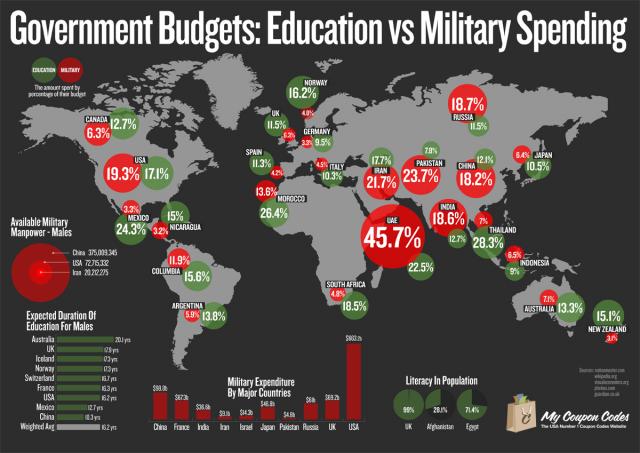
Military vs. Education spending around the globen (US in company of Iran, China, Russia, UAE and India)
That same poll showed that the vast majority of Americans (73%) object to proposals to cut the budget by reducing federal funding for social programs, or federal funding to the states for education, or by reducing Social Security benefits (59%), for example by raising the retirement age.
What the Pew poll finds Americans do support is raising the cap on income subject to the Social Security Tax (FICA), from its current meager level of $106,000, to cover all income (66% in favor). They also favor raising taxes on those households that earn more than $250,000 a year (65% in favor), and they favor getting rid of tax deductions for corporations, which have allowed many wildly profitable companies like Exxon, GE and News Corp to pay no corporate taxes despite earning billions of dollars in profits (62% in favor). They also overwhelmingly favor reducing America’s military operations overseas, where the US currently maintains over 800 bases in countries all over the world, including wealthy allies such as Europe and Japan (62% in favor).
After being deluged with poorly written, simplistic and often ideologically-driven news stories all year hyping the supposed budget “crisis,” the percentage of Americans who say they are worried about the budget deficit has crept up from 24% to 28%, but far more Americans say they are worried about the jobs crisis (38%, up from 34% in March).
If you were a political advisor in the White House, or in the Democratic Congressional Committee or the Democratic National Committee, one would think that seeing those numbers, the strategy going forward would be obvious: declare the country to be facing New Depression, call the Republican Party out as a bunch of know-nothings, end the wars, bring the troops home, slash military spending, call for higher taxes on the rich, and, in Congress, introduce a public jobs program every day of every week, forcing the Republicans to vote them down, one after another through the next election day.
But the Democratic Party, as I said, is a rotting corpse, and it certainly is not an organization that sees itself as fighting for the common man and woman.
As for the White House political team, and the president himself, they seem to have long since lost their grip on reality.
The president has been hanging around with Wall Street bankers, taking their money and their self-serving ideas, for so long now he actually thinks like them. Congressional Democrats, like their Republican colleagues, are so covetous of corporate campaign cash and lobbyist perks that, with a few exceptions, they can’t imagine crossing any corporate interests.
This is not a case of Democrats being stupid. You’d have to be far worse than stupid not to see the correct political strategy to adopt at this point.
What has happened is that the Democratic Party is no more. It is, at this point, all about current incumbents gaining the favor of the corporate elite, lulling the public into a non-voting torpor or stupor, and of course, arguing that people worried about the nation’s future should vote for them yet again because “the Republicans are worse.”
In a press conference on Friday, President Obama made some incredible statements, all demonstrably untrue. He said “We are all part of the same country,” and yet he surely knows that when it comes to the leaders of America’s biggest corporations, including GE, whose chairman Jeffrey Immelt he appointed to head his Jobs Council, this is demonstrably false. While many of these leaders may be Americans by birth, the companies they run and represent earn the majority of their revenues and profits from operations abroad, and are thus, technically speaking, foreign enterprises, with foreign interests that trump any US interests. Obama said, “We are all in this together,” speaking of the supposed debt “crisis,” but of course, he has announced himself ready to cut Social Security and Medicare and Medicaid programs, upon which poor and working class families depend, while leaving the rich largely unscathed. He has said it is the “will of the people” to cut the budget, but to the extent that that is even true, which is highly debatable, the will of the people is actually to cut military spending, not to cut Social Security or Medicare or even budgets for education or Medicaid.
The good news is that an increasing number of Americans appear to be finally realizing that this president is a fraud--a shill for bankers, the corporate interests and the neo-con military establishment who has just been posing as a man of the people.
The bad news is that there is little likelihood of any Third Party arising before 2012 that could seriously contest the national election, meaning that we are probably headed for either more of the same or a for Republican-led government.
The hope has to be that the blatant sell-out of the public interest and the national interest by both parties and by the president is becoming so self-evident that the American public will actually wake up from its media-induced somnolence and will abandon them both.
The institutional obstacles to such an unprecedented rebellion are of course enormous, but then, these are unprecedented times.
Friday, July 15, 2011
Fiscal FactCheck
Fiscal FactCheck
Does Washington have a spending problem or an income problem? We offer some key facts.
July 15, 2011
Summary
So does the U.S. have "a spending problem," as Republicans keep repeating in the current debate over how to reduce the nation's record deficits? Or is the problem that taxes are not high enough? Those questions frame a long-running partisan debate, and as usual we won't offer an opinion one way or the other. But for those seeking their own answers, we can offer some fiscal history and factual context.
Some key facts we think are worth considering:
* Federal spending ("outlays" in budget jargon) is expected to equal 24.1 percent of the nation's gross domestic product in the current fiscal year, which ends Sept. 30. The figure was 25 percent in fiscal year 2009, highest since 1945.
* On the other hand, federal revenues are expected to drop to 14.8 percent of GDP this year, lower even than the 14.9 percent attained in both 2009 and 2010. There has been only one year since World War II when revenues have been as low as in any of these years: 1950, when the figure was 14.4 percent.
* These historically high rates of spending and low rates of taxation have combined to produce a chain of deficits that are also the highest since WWII. The deficit was 10.0 percent of GDP in fiscal 2009. It declined to 8.9 percent last year as the economy started to recover, but is projected to go up to over 9 percent this year. Each of these deficits is larger than in any year since 1945, measured as a percentage of GDP.
* The U.S. is borrowing about 36 cents of every dollar spent so far this year. It borrowed 37 cents on the dollar last year, and 40 cents in fiscal 2009.
* The largest components of federal spending are Social Security and Medicare programs for the elderly (33.5 percent of total outlays in 2010) and national defense (20.1 percent). Interest payments on the federal debt alone accounted for 5.7 percent of all federal spending, and that percentage is rising.
* The federal income tax accounted for 41.5 percent of federal receipts in 2010 (down from 49.6 percent prior to the Bush tax cuts of 2001 – 2003). Corporate taxes brought in only 8.9 percent, also down sharply since the recent recession. Payroll taxes and other "social insurance" payments accounted for 40 percent of total receipts in 2010.
It's easy to argue one side or the other by just citing facts that support a particular view, and omitting others. In the Analysis that follows, we offer some graphics, details and documentation in an attempt to give our readers a quick look at the entire picture — both where the money goes, and where it comes from.
Analysis
A glance at this chart quickly puts our current fiscal mess in historical context. We created it using historical budget data from the federal Office of Management and Budget, updated with the most recent estimates of the current fiscal year's outlays and receipts from the nonpartisan Congressional Budget Office, issued June 22 as part of CBO's 2011 long-term budget outlook.
.png)
Not since the enormous effort required to defeat Nazi Germany and Japan in WWII has the gap between Washington's spending and its revenues been so large, as a portion of the economy. Then, taxes were increased sharply to pay for the war, but spending increased even faster. In recent years, Washington has increased spending while cutting taxes.
The current situation is a marked change from the booming 1990s. In those years revenues increased, due to a 1993 tax increase, which fell most heavily on those making more than $200,000 a year. Meanwhile spending decreased relative to the rapidly growing economy, partly because of an absolute decline in military spending following the collapse of the Soviet Union in 1991. Deficits were erased, and the government posted surpluses in fiscal 1998, 1999, 2000 and 2001.
But then a string of deficits began in the fiscal year 2002, and there is no end in sight. For the current year, the administration originally projected in February a deficit equal to 10.9 percent, a new postwar record. The Congressional Budget Office in April, using different economic assumptions, projected that enacting the president's budget would produce a deficit of 9.5 percent of GDP, and that making no changes to current law would result in a deficit of 9.3 percent of GDP.
What has produced these huge budget gaps? Tax cuts and wars have been big factors, as have recessions and expanded spending for health care in both Republican and Democratic administrations. For example:
- Income-tax receipts are down sharply since the Bush tax cuts. In fiscal 2000, the year before the cuts began to take effect, receipts from the federal income tax on individuals amounted to 10.2 percent of GDP. That figure was down to 6.2 percent of GDP last year.
- Spending for the military and for homeland security has risen substantially since the attacks of Sept. 11, 2001. Spending for national defense rose from 3.0 percent of GDP that year to 4.8 percent last year.
- Non-military spending also has continued to rise. President George W. Bush pushed through an expensive prescription drug benefit for seniors in 2003, the largest expansion of Medicare in its history. In the financial crisis of 2008, Bush also pushed for and signed for a massive banking bailout. In early 2009, President Barack Obama pushed for and signed an expensive stimulus measure, and after a long fight in Congress he signed another expensive plan, the health care law, in March of last year, aimed at expanding coverage for millions who lack health insurance.
- Two economic recessions have had their effect. The recession of 2001 began in March and lasted until November. And the worst downturn since the Great Depression began in December 2007 and continued until June 2009. In both cases unemployment remained high for long after business activity began to recover, holding back both wages and the taxes that jobless workers would have paid on them.
We won't attempt to assign blame to one party or the other for the deficits. There is plenty of blame to go around, some of which rests with an American public that won't accept cuts in the largest categories of public spending, and also resists tax increases on anybody but "the rich."
Where Does It Go?
The biggest share of federal spending now goes for Social Security (20.4 percent in 2010) and Medicare (13.1 percent), the two entitlement programs that big majorities of Americans want to protect from any reductions, according to a recent poll. Together these two programs for senior citizens consume more than one-third of spending, far more than national defense, which accounts for just 20.1 percent, despite the increases of recent years.

Some categories that are unpopular with much of the public turn out to represent a fairly small part of total spending. Foreign aid, for example, amounts to less than 1 percent of the entire budget — even counting in military assistance to Israel, Egypt, Iraq and Afghanistan. All agriculture programs — including farm subsidies — make up just over one-half of 1 percent.
Where Did It Go? Major components of the $3.5 trillion spent in fiscal 2010 | |
| Social Security | 20.4% |
| National Defense | 20.1% |
| Medicare | 13.1% |
| Medicaid/CHIP | 8.1% |
| Interest | 5.7% |
| Low-Income Assistance | 5.3% |
| Unemployment Compensation | 4.6% |
| Education & Training | 3.7% |
| Federal Employee Retirement | 3.5% |
| Veterans | 3.1% |
| Transportation | 2.7% |
| Other health care | 2.6% |
| Parks & natural resources | 1.3% |
| Space/Science | 0.9% |
| Foreign aid | 0.9% |
| Agriculture | 0.6% |
| Everything else | 3.5% |
The wildly unpopular TARP program, used to finance banks, a big insurance company and two U.S. auto companies, is now actuallybringing billions back into the Treasury, as old loans are repaid and government-owned stock is sold to the public. The nonprofit investigative project Pro Publica figures that $322 billion has now flowed back into the Treasury, of the $573 billion loaned, invested or spent originally. And even the Obama administration's $787 billion stimulus program, so excoriated by Republicans, has nearly run its course. It was enacted in 2009, and according to the official Recovery.gov website, had spent 84 percent of the total as of June 30. That included 90 percent of the tax benefits, 83 percent of entitlements, and 78 percent of contracts, grants and loans.
Borrowing 36 Cents on the Dollar
The current gap between tax revenue and congressionally approved spending is so great that so far this fiscal year the federal government has borrowed an average of 36 cents of every dollar paid out. According to the most recent "Monthly Budget Review," issued by the Congressional Budget Office on July 8, the total spent through the end of June (the first nine months of the current fiscal year) was estimated at $2.705 trillion. But government receipts fell $973 billion short of spending, CBO estimates.
The good news — if it can be called that — is that the huge deficit is running at $31 billion lower than last year at this time. Spending is higher (Medicaid is up 6 percent over last year, for example), but federal income tax receipts are running higher as well. CBO credited "higher wages and more employment" than last year for the increase in tax revenue. And borrowing 36 cents on the dollar is an improvement of sorts. For all of fiscal 2009, the deficit amounted to 40 cents of every dollar spent, and it was 37 cents in fiscal 2010.
Where the Money Comes From
Taxes make up the vast bulk of federal revenues, of course. Individual income-tax payers supplied 41.5 percent of all federal revenues in fiscal 2010, but Social Security and Medicare payroll taxes paid both by workers and their employers made up nearly as much. Combined with federal unemployment insurance taxes and a few others, these social insurance taxes made up 40 percent of revenues. The income tax on corporations brought in just under 9 percent, while excise taxes, on such things as gasoline and diesel fuel, alcoholic beverages and telecommunications services, brought in just over 3 percent.

We found a surprising bit of news buried in the "other" category, which made up 6.5 percent of all revenue.
| Breakdown of "other" in 2010 | |
| (Percent of total revenues) | |
| Federal Reserve | 3.5% |
| Customs | 1.2% |
| Misc | 1.0% |
| Estate & Gift | 0.9% |
| Total "Other" | 6.5% |
It turns out that in 2010, more than half of that category came from profits made by the Federal Reserve System, whose lending operations expanded dramatically to address the financial crisis that started in 2007. The Fed's payments to the Treasury made up 3.5 percent of all federal revenue in 2010 — nearly $76 billion. The rest of the "other" category is made up of customs duties (1.2 percent of all revenue), federal estate and gift taxes (0.9 percent), and miscellaneous sources.
Who Pays?
Who pays all of these taxes? The best information on thatcomes from the Congressional Budget Office, which has tracked the tax burden for many years. The most recent complete data cover 2007. CBO figured in that year more than half of all federal taxes was paid by the top 10 percent of income earners. They paid 55 percent of all federal taxes in 2007, CBO said.
That's a comprehensive figure, counting the income tax, payroll taxes, excise taxes and even the corporate income tax (borne by stockholders in the form of reduced dividends and appreciation). And perhaps surprisingly, the top 10 percent of earners pay a greater share of federal taxes now than they did before the Bush tax cuts, which Democrats constantly criticize as a giveaway to "the rich." The top 10 percent paid 50 percent of all federal taxes in 2001.
However, that comes in spite of lower tax rates at the top, not because of it. The reason the most affluent 10 percent pay a greater share of taxes is that they are getting a greater share of all income. Their share of all pre-tax income went from 37.5 percent in 2001 to 42 percent in 2007.
One figure that gets a lot of attention is the percentage of individuals and married couples who pay zero federal income taxes. Those figures come from the nonpartisan Tax Policy Center. The TPC's most recent report was released June 14, and it shows that this year 46.4 percent of "tax units" (individuals or married couples) had zero federal income tax liability. That's because of various exemptions and tax credits aimed at reducing the income-tax burden on lower-income workers and families with children. The figure is down from 2008 and 2009, when the percentage topped out at 50.8 percent.
But practically all workers (and their employers) pay Medicare taxes on every dollar of wages, and Social Security taxes on every dollar of wages up to $106,800. Consequently, those who pay no federal income or payroll taxes at all amount to only 18.1 percent this year, the Tax Policy Center figures.
There's plenty more where these figures came from. We could focus more closely on what was paid and earned by the top 1 percent, for example. Or we could zoom in to examine the role of rising medical and drug costs in pushing up spending for Medicare and Medicaid. We may well visit those subjects in future articles. For now, we've tried to give a quick, accurate and balanced look at the big picture: Both where Washington spends, and where its money comes from.
– by Brooks Jackson
Sources
Office of Management and Budget. "Fiscal 2012 Budget of the United States, Historical Tables:Table 1.3—Summary Of Receipts, Outlays, And Surpluses Or Deficits (−) In Current Dollars, Constant (Fy 2005) Dollars, And As Percentages Of Gdp: 1940–2016" 14 Feb 2011.
Congressional Budget Office. "CBO's Long-Term Budget Outlook: Supplemental Data" 22 Jun 2011.
U.S. Congress, Joint Committee on Taxation, "Estimated Budget Effects of the Revenue Provisions of H.R. 2264. (The Omnibus Budget Reconciliation Act of 1993) As Agreed to by the Conferees" 4 Aug 1993.
Office of Management and Budget. "Fiscal 2012 Budget of the United States, Historical Tables:Table 2.3—Receipts by Source as Percentages of GDP: 1934–2016 " 14 Feb 2011.
Office of Management and Budget. "Fiscal 2012 Budget of the United States, Historical Tables:Table 3.1—Outlays by Superfunction and Function: 1940–2016" 14 Feb 2011.
Connolly, Ceci and Mike Allen "Medicare Drug Benefit May Cost $1.2 Trillion; Estimate Dwarfs Bush's Original Price Tag" Washington Post. 9 Feb 2005.
Johnson, Allen "Bush signs $700 billion financial bailout bill" MSNBC.com. 3 Oct 2008.
The Associated Press, "Obama: Stimulus lets Americans claim destiny: President signs $787 billion program into law in Denver Tuesday" 17 Feb 2009.
Stolberg, Sheryl Gay and Robert Pear, "Obama Signs Health Care Overhaul Bill, With a Flourish" New York Times. 23 Mar 2010.
National Bureau of Economic Research, "US Business Cycle Expansions and Contractions" undated. Accessed 15 Jul 2011.
King, Jr., Neil and Scott Greenberg "Poll Shows Budget-Cuts Dilemma: Many Deem Big Cuts to Entitlements 'Unacceptable,' but Retirement and Means Testing Draw Support" Wall Street Journal 3 March 2011.
Cohen, Jon and Dan Balz, "Poll shows Americans oppose entitlement cuts to deal with debt problem," Washington Post. 20 Apr 2011.
U.S. Department of State, "Foreign Assistance Budget" undated. Accessed 11 Jul 2011.
U.S. Treasury, "$1.7 Billion Additional TARP Funds Returned to Taxpayers, Positive Return on TARP Bank Programs Reaches $10 Billion" press release. 5 Jul 2011.
Pro Publica, "The State of the Bailout" undated. Accessed 11 Jul 2011.
U.S. Government, Recovery.gov "Overview of Funding" undated. Accessed 11 Jul 2011.
Congressional Budget Office, "Monthly Budget Review" 8 Jul 2011.
Congressional Budget Office, "Monthly Budget Review" 5 Nov 2010.
Office of Management and Budget. "Fiscal 2012 Budget of the United States, Historical Tables:Table 2.5—Composition of "Other Receipts": 1940–2016" 14 Feb 2011.
Board of Governors of the Federal Reserve System, "What does it mean that the Federal Reserve is 'independent within the government'?" 17 Jun 2010.
Congressional Budget Office, "Average Federal Taxes by Income Group" Jun 2011.
Congressional Budget Office, "Shares of Federal Tax Liabilities for All Households, by Comprehensive Household Income Quintile, 1979-2007" Jun 2010.
Congressional Budget Office, "Pre-Tax Income Shares All Households, by Household Income Category, 1979-2007" Jun 2010.
Urban-Brookings Tax Policy Center, "T11-0173 – Tax Units with Zero or Negative Tax Liability, Current Law, 2004-2011" 14 Jun 2011.
Tuesday, June 7, 2011
The Walter Jones-ization of Conservative Foreign Policy Thinking | |
| By: David Dayen Monday June 6, 2011 11:40 am | |
This profile of antiwar Republican Walter Jones in the New York Times is pretty interesting.
And I don’t think Jones believes this either; he willingly admits that the Bush Administration lied to him to get him to support the war in Iraq, and that his opposition to wars now flows from that betrayal. Moreover, if you look at Jones’ recent record, he has split with party orthodoxy on much more than matters of war.
But if the cost issue is what it takes to sell conservatives on the idea that we need to be much more humble in our foreign policy, I’ll take that over the neocon push for endless war, and persistence of will standing in place of an actual strategy.
And indeed, the Jones argument about wasting money in pointless wars has broad applicability. It applies to Iraq, where extending our military presence would just cause a mass uprising, collapse the government and put US troops at grave risk (imagine the sad spectacle of five US deaths today in a rocket attack on an operating base being multiplied many times over). It applies to Libya, where Sen. Richard Lugar, who’s moving to the right on most other matters to stave off a Tea Party primary challenge, felt comfortable to write an op-ed castigating the President for denying Constitutional principles in seeking a rubber stamp to continuing military operations. That’s very much in the vein of the isolationist, Jones-ian impulse, rather than the neocons who put together the Senate resolution of approval for the conflict in Libya, which Lugar wants canceled. Here’s what Lugar has to say:
The piece adds that voters in Jones’ district, which includes the Marine Camp Lejeune, are starting to come around to this view, at least with respect to Afghanistan. And the cost issue seems to be driving a lot of this. I don’t believe that an economic crisis which is being felt by the entire world connotes that we are somehow no longer a world power. But I believe that, in order to keep that status, we need to stop inflaming the world by engaging in imperial adventures.Some foreign policy analysts now see Mr. Jones, 68, Representative Ron Paul, Republican of Texas, and a small coterie of Tea Party stalwarts as the leading edge of a conservative movement to rein in American military power — a break from the muscular foreign policy of President George W. Bush.
“They reflect a growing discontent within the Republican Party about the wars and a growing feeling that they don’t want to spend money on them anymore,” said John Isaacs, executive director of the Council for a Livable World, an advocacy group that promotes arms control. “They are military noninterventionists.”
Mr. Jones agreed, saying: “We can’t police the world anymore. We’re not the world power. It’s China. Our economy is in chaos right now.”
And I don’t think Jones believes this either; he willingly admits that the Bush Administration lied to him to get him to support the war in Iraq, and that his opposition to wars now flows from that betrayal. Moreover, if you look at Jones’ recent record, he has split with party orthodoxy on much more than matters of war.
But if the cost issue is what it takes to sell conservatives on the idea that we need to be much more humble in our foreign policy, I’ll take that over the neocon push for endless war, and persistence of will standing in place of an actual strategy.
And indeed, the Jones argument about wasting money in pointless wars has broad applicability. It applies to Iraq, where extending our military presence would just cause a mass uprising, collapse the government and put US troops at grave risk (imagine the sad spectacle of five US deaths today in a rocket attack on an operating base being multiplied many times over). It applies to Libya, where Sen. Richard Lugar, who’s moving to the right on most other matters to stave off a Tea Party primary challenge, felt comfortable to write an op-ed castigating the President for denying Constitutional principles in seeking a rubber stamp to continuing military operations. That’s very much in the vein of the isolationist, Jones-ian impulse, rather than the neocons who put together the Senate resolution of approval for the conflict in Libya, which Lugar wants canceled. Here’s what Lugar has to say:
This marks a turning point away from the muscular, unilateralist foreign policy of the Bush years, characterized by executive decision making, and toward a more cautious, more circumspect policy view. That is still a minority view in the Republican Party, but it’s growing.The Founding Fathers gave Congress the power to declare war for good reason: It forces the president to present his case in detail to the American public, allows for a robust debate to examine that case and helps build broad political support to commit American blood and treasure overseas. Little of that has happened here.
 36 Comments
Friday, June 3, 2011
America Needs Taxe: Carl Gibson, US Uncut
What do USAA, CVS Caremark, Costco, UnitedHealth Group and Berkshire Hathaway all have in common?
They're all multi-billion dollar American corporations that pay their fair share of taxes and don't hide their money offshore. In fact, if you combined the federal tax receipts of just these five corporations, that accounts for more than $7 billion. Theoretically, that money paid for 175,000 teachers at $40,000 a year, or for the guaranteed healthcare for sick and injured 9/11 first responders outlined in the Zadroga bill.
Oliver Wendell Holmes Jr. said
Instead, the American people who pay taxes and abide by the laws put before us are seeing these essential pillars of American democratic society crumble to pieces. The same corporations who pay for the campaigns of our elected officials and own the mainstream media are instead allowed the opportunity to not only avoid paying their fair share to participate in society, but also to spend millions lobbying our leaders to continue avoiding their obligation.
If an American business wants to employ our workers, use our infrastructure, and depend on us to make them prosperous, they should be required to pay our taxes. Our leaders must reform our tax laws to reinforce that standard. Let's hold government and businesses accountable to the American people -- the real shareholders.
They're all multi-billion dollar American corporations that pay their fair share of taxes and don't hide their money offshore. In fact, if you combined the federal tax receipts of just these five corporations, that accounts for more than $7 billion. Theoretically, that money paid for 175,000 teachers at $40,000 a year, or for the guaranteed healthcare for sick and injured 9/11 first responders outlined in the Zadroga bill.
Oliver Wendell Holmes Jr. said
"Taxes are the price we pay for civilized society."
Taxes have paid for everything from the interstate system to national parks, the moon landing and the liberation of France. In fact, Eisenhower, a Republican, presided over an era where corporate taxes accounted for a quarter of all federal tax receipts, and the richest Americans still enjoyed their wealth while paying a 90% top tax rate. Americans were never more prosperous as a whole than during that era. Now, loopholes and lobbying have lowered the top tax rate to its lowest point since the Truman era, and corporate tax dollars only count for 5-7% of all federal tax receipts.
After the Great Depression, our leaders had a vision for America. They fought to see ours was a country where everyone was afforded the opportunity for free basic education, an affordable home, a steady income and free healthcare for the poor and the elderly. FDR took to the airwaves in his last months of life to push for a second bill of rights that guaranteed all of these things and more. MLK called for an economic bill of rights to be drafted in 1967 that guaranteed Americans a fair standard of living.
Instead, the American people who pay taxes and abide by the laws put before us are seeing these essential pillars of American democratic society crumble to pieces. The same corporations who pay for the campaigns of our elected officials and own the mainstream media are instead allowed the opportunity to not only avoid paying their fair share to participate in society, but also to spend millions lobbying our leaders to continue avoiding their obligation.
We're constantly bombarded by rhetoric about how businesses are "obligated" by their shareholders to avoid taxes at all costs. Talking heads on TV constantly deride America's corporate tax rate, calling for it to be lowered so we can be more "competitive." Yet, the aforementioned corporations paid close to, and in some cases more than America's marginal 35% corporate tax rate. And each year, they continue to be extremely profitable without dodging taxes through offshore accounts.
What if today's corporations abided by a more sustainable business culture, where taxes are seen as an investment in their country rather than something to avoid? What if those investments could pay for nationwide poverty relief? Or cross-country green energy infrastructure? If NASA had the money to carry out a Mars landing, instead of a moon landing? If we could guarantee high-quality free public education to ALL students, regardless of zip code.
Tuesday, April 26, 2011
Hudson/Wolff On Debt and Recession
Michael Hudson and Richard Wolff discuss the theatrics of the debt debate in Washington and why debt does matter
Saturday, February 19, 2011
SAY NO TO THE CUTS, END CORPORATE TAX AVOIDANCE

Washington’s proposed budget for the coming year sends a clear message: The wrath of budget cuts will fall upon the shoulders of hard-working Americans.
Obama seeks to trim http://www.reuters.com/article/2011/02/13/ usa-budget obamaidUSN1323655420110213">$1.1 trillion</a> from the
budget in the next ten years by cutting or eliminating over 200
federal programs, many dedicated to social services and education. For
instance, it cuts in half funding to subsidize heating for low-income
Americans; limits an expansion of the Pell grant program for students;
and <a href="http://voices.washingtonpost.com/44/2011/02/budget-2012-
environmental-prot.html">decreases</a> Environmental Protection Agency
funding by over 12%.
Meanwhile, Republicans are using their new House majority to slash
spending even more brutally. The GOP has made it clear that they are
bent on raiding funds for Social Security, Medicare, education;
determined to kill <a href="http://www.greatfallstribune.com/article/
20110219/NEWS01/102190303/1002/rss/House-adopts-Rehberg-measure-defund-
health-care-law?odyssey=nav|head">health care reform</a>; and gut
needed investments in infrastructure, climate change and job creation,
at a time when America needs it most.
These cuts will come on top of very painful austerity measures made at
the state-level across our nation–-<a href ="http://www.cbpp.org/cms/
index.cfm?fa=view&id=711">worth hundreds of billions</a>--since the
recession began.
In short, budget cuts demonstrate that Washington has abandoned
ordinary Americans.
<b>But there is an alternative: Make corporate tax avoiders pay.</b>
Enjoying record profits and taxpayer-funded bailouts as the economy
slowly recovers from a financial crisis, <a href="http://money.cnn.com/
2008/08/12/news/economy/corporate_taxes/">nearly two-thirds</a> of US
corporations don't pay any income taxes, instead opting to abuse tax
loopholes and offshore tax havens. According to <a href="http://
levin.senate.gov/newsroom/supporting/2009/PSI.GAOtaxhavensreport.
011609.pdf">this study</a> from the non-partisan Government
Accountability Office, 83 of the top 100 publicly traded corporations
that operate in the US exploit corporate tax havens. Since 2009,
America’s most profitable companies such as <a href="http:// motherjones.com/mojo/2010/04/exxon-mobil-paid-zero-income-tax-offshore %20shelter-wal-mart-general-electric-forbes">ExxonMobil</a>, <a
href="http://money.cnn.com/2010/04/16/news/companies/
ge_7000_tax_returns/">General Electric</a>, <a href="http://
www.mcclatchydc.com/2010/03/26/91119/bank-of-america-wells-fargo-migh...">Bank
of America</a> and <a href="http://www.wikinvest.com/stock/Citigroup_
%28C%29/Data/Deferred_Income_Taxes/2010/Q3">Citigroup</a> all paid a
grand total of $0 in federal income taxes to Uncle Sam. Tax havens
alone account for up to <a href="http://www.wikinvest.com/stock/
Citigroup_%28C%29/Data/Deferred_Income_Taxes/2010/Q3">$1 trillion</a>
in tax revenue lost every decade, money that could be invested in K-12
education, colleges, public health, job creation and hundreds of other
worthy public programs.
If we pay our taxes, why don’t they? If corporations profit here,
shouldn't they pay here?
It’s time for ordinary Americans to fight back and demand an end to
the corporate tax avoidance.
II. CALL TO ACTION
US Uncut is calling for a national day of non-violent direct action
across on Saturday, February 26 2011. Groups of citizen volunteers in
cities throughout the U.S. will take actions targeting Bank of America
branches demanding that it pays its fair share.
If there is a Bank of America in your city, then it is the central
target for action on Saturday. (If there is not, then choose another
target locally; the website should have more information on other key
corporations soon.) In the years leading up to 2007, Bank of America
played a major hand in creating the largest financial crisis in recent
history, and it has received generous bailouts and avoided both
accountability and restitution. On top of that, it has doled out <a
href="http://www.seiu.org/2010/12/big-banks-bonus-bonanza.php">$35
billion</a> in bonuses and grew bigger as the largest bank in the
country, holding over <a href="http://www.ffiec.gov/nicpubweb/nicweb/
top50form.aspx">$2.2 trillion in total assets</a>. <b>Since 2008, Bank
of America has shown a negative income tax rate. This means that not
only have they not paid any taxes, they have received <a href="http://
www.nhregister.com/articles/2011/02/15/business/bb6_bizbankofamerica0...">$15
billion</a> from the US government.</b>
Our sister organization UK Uncut (who inspired this very movement, and
whom we are acting in solidarity with on the 26th) has provided a
great suggestion for <a href="http://www.youtube.com/watch?v=RIHg3-
xYJlI">how to execute a direct action at a bank</a>:
These <a href="http://www.ukuncut.org.uk/actions/organise">two</a> <a
href="http://brightonuncut.wordpress.com/da-training/">links</a>
should also be helpful, until US Uncut has more on the website.
Stay tuned to US Uncut for more ideas for actions and for downloadable
flyers that can spread a coordinated message.
III: GENERAL GUIDING PRINCIPLES
1. We are trying to protect and improve the quality of life for
ordinary people that is currently threatened by an unfair tax code for
corporations.
2. Visit US Uncut’s website with regularity (but again, please be
patient while things start up), follow US Uncut on twitter.
3. All chapters use the logo as a sign of solidarity, which will reach
global proportions very soon. We are using a branding strategy that
corporations use -- against them.
4. US Uncut does not support violence against people or property.
5. Point 4 does not mean we cannot be forceful or assertive.
6. There is unique and enormous power in acting in unity, so where
possible, we will coordinate actions through the website.
7. Chapters, like anyone, are free to act autonomously.
8. US Uncut and its chapters are a non-hierarchical and decentralized
structure. Its success must rest on shared values, identity and
commitment.
9. By abiding by these values, creative and autonomous action can
flourish, as people can act independently.
10. Creativity is vital
US Uncut is a horizontal movement. There are no centrally planned protests. If you want one in your town or city, you'll have to take it on yourself. Read http://www.usuncut.org/blog/how-to-organise-an-action our blog about how to organize an action and visit our http://www.usuncut.org/actions to list it.
Also remember to visithttp://www.ukuncut.org.uk" UK Uncut for some inspiration.
See you on the streets.
International Day of Action: February 26th 2011
Washington’s proposed budget for the coming year sends a clear message: The wrath of budget cuts will fall upon the shoulders of hard-working Americans.
Obama seeks to trim http://www.reuters.com/article/2011/02/13/ usa-budget obamaidUSN1323655420110213">$1.1 trillion</a> from the
budget in the next ten years by cutting or eliminating over 200
federal programs, many dedicated to social services and education. For
instance, it cuts in half funding to subsidize heating for low-income
Americans; limits an expansion of the Pell grant program for students;
and <a href="http://voices.washingtonpost.com/44/2011/02/budget-2012-
environmental-prot.html">decreases</a> Environmental Protection Agency
funding by over 12%.
Meanwhile, Republicans are using their new House majority to slash
spending even more brutally. The GOP has made it clear that they are
bent on raiding funds for Social Security, Medicare, education;
determined to kill <a href="http://www.greatfallstribune.com/article/
20110219/NEWS01/102190303/1002/rss/House-adopts-Rehberg-measure-defund-
health-care-law?odyssey=nav|head">health care reform</a>; and gut
needed investments in infrastructure, climate change and job creation,
at a time when America needs it most.
These cuts will come on top of very painful austerity measures made at
the state-level across our nation–-<a href ="http://www.cbpp.org/cms/
index.cfm?fa=view&id=711">worth hundreds of billions</a>--since the
recession began.
In short, budget cuts demonstrate that Washington has abandoned
ordinary Americans.
<b>But there is an alternative: Make corporate tax avoiders pay.</b>
Enjoying record profits and taxpayer-funded bailouts as the economy
slowly recovers from a financial crisis, <a href="http://money.cnn.com/
2008/08/12/news/economy/corporate_taxes/">nearly two-thirds</a> of US
corporations don't pay any income taxes, instead opting to abuse tax
loopholes and offshore tax havens. According to <a href="http://
levin.senate.gov/newsroom/supporting/2009/PSI.GAOtaxhavensreport.
011609.pdf">this study</a> from the non-partisan Government
Accountability Office, 83 of the top 100 publicly traded corporations
that operate in the US exploit corporate tax havens. Since 2009,
America’s most profitable companies such as <a href="http:// motherjones.com/mojo/2010/04/exxon-mobil-paid-zero-income-tax-offshore %20shelter-wal-mart-general-electric-forbes">ExxonMobil</a>, <a
href="http://money.cnn.com/2010/04/16/news/companies/
ge_7000_tax_returns/">General Electric</a>, <a href="http://
www.mcclatchydc.com/2010/03/26/91119/bank-of-america-wells-fargo-migh...">Bank
of America</a> and <a href="http://www.wikinvest.com/stock/Citigroup_
%28C%29/Data/Deferred_Income_Taxes/2010/Q3">Citigroup</a> all paid a
grand total of $0 in federal income taxes to Uncle Sam. Tax havens
alone account for up to <a href="http://www.wikinvest.com/stock/
Citigroup_%28C%29/Data/Deferred_Income_Taxes/2010/Q3">$1 trillion</a>
in tax revenue lost every decade, money that could be invested in K-12
education, colleges, public health, job creation and hundreds of other
worthy public programs.
If we pay our taxes, why don’t they? If corporations profit here,
shouldn't they pay here?
It’s time for ordinary Americans to fight back and demand an end to
the corporate tax avoidance.
II. CALL TO ACTION
US Uncut is calling for a national day of non-violent direct action
across on Saturday, February 26 2011. Groups of citizen volunteers in
cities throughout the U.S. will take actions targeting Bank of America
branches demanding that it pays its fair share.
If there is a Bank of America in your city, then it is the central
target for action on Saturday. (If there is not, then choose another
target locally; the website should have more information on other key
corporations soon.) In the years leading up to 2007, Bank of America
played a major hand in creating the largest financial crisis in recent
history, and it has received generous bailouts and avoided both
accountability and restitution. On top of that, it has doled out <a
href="http://www.seiu.org/2010/12/big-banks-bonus-bonanza.php">$35
billion</a> in bonuses and grew bigger as the largest bank in the
country, holding over <a href="http://www.ffiec.gov/nicpubweb/nicweb/
top50form.aspx">$2.2 trillion in total assets</a>. <b>Since 2008, Bank
of America has shown a negative income tax rate. This means that not
only have they not paid any taxes, they have received <a href="http://
www.nhregister.com/articles/2011/02/15/business/bb6_bizbankofamerica0...">$15
billion</a> from the US government.</b>
Our sister organization UK Uncut (who inspired this very movement, and
whom we are acting in solidarity with on the 26th) has provided a
great suggestion for <a href="http://www.youtube.com/watch?v=RIHg3-
xYJlI">how to execute a direct action at a bank</a>:
These <a href="http://www.ukuncut.org.uk/actions/organise">two</a> <a
href="http://brightonuncut.wordpress.com/da-training/">links</a>
should also be helpful, until US Uncut has more on the website.
Stay tuned to US Uncut for more ideas for actions and for downloadable
flyers that can spread a coordinated message.
III: GENERAL GUIDING PRINCIPLES
1. We are trying to protect and improve the quality of life for
ordinary people that is currently threatened by an unfair tax code for
corporations.
2. Visit US Uncut’s website with regularity (but again, please be
patient while things start up), follow US Uncut on twitter.
3. All chapters use the logo as a sign of solidarity, which will reach
global proportions very soon. We are using a branding strategy that
corporations use -- against them.
4. US Uncut does not support violence against people or property.
5. Point 4 does not mean we cannot be forceful or assertive.
6. There is unique and enormous power in acting in unity, so where
possible, we will coordinate actions through the website.
7. Chapters, like anyone, are free to act autonomously.
8. US Uncut and its chapters are a non-hierarchical and decentralized
structure. Its success must rest on shared values, identity and
commitment.
9. By abiding by these values, creative and autonomous action can
flourish, as people can act independently.
10. Creativity is vital
US Uncut is a horizontal movement. There are no centrally planned protests. If you want one in your town or city, you'll have to take it on yourself. Read http://www.usuncut.org/blog/how-to-organise-an-action our blog about how to organize an action and visit our http://www.usuncut.org/actions to list it.
Also remember to visithttp://www.ukuncut.org.uk" UK Uncut for some inspiration.
See you on the streets.
Subscribe to:
Posts (Atom)