USuncutMN says: Tax the corporations! Tax the rich! Stop the cuts, fight for social justice for all. Standing in solidarity with http://www.usuncut.org/ and other Uncutters worldwide. FIGHT for a Foreclosure Moratorium! Foreclosure = homelessness. Resist the American Legislative Exchange Council, Grover Norquist and Citizen's United. #Austerity for the wheeler dealers, NOT the people.


We Are The 99% event

USuncutMN supports #occupyWallStreet, #occupyDC, the XL Pipeline resistance Yes, We, the People, are going to put democracy in all its forms up front and center. Open mic, diversity, nonviolent tactics .. Social media, economic democracy, repeal Citizen's United, single-payer healthcare, State Bank, Operation Feed the Homeless, anti-racism, homophobia, sexISM, war budgetting, lack of transparency, et al. Once we identify who we are and what we've lost, We can move forward.


Please sign and SHARE

Showing posts with label state deficits. Show all posts

Thursday, September 8, 2011

The State and Local Budget Crisis: Micheal Hudson

The State and Local Budget Crisis

By Michael Hudson
Global Research, September 6, 2011

The cost of the 2011 cutbacks in federal spending will fall most directly on consumers and retirees by scaling back Social Security, Medicare, Medicaid and social spending programs. The population also will suffer indirectly, by lower federal revenue sharing with U.S. states and cities. The following chart from the National Income and Product Accounts (NIPA, Table 3.3) shows how federal financial aid has helped cities shift the tax burden off real estate, although the main shift has been off property taxes onto income – and onto consumption (sales) taxes.

State and local revenue, 1930-2007.
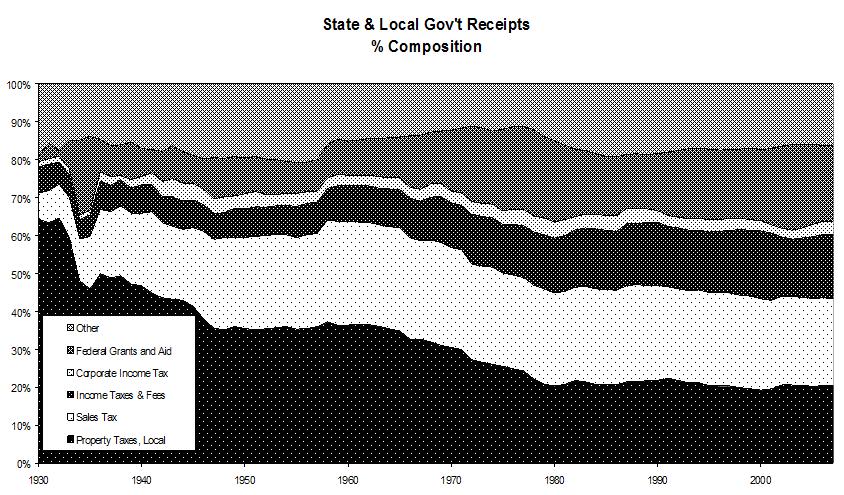


Untaxing real estate has served mortgage bankers by freeing more rental income (the land’s site value) to be paid as interest. Property taxes have not absorbed anywhere near the rise in debt-leveraged housing and commercial prices. However, this has not lowered the cost of housing for most people. New buyers must pay a price that capitalizes the property’s rental value. Less and less of this payment has taken the form of local property taxes. More and more has been paid to mortgage lenders as interest. So cutting property taxes has simply left more revenue to be capitalized into higher debt-financed prices.

While homeowners saw their carrying charges rise, they nonetheless felt more affluent as real estate prices rose – inflated on easier and easier credit terms. Prices rose faster than mortgage debt as long as (1) interest rates were declining; (2) loan maturities were stretched out (ultimately reaching the point of zero amortization rather than the old-fashioned 30-year self-amortizing mortgages); (3) down payments were shrinking toward zero (rather than requiring 20 percent equity as used to be the case) and indeed as “liars’ loans” led prices to be bid up recklessly; and finally (4) cities refrained from raising property taxes as fast as market prices were rising. This left more revenue to be capitalized into higher prices, providing capital gains that home owners were encouraged to treat like “money in the bank” – by taking out home equity loans. This rising mortgage debt was increasingly important in enabling people to maintain their living standards, especially as they had to pay more for housing. So what appeared to be affluence and rising net worth from the value of one’s home on the asset side of the balance sheet found its counterpart in debt on the liabilities side.

From the local fiscal vantage point, these debt-leveraged price gains represented uncollected user fees for the site value provided by public infrastructure and rising prosperity. The bankers ended up with the rising flow of rental value, not the cities. This obliged tax collectors to look to other sources of revenue. So homeowners paid out what they seemed to be saving in modest property taxes in the form of rising sales taxes and income taxes.

By 2008 these financial system’s easing of credit terms had reached its limit. No more room for credit inflation remained, so speculators began to withdraw from the market. (They accounted for about one-sixth of demand for housing.) When the credit spigot was turned off, prices plunged – leaving the debts in place. (So taking out a home-equity mortgage was not really like drawing down money from a piggy bank after all. Years of future income had to be diverted to spend for past shortfalls.)

Now that federal aid is falling – along with revenue from sales and income taxes – local budgets are falling into deficit. But for many cities and states, their constitutions and regulations prevent them from running deficits. So they face a number of hard choices.

It is hard to raise property taxes back toward earlier rates, because the rental income already has been pledged to the mortgage bankers. To tax heavily indebted property would lead to more foreclosures and abandonment. And the Obama Administration’s hope that banks somehow will use the Federal Reserve’s tsunami of cheap (0.25%) reserves and credit to re-inflate a new real estate bubble is in vain, because bankers have little interest in lending to property that is still sinking in market price. It is easier to speculate on interest-rate arbitrage with the BRICS and get a foreign-exchange premium as well, or simply to play the market. Banks report winnings in the derivatives trade day after day, with nary a loss – an indication of how poorly their hapless customers and other outsiders must be doing! So the path of least resistance for most cities and states is to cut back spending on public services, and above all on pension plan contributions.

The ultimate sacrifice (and the aim of financial predators) is to sell off public land and buildings, roads and other transportation services, sewer systems and other basic infrastructure. In this aim, the investment bankers are being aided and abetted by the credit ratings industry, threatening to downgrade cities that do not sell off their public domain. In this respect the financial end-game of privatization is similar in the United States to pressures by the European Central Bank to force the indebted PIIGS economies to engage in privatization sell-offs, Third World and post-Soviet style.

Just as in Europe, when revenues are squeezed and something must give – either debt service, payment to pensioners or current payments to labor – the financial sector is seeking to take all the available surplus for itself. This puts creditors in the forefront of today’s class war against labor.

On the eve of the September 2008 financial crash, cities such as Birmingham, Alabama and Chicago already were looking for ways to cope with the fiscal squeeze imposed by political pressures from the major local campaign contributors – the real estate and banking sectors – to cut property taxes. One seeming path of little resistance was to gamble in the Wall Street financial casino, hoping to make easy gains rather than making landlords, wage earners or consumers pay higher taxes.

Landlords and bankers encouraged this speculation as an alternative to taxing property. Landlords wanted to pay less in property taxes, and banks knew that whatever rental value buyers could save in the form of lower taxes would end up being used to bid up prices to capitalize into debt service for mortgages to buy properties up for sale.

Here is the dilemma that states and cities now face: So much urban property is sinking into negative equity territory that a rise in property taxes will lead to even more foreclosures and abandonments, and hence even lower fiscal returns. To avoid this, cities are seeing Chapter 9 bankruptcy as the main route to free themselves, especially from problems that stem from an unwarranted trust in bankers to help them out of the earlier fiscal squeeze by putting them into losing financial gambles. Orange County in California successfully sued Merrill Lynch to recover damages, and Birmingham also was awarded recovery payments from JP Morgan Chase.

Birmingham and Chicago as microcosms of the national debt squeeze

Now that financial fraud has been decriminalized for all practical purposes, most financial victims are obliged to sue for reimbursement in civil court without much help from prosecutors. Alabama’s state capital Birmingham is a case in point. After a predatory financing arrangement to upgrade its sewers in 2008 forced its Jefferson County into bankruptcy, the Securities and Exchange Commission (S.E.C.) negotiated $75 million in fines and reimbursement of fees to be paid by JP Morgan Chase as lead lender and negotiator for the complex interest-rate swaps they had advised the country to take, ostensibly to protect its economic interest. The banks also forfeited nearly ten times this sum ($647 million) in termination fees. But the court-appointed receiver grabbed the $75 million settlement for payment on the debts the country still owed.

As usual, the banks had paid the fine and made reimbursement without admitting any wrongdoing. To the financial sector, deception and fraud is part of the game, after all, not a tactic that can be prosecuted as criminal. They paid their fines without admitting any wrongdoing, and without even admitting the S.E.C. charges. They merely paid up and kept silent – while the Justice Department and Internal Revenue Service were still in the time-taking process of ruling on legal claims brought by Jefferson County. The case prompted bankers and bondholders to bring pressure on the state of Alabama to take responsibility (that is, take on the debt liability) all on behalf of statewide taxpayers, and to demand that all lawsuits brought for financial fraud to be dropped.[1] “Responsibility” is supposed to be only for debtors, not for the financial sector itself. This is how the banks have managed to rewrite the laws, after all.

Jefferson County is now debating whether to declare Chapter 9 bankruptcy to free itself from debts that can be paid only at the cost of disrupting economic continuity and living standards. The city’s debt quandary is a microcosm for the U.S. economy as a whole. Its lowest-income residents are burdened with financialized charges for sewer-system debt payments so far beyond their ability to pay that they face the same fate as Latvians, Irish and Greeks: As the local economy shrinks, they must move in order to find jobs – in places less debt-burdened and hence lower-cost. The “free market” choice is to emigrate to flee the debts imposed on their economies and on themselves personally.

Well-to-do Birmingham families have yards large enough to have their own septic tanks as an alternative to paying for access to sewers, but lower-income families living in small houses or apartment buildings lack this option. One county commissioner asked: “Why should the poor have to pay for the ill-gotten gain of some of these banks who poisoned the well in the very first place?”[2] Other commissioners demanded that bondholders “bear the entire cost of a $20 million fund that is being created to help low-income residents pay their sewer bills.”[3]

But the government usually provides relief only for creditors – above all, relief from criminal prosecution for their business plan that involved making loans beyond the debtors’ ability to pay. Some states have fraudulent conveyance laws to prevent this, as well as to prevent banks from misrepresenting the quality of their loans to outside investors. There are laws to punish appraisers who give false appraisals, and mortgage brokers who fill in false income reports to qualify for loans. But the S.E.C. has seen its staff and budget slashed and deregulators appointed to oversee its affairs. It has no authority to prosecute, only to make recommendations to the Justice Department, where Attorney General Eric Holder has followed the Obama Administration’s support of Wall Street, feeling no obligation to live up to the promises to make that a change from the Bush Administration’s similar lax behavior.

The financial sector recognizes a dimension of economic behavior that textbooks politely refrain from citing: the ability to capture regulatory agencies, gain control of the courts and buy control of politics. The Supreme Court has ruled that corporations have the same rights as individuals to contribute to campaigns, a euphemism for buying the loyalty of politicians and judges, and obtaining veto power over regulatory appointees. Corporations pay lower income-tax rates and are free of value-added and excise or other sales taxes paid by consumers.

Unlike real people, corporations cannot be sent to jail. Corporate shells shield owners and managers from criminal prosecution for the wholesale frauds that have left Countrywide Financial, Bank of America, Citibank, JP Morgan Chase and other pillars of the banking community free to make civil settlements for deceptive policies without admitting wrongdoing. And whereas individual crooks need to pay their own lawyers, corporations pick up the tab for their managers, while contributing generously to politicians who rewrite the laws to decriminalize fraud and deceptive business dealing. The corporate-backed media applaud politicians who insist that families “take responsibility” for their unemployment risk, debts and health care – while bailouts free the wealthy from having to suffer losses on bad loans.

Rhode Island recently rewrote its laws to place bondholders ahead of other creditors, including pension recipients. Under the new law, “city officials who intentionally fail to pay bondholders can be removed from office or held personally liable for the payments.”[4] In contrast to the pro-debtor trend of legislation since the 13th century, wealth at the top of the pyramid takes precedence over retired schoolteachers and other public employees. The effect has been for the city of Central Falls, Rhode Island, to seek Chapter 9 bankruptcy protection to avert a 34 percent cut in pensions to its retirees in order to pay bondholders.

Rhode Island is not alone in giving legal priority to bondholders. “Illinois has some of the strongest bondholder protections anywhere, which explains how a state that began its fiscal year with $3.8 billion in unpaid bills from last year – and whose pension system has less than half of the money it needs – is able to keeping selling bonds. State law requires Illinois to make ‘an irrevocable and continuing appropriation’ of tax revenues into a special fund every month that can be used only to pay bondholders.”[5]

Chicago has balanced its budget not by taxing finance and real estate gains, but by selling off its roads and other basic infrastructure. Much as in feudal Europe, the leverage is financial. Privatizers are charging tolls and even installing parking meters on the city’s sidewalks to charge cars for parking by the minute. New York City has slashed is public subway and bus service, extending commuting times and making life harder. It has privatized its television and radio, replacing public airtime with commercial advertising.

The ending of federal revenue sharing will exacerbate local budget constraints. The fact that many cities and states have constitutional requirements of balanced budgets – just as Republicans advocated for the federal government in the 2011 debt-ceiling agreement – requires that taxes be raised, public services cut, or assets sold off. California’s Proposition 13 prevents the state from raising property taxes in keeping with market prices, tying its hands fiscally and obliging it to commercialize its once-great university system. Students must now take on enormous education debt for what formerly was free or subsidized. New York City’s real estate tax likewise favors large investors and wealthy homeowners, at the expense of co-ops and condominium owners in apartment buildings. The rising rental value that local tax collectors relinquish does not lower housing costs; it merely enables the land’s site value to be paid to bankers. Rising debt-inflated housing prices have priced the city out of the market as the manufacturing center it formerly was. Its textile buildings and other industrial properties have been gentrified, leaving it a one-industry (finance) town focused on Wall Street.

At the international level, Irish voters confirmed the policy of taking bad European Central Bank advice to put the interest of bondholders first by taking bad bank loans onto the government’s balance sheet and taxing the population to make up the losses, even at the cost of imposing a generation of debt-strapped depression on their economy. This is the self-destructive road to debt peonage that the IMF and World Bank forced Third World countries to follow for many decades. The fact that this ethic reverses centuries-long social values promises to make the great debate of the 21st century over the issue of which debts are paid and which will not be – and how much debts should be written down.


Notes
 

[1]
Mary Williams Walsh, “A County in Alabama Puts Off Bankruptcy,” The New York Times, August 13, 2011.
[2] Michael Corkery and Kelly Nolan, “Alabama Bankruptcy Fight Hinges on Sewer-Rate Increase; Impact on Poor Bedevils Deal,” Wall Street Journal, August 11, 2011.
[3] Michael Corkery and Michael Aneiro, “Alabama County Rejects Creditor Plan but Delays Bankruptcy Decision,” Wall Street Journal, August 13, 2011.
[4] Michael Corkery, “Bondholders Win in Rhode Island,” Wall Street Journal, August 4, 2011.
[5] Mary Williams Walsh and Michael Cooper, “Faltering Rhode Island City Tests Vows to Pensioners,” The New York Times, August 13, 2011. The article adds that: “The federal bankruptcy code says pensioners and general-obligation bondholders are both unsecured creditors, stuck at the back of the line and treated as equals. But there is maneuvering room in the welter of state and federal laws.”

Six laid off in state Attorney General's Office #Minnesota

Six laid off in state Attorney General's Office

By Joe Kimball | Published Fri, Aug 26 2011 2:44 pm 

Five attorneys and a legal assistant have been laid off in the Minnesota Attorney General's office, after the Legislature cut $2.35 million from the agency's two-year budget.

The staff is being reorganized, and more savings will come from attrition through retirement, the office said in a statement.

And:
The general fund of the Attorney General’s Office (“AGO”) has been substantially reduced over the past ten years, from $28,852,000 in 2001 to $21,029,000 in 2011. In adjusted dollars, this represents a budget cut of over 40 percent.

Because 80 percent of the budget is personnel, staff cuts were needed to meet the lower budget numbers.
Ten years ago the office had 525 personnel, and was the largest public law office in the state. Today, the office, with about 300 employees, is substantially smaller in size than several metropolitan county attorney offices, the statement said.

Tuesday, September 6, 2011

New School Year Brings Steep Cuts in State Funding for Schools — Center on Budget and Policy Priorities

New School Year Brings Steep Cuts in State Funding for Schools — Center on Budget and Policy Priorities

y Phil Oliff and Michael Leachman *
Updated September 2, 2011
As a new school year begins, elementary and high schools are receiving less state funding than last year in the great majority of states for which the necessary data are available, and are now funded at below pre-recession levels in most of these states. In at least 10 states, the shortfall compared with pre-recession levels exceeds 10 percent.

These are the results of an initial analysis of state budget documents in 24 states where the necessary data were available. These 24 states include about two-thirds of the nation's school-age population.

The analysis illustrates the continuing effect on state-funded services like education of the 2007-09 recession and slow recovery. The failure of the federal government to extend emergency fiscal aid to states and school districts and the failure of most states to enact needed revenue increases have exacerbated the cuts.
Specifically, 21 of the 24 states analyzed are providing less funding per student to local school districts in the new school year than they provided last year, and 17 of the 24 are providing less than they did before the recession, after adjusting for inflation. In 10 of these 24 states, per student funding is down by more than 10 percent from pre-recession levels. The three states with the deepest cuts — South Carolina, Arizona, and California — each have reduced per student funding to K-12 schools by more than 20 percent.

State-level K-12 spending cuts of this magnitude have serious consequences for the national economy, both by reducing purchasing power in the short run and by undermining the nation's economic competitiveness in the long run.
  • State-level K-12 cuts have large consequences for local school districts. Some 47 percent of total education expenditures in the U.S. come from state funds (the exact share varies by state). Cuts at the state level mean that local school districts have to either scale back the educational services they provide, raise more revenue to cover the gap, or both. In particular, the cuts may have particularly affected school districts with high concentrations of children in poverty. States typically distribute general education aid through formulas that target additional funds to school districts with large shares of low-income and other high-need children and/or with lower levels of taxable wealth. As a result, reductions in "formula" funding may result in particularly deep cuts in general state aid for poorer districts unless a state goes out of its way to protect them.
  •  
  • The cuts have extended the recession and slowed the recovery. Federal employment data show that school districts began reducing the overall number of teachers and other employees in August 2008, when the first round of budget-driven cuts began taking effect. The job losses have accelerated in the last year as the cuts have deepened; by July 2011, local school districts had cut 229,000 jobs nationally. These job losses have reduced the purchasing power of workers' families, in turn reducing overall consumption in the economy and thus extending the recession and slowing the pace of recovery.
  •  
  • A further negative economic consequence of the cuts is that they counteract and sometimes undermine education reform and more generally hinder the ability of school districts to deliver high-quality education, with long-term negative consequences for the nation's economic competitiveness. Many states have undertaken a number of important school reform initiatives to prepare children better for the future, but deep funding cuts counteract and sometimes undermine these reforms. At a time when the nation is trying to produce workers with the skills to master new technologies and adapt to the complexities of a global economy, large cuts in funding for basic education threaten to undermine a crucial building block for future prosperity.
  •  
  • Local school districts typically have little ability to replace lost state aid on their own. Given the sorry state of many of the nation's real estate markets, it is difficult for many school districts to raise more money from the property tax without raising rates — and rate increases are often politically very difficult. As a result, property tax and other local revenues were actually lower in the 12- month period ending in March 2011 than they were the previous year. However, at least some localities are considering and in some cases enacting property tax increases — a sign of the challenges that schools face.

States Are Cutting K-12 Education Formulas -- the Primary Funding Source for Schools

States typically distribute the largest share of their K-12 education funding through formulas that allocate money to school districts, with some share of the funds often targeted to districts that have higher levels of student needs (such as the concentration of students from low-income families) and less ability to raise funds from local revenue sources (primarily the local property tax).

To help states sustain their education systems during the recession, the federal government in recent years has provided emergency education aid to states. Under the State Fiscal Stabilization Fund established by the American Recovery and Reinvestment Act (ARRA) in 2009, states received $39 billion in federal aid targeted at K-12 and higher education funding. And through the Education Jobs Fund enacted by Congress in August 2010, states received an additional $10 billion in federal aid aimed at saving education jobs in schools, colleges, and universities.

States distributed most of the portion of this funding that went to K-12 school districts using the same formulas they normally use to distribute state education funding. Indeed, both ARRA and the Education Jobs Fund generally required states to distribute the funding in this way. [1]

Both ARRA and the Education Jobs Fund required states to maintain their K-12 education spending at certain levels, to assure that the federal aid was used as intended to help states sustain their education systems during the recession.[2]

ARRA also provided states with much more narrowly targeted forms of federal education aid. For example, ARRA provided $13 billion in targeted, additional aid for schools with a large share of low-income students (Title I schools), and $12 billion in aid targeted to help schools sustain education programs for disabled students. These funds are targeted to particular student populations and hence typically are not distributed through the funding formulas used to distribute general state aid.

Cuts to state formula funding often have very large consequences for local school districts. Some 47 percent of total education expenditures in the U.S. come from state funds (the exact share varies by state), and most of that is through the formulas. Cuts at the state level mean that local school districts have to either scale back the educational services they provide, raise more revenue to cover the gap, or both. In addition to the funding distributed through general aid formulas, states may or may not use separate allocations to fund items such as pupil transportation, contributions to school employee pension plans, and teacher training; some of those allocations also have been cut.

Moreover, since states typically distribute general education aid through formulas that target additional funds to school districts with large shares of low-income and other high-need children, reductions in "formula" funding may result in particularly deep cuts in general state aid for districts with high concentrations of low-income students. ARRA's additional federal aid for Title I schools and for schools serving disabled students helped soften the blow of the recession on the children in these schools. But with the federal aid now expiring, reductions in state formula funding may be pulling in the opposite direction by reducing funding disproportionately for districts with high concentrations of low-income students. (A number of states, such as New Jersey, are under court order to avoid cuts that hurt high-poverty districts, in which case middle-income districts may be hit harder.)

States Have Cut Education Formula Funding Deeply Since the Recession Began

As of late August 2011, there are 24 states for which data are readily available to compare state K-12 formula funding in the current school year with funding in earlier years.[3] (Other states publish education funding data in ways that make it more difficult to make historical comparisons, but it is reasonable to suspect that some or many of those other states also are cutting education funding.) These 24 states are home to two-thirds of the nation's schoolchildren. Overall, these states have been facing levels of fiscal stress that are roughly reflective of the nation as a whole, with average shortfalls closed as a share of their budgets for fiscal year 2012 very close to the national average.[4]

School Funding in 2011-12 Compared with 2007-08

Based on the data available in these 24 states, cuts to state education formula funding since the start of the recession have been widespread and very deep. This survey finds that, after adjusting for inflation:
  • Over two-thirds of the states — 17 of the 24 states surveyed — are providing less per-student funding for K-12 education in the current 2012 fiscal year than they did in fiscal year 2008, just before the start of the recession.

    Why a Few States Are Increasing Education Funding

    While most states are cutting spending on education, as the figures in this analysis show, a few states are boosting it. A few states such as Alaska and Montana have not suffered the same level of economic problems as other states, and thus they have enacted fewer budget cuts. In other states, the growth in spending reflects policymakers' prioritization of education funding in the face of fiscal stress. For example Maryland was already embarking on a program of increased state aid for local school districts when the recession hit, and chose largely to maintain that program. Massachusetts' and Iowa's spending growth reflects lawmakers' decisions to maintain education funding even as these states cut programs in other areas. Maryland and Massachusetts also raised significant amounts of revenue after the onset of the recession, which lessened the need to scale back education funding.
  • In well over one-third or 10 of the 24 states, per student funding is dropping more than 10 percent below pre-recession levels.
  •  
  • The three states with the deepest cuts — South Carolina, Arizona, and California — each are reducing per student funding by more than 20 percent from pre-recession levels.

School Funding in 2011-12 Compared with 2010-11

Some of the deepest reductions to K-12 formula funding since the onset of the recession have occurred in the past year, as federal aid intended to sustain state education spending has expired, rainy day funds have been exhausted, and states have resisted raising additional taxes to offset the need for cuts. After adjusting for inflation between last year (fiscal year 2011) and the current 2012 fiscal year:
  • Almost all states for which data are available — 21 of the 24 states — have cut per student education funding.
  • Seventeen of the 24 states have cut per student funding by more than two percent.
  • Eleven of the 24 states have cut per student funding by more than five percent.
  • Of the states surveyed, the three states that reduced per student funding the most since last year are Illinois, Texas, and Wisconsin. Illinois cut per student spending by 13 percent, while Ohio and Texas imposed cuts of about 10 percent.
These cuts are occurring at a time when schools face demands from parents, employers and civic leaders to bring more and more students to higher levels of academic proficiency, in large part because workers will increasingly need higher levels of educational attainment to thrive in the workforce.

Why This Happened

It is not just K-12 education that is being cut. States are cutting funding for higher education, for health care, for human services, and a range of other areas of spending.[5] States have enacted these cuts primarily because the recession caused state revenue to decline sharply as costs increased. In addition, the federal government has not offered additional emergency fiscal aid and few states raised new revenue this year.

  • Revenues remain depressed. With unemployment still high and housing values still depressed, people have both less income and purchasing power. As a result, income and sales tax revenue — the main sources of revenue states use to fund education and other services — is still low. Of the 44 states that have released the necessary data, 36 project that they will have less state revenue in 2012 (after adjusting for inflation) than they did in fiscal year 2008, when the recession began. These states on average balanced their budgets based on fiscal year 2012 revenue projections that were seven percent lower than before the recession, after adjusting for inflation.[6] While state revenues are starting to improve across the country, the rate of growth is generally slow.
  •  
  • Costs are rising. The cost of meeting people's needs has increased since the recession began, due both to demographic changes and to the recession. In the upcoming 2011-12 school year, the U.S. Department of Education projects that there will be about 260,000 more K-12 students and another 1.5 million more public college and university students than in 2007-08, for example.[7] Some 5.6 million more people are projected to be eligible for subsidized health insurance through Medicaid in 2012 than were enrolled in 2008, as employers have cancelled their coverage and people have lost jobs and wages.[8]
  •  
  • Emergency federal aid is mostly depleted. States used emergency fiscal relief from the federal government (including both education aid and other forms of state fiscal relief) to cover about one-third of their budget shortfalls through the 2011 fiscal year, which ended on June 30 in most states. Only about $6.7 billion in fiscal relief remains for the current 2012 fiscal year, a year in which states faced shortfalls totaling at least $103 billion. That is, the remaining fiscal relief covers less than seven percent of state budget shortfalls for the fiscal year that just began.

    Nearly all the aid remaining is explicitly targeted to education, but it is mostly depleted. For the current 2012 fiscal year only about $2 billion of the $39 billion in education aid under ARRA's State Fiscal Stabilization Fund remains, and only about $4 billion of the $10 billion from the Education Jobs Fund remains. In total, then, only about $6 billion or roughly 13 percent of the federal aid targeted explicitly to supporting general state education funding remains.[9] Since this education aid is intended to help states sustain both their K-12 systems and their higher education institutions, not all of the remaining education funds will go to K-12 schools.

    Not only is emergency federal aid largely depleted, federal policymakers are making state budget problems worse by deeply cutting the amount of ongoing federal funding to states. The recent debt limit deal likely will lead to well over half a trillion dollars in cuts in "non-security discretionary" funding over the next decade. Fully one-third of this category of federal spending flows through state governments in the form of funding for education, health care, human services, law enforcement, infrastructure, and other services that states and localities administer. Large cuts in federal funding to states would force states to make still-deeper cuts in their budgets. The cuts to state aid could start as soon as federal fiscal year 2012, which begins October 1, 2011.

    Congress could spare aid to states while taking all the required savings from purely federal areas of spending, like the FBI and the National Institutes for Health. But that's extremely unlikely, since the resulting cuts in those areas would be prohibitively large.

  • In addition, if the committee charged with recommending further deficit-reduction measures reaches agreement, the additional cuts likely will further reduce federal funding for states. If the committee fails to reach agreement, the automatic, across-the-board cuts that will occur will mean even deeper cuts to non-security discretionary funding.
  •  
  • Few states raised new revenue this year. While more than 30 states raised revenue to help close their budget shortfalls earlier in the recession, this year few states raised new revenue; most depended entirely on spending cuts.

The Cuts Have Serious Consequences

States' large cuts in spending on education have serious consequences for the economy, both in the short and long term. They also counteract and sometimes undermine important state education reform initiatives, and put upward pressure on local property taxes.

Damage to the Economy, Now and in the Future

State education budget cuts have deepened the recession and slowed the pace of economic recovery by reducing overall economic activity. The spending cuts have forced school districts to lay off teachers and other employees, reduce pay for the education workers who remain, and cancel contracts with suppliers and other businesses. All of these steps remove demand from the economy.
Local school districts already have eliminated 293,000 jobs nationally since August 2008, federal data show. In addition, education spending cuts have cost an unknown but probably very large number of additional jobs in the private sector as school districts cancel or scale back private-sector purchases and contracts (for instance, purchasing fewer textbooks). These job losses shrink the purchasing power of workers' families, which in turn affects local businesses and slows recovery. While it is not possible to calculate directly the additional loss of jobs resulting from state education budget cuts, it appears very likely that school districts will continue to cut jobs and also to cut funding for some private-sector jobs, negating some of the job growth that otherwise would occur in the economy as a whole.

The just-ended school year was the worst yet for school district layoffs, with a net reduction in local education employment (mostly K-12) totaling 194,000 nationally — more than triple the total in the previous year (Figure 5). (Normally, local education employment grows each year in large part to keep pace with an expanding student population.) And the coming year may not be any better. States just closed budget shortfalls totaling over $100 billion for the current 2012 fiscal year, which started on July 1 in most states. In most states, the shortfalls were closed almost entirely with spending cuts, including deep cuts in funding for elementary and high schools.[10]

Moreover, in the long term the savings from today's cuts may cost states much more in diminished economic growth. To prosper, businesses require a well-educated workforce. The deep education spending cuts states have enacted will weaken that workforce in the future by diminishing the quality of elementary and high schools. At a time when the nation is trying to produce workers with the skills to master new technologies and adapt to the complexities of a global economy, large cuts in funding for basic education undermine a crucial building block for future prosperity.

Undermining Education Reform

State education cuts are counteracting and sometimes undermining reform initiatives that many states are undertaking with the federal government's encouragement, such as supporting professional development to improve teacher quality, improving interventions for young children to heighten school readiness, and turning around the lowest-achieving schools, to name just a few. As U.S. Secretary of Education Arne Duncan has said, "It is very difficult to improve the quality of education while losing teachers, raising class size, and eliminating after school and summer school programs." [11]

Some education reforms have moved forward despite reductions in state education funding, in part because ARRA required states to agree to certain reforms before they could receive the aid provided through the State Fiscal Stabilization Fund,[12] and because ARRA offered funds to help states innovate through the competitive "Race to the Top" program.

But deep cuts in state spending on education counteract and sometimes undermine reform initiatives both by limiting the funds generally available to improve schools, and by cutting specific reform initiatives. For example:
  • Research suggests that teacher quality is the most important school-based determinant of student success, and it is a major emphasis of the "Race to the Top" program. [13] For that reason recruiting, developing, and retaining high-quality teachers is widely thought to be critical to improving student achievement. But these tasks are much more difficult when school districts are cutting their budgets. Since teacher salaries make up a large share of public education expenditures, funding cuts inevitably restrict districts' ability to expand teaching staffs and supplement wages. Indeed, numerous school districts have reduced teacher wages through furloughs since the start of the recession and have resorted to hiring freezes. Moreover, Washington state as well as a number of local school districts have cut funding for professional development, which makes it more difficult to develop teachers' skills.
  •  
  • There is evidence to suggest that smaller class sizes can boost achievement, especially in the early grades. Yet small class sizes are difficult to sustain when schools are cutting teaching positions while enrollments increase. [14] Indeed, a survey of school administrators found that 57 percent of respondents increased class sizes for the 2010-11 school year, and 65 percent anticipate doing so for the 2011-12 school year. [15]
  •  
  • Many education policy experts believe that more student learning time can improve achievement.[16] In a number of states and school districts, however, budget cuts are making it more difficult to extend instructional opportunities. For example, funding cuts in Georgia will mean shortening the pre-kindergarten school year from 180 to 160 days for 86,000 four-year-olds. New Jersey's funding cut for afterschool programs will limit structured learning time, and in a 2009 survey of California parents, 41 percent of respondents reported that their child's school was cutting summer programs.[17]

    Moreover, reductions in the education workforce make it less likely that schools will have adequate personnel to teach and supervise students for additional periods of time or to give additional attention to students who are having difficulty learning, despite state and federal goals to lessen disparities among achievement levels. Cuts that limit student learning time are likely to intensify in the coming year. The school administrators' survey mentioned above found that 17 percent of respondents were considering shortening the school week to four days for the 2011-12 school year and 40 percent were considering eliminating summer school programs.[18]
  •  
  • As of the 2009-10 school year, 40 states provided pre-kindergarten or pre-school programs, serving 1.3 million children.[19] A number of studies conclude that such programs can improve cognitive skills, especially for disadvantaged children.[20] Since the start of the recession, however, Arizona, Florida, Georgia, Illinois, Massachusetts, North Carolina, Texas and other states have cut funding from early education programs to help close their budget shortfalls. This year, Texas eliminated state grants for pre-K expansion programs that serve around 100,000 mostly at-risk children, or more than 40 percent of the state's pre-kindergarten students.

Impact on Property Taxes and Other Local Revenues

State budget cuts are also placing upward pressure on property taxes and other local revenues, because increasing these revenues is one of the few ways school districts can compensate for the loss of state funding.
Given the precipitous decline in property values since the start of the recession and in many places the political and/or legal difficulty of raising property taxes, raising significant additional revenue through the property tax will likely be very difficult for school districts in the coming years. Indeed, property tax collections were lower in the 12-month period ending in March 2011 than in the previous 12 months. [21]

Despite the obstacles to raising local revenues, however, there are at least a few districts that are considering, or implementing property tax increases. For example, the Granite School District and the Davis School District, two of the three largest school districts in Utah, recently raised property tax rates by six percent and nine percent respectively to compensate for cuts in state funding and growing enrollments. [22] The city of Chicago is considering raising property taxes to the maximum allowed by law to fund city schools, in part in response to cuts in state education funding.[23] The Eagle County School District in Colorado will ask voters to approve a $6 million increase in property taxes, in part to make up for declines in state aid, this coming November.[24]

Beyond increasing local revenues, school districts' options for preserving education services are very limited. Some localities could divert funds from other local services to shore up school district budgets. But this would sustain education spending at the expense of services like police and fire protection.

End Notes:
[*] Kwame Boadi, Dylan Grundman, Andrew Hartsig, Christine Mai, and Katherine Sydor conducted much of the research for this report.
[1] ARRA's State Fiscal Stabilization Fund required governors to use the funds "to allow existing State formulae increases to support elementary and secondary education . . . to be implemented and allow funding for phasing in State equity and adequacy adjustments. . . ." The Education Jobs Fund required states to distribute the funds through either their primary funding formula or based on each district's share of Title I funds.
[2] ARRA required states to maintain their spending in fiscal years 2009, 2010, and 2011 at a minimum of FY2006 levels, unless they received a waiver from the Secretary of Education. The Education Jobs Fund required states to maintain their spending in FY2011 at FY2009 levels and also at the same share of total revenues as in FY2010. Under certain circumstances, states alternatively could maintain their spending in FY2011 at FY2006 level and also at the same share of total revenues as in FY2006. There was a separate "maintenance of effort" requirement for Texas.
[3] The education funding totals presented in this paper correspond to the funding distributed through states' major education funding formulas, including the federal funds distributed through these formulas -- ARRA's State Fiscal Stabilization Fund and the Education Jobs Fund. In general the funding totals do not include any of the more narrowly targeted forms of federal education aid in ARRA such as Title I funding. However, in a number of cases it was impossible to isolate funding from these sources; hence, in these cases the more targeted forms of federal aid may be included in the totals as well. The numbers do not include any local property tax revenue or any other source of local funding. Please also note the following state specific details: California's numbers reflect General Fund Proposition 98 spending for K-12 education and exclude child care funding which was removed from Proposition 98 spending in FY2012. Maryland's numbers include funding for the state's foundation program as well as funding for compensatory education, aid for local employee fringe benefits, formula programs for specific populations, and limited English proficiency programs. Mississippi's FY2012 numbers exclude $50 million appropriated for debt payments. New York's numbers reflect school districts' fiscal years (which end June 30), rather than the state's fiscal year (which ends March 31 st). Ohio numbers include line items for state and stimulus funded foundation funding, as well as school district property tax replacement funds that are also considered to be part of the school funding formula. South Carolina's numbers do not include federal aid. Wisconsin's numbers include high poverty aid.
[4] States in this survey faced FY12 budget shortfalls that were 15 percent of their collective budgets. States nationwide faced shortfalls that were 14.8 percent of their collective budgets.
[5] Erica Williams, Michael Leachman, and Nicholas Johnson, State Budget Cuts in the New Fiscal Year Are Unnecessarily Harmful, Center on Budget and Policy Priorities, updated July 28, 2011, available at http://www.cbpp.org/cms/index.cfm?fa=view&id=3550.
[6] This figure refers to revenues projected to be available for states' operating budgets — typically referred to as general fund revenues. While there is some variation by state, general fund revenues are typically revenues collected by the state, such as income and sales taxes. As with the spending figures in this paper, there are a couple of exceptions. In Connecticut and Massachusetts, operating revenues include federal funds and non-general state revenue. For the sake of comparison with other states in this paper, we have netted out federal funds from Massachusetts's revenue figures and all identifiable federal funds from Connecticut's revenue figures. Also, to be consistent with previous years, California's general fund revenue total for FY2012 includes $5.1 billion associated with the realignment of certain services to local governments.
[7] U.S. Department of Education, Condition of Education 2011, tables A-2-1, A-8-1, and A-9-1.
[8] CBPP calculations based on data from the Congressional Budget Office and Centers for Medicare and Medicaid Services.
[9] There is also about another $4 billion left from ARRA's additional federal aid for Title I schools and about $2 billion left for schools educating students with disabilities. That's about one-fourth of the total ARRA funds allocated for these two purposes. These funds are helping schools educate low-income and disabled students more effectively than they would otherwise, and to some extent in certain schools they are counteracting the cuts in state formula funding.
[10] Erica Williams, Michael Leachman, and Nicholas Johnson, State Budget Cuts in the New Fiscal Year Are Unnecessarily Harmful, Center on Budget and Policy Priorities, updated July 28, 2011, available at http://www.cbpp.org/cms/index.cfm?fa=view&id=3550.
[11] Education Secretary Arne Duncan's Testimony Before the Senate Appropriations Subcommittee on Labor, Health and Human Services, Education, and Related Agencies Regarding the FY 2011 Education Budget — April 14, 2010, http://www.ed.gov/news/speeches/secretary-arne-duncans-testimony-senate-appropriations-subcommittee .
[12] To receive ARRA's State Fiscal Stabilization Fund money, states had to assure that they would "take actions to: (a) increase teacher effectiveness and address inequities in the distribution of highly qualified teachers; (b) establish and use pre-K-through-college and career data systems to track progress and foster continuous improvement; (c) make progress toward rigorous college- and career-ready standards and high-quality assessments; and (d) support targeted, intensive support and effective interventions to turn around schools identified for corrective action and restructuring." (Language from U.S. Department of Education fact sheet about the State Fiscal Stabilization Fund, available at http://www2.ed.gov/policy/gen/leg/recovery/factsheet/stabilization-fund.html .)
[13] See for example, "Empowering Effective Teachers: Readiness for Reform", Bill and Melinda Gates Foundation Research Brief, February 2010 http://www.gatesfoundation.org/united-states/Documents/empowering-effective-teachers-readiness-for-reform.pdf.
[14] See Education Commission of the States, State Notes, "State Policies Focusing on Class Size Reduction," updated by Kyle Zinth, September 2009.
[15] Noelle M. Ellerson, American Association of School Administrators, Surviving A Thousand Cuts: America's Public Schools and the Recession, December 2010, p. 4.
[16] See for example, Center for American Progress, "Expanded Learning Time By the Numbers," April 22, 2010 at http://www.americanprogress.org/issues/2010/04/elt_numbers.html .
[17] California PTA, "State PTA Survey: Budget Cuts Hurting Schools and Children," http://archive.constantcontact.com/fs089/1102168765122/archive/1102578911081.html .
[18] Noelle M. Ellerson, American Association of School Administrators, Surviving A Thousand Cuts: America's Public Schools and the Recession, December 2010, p. 4.
[19] Steven Barnett, et. al., The State of Preschool 2010, National Institute for Early Education Research, available at http://nieer.org/yearbook/.
[20] Ibid. See also Julia Isaacs, "State Research Brief #1: State Pre-Kindergarten," Impacts of Early Childhood Programs, September 2008, http://www.brookings.edu/~/media/Files/rc/papers/2008/09_early_programs_isaacs/09_early_programs_brief1.pdf .
[21] See Lucy Dadayan, "Robust Revenue Gains Continue in First Quarter and Early Second Quarter," The Nelson A. Rockefeller Institute of Government, July 2011.
[22] See Rosemary Winters, "Granite School District OK's $5 Million Tax Boost," The Salt Lake Tribune, August 2, 2011, and "Davis School Board Approves 9.3 Percent Property Tax Increase," Deseret News, August 17, 2011.
[23] See for example, John Byrne, "Emanuel Defends Property Tax Increase for Chicago Schools," Chicago Tribune, August 9, 2011.
[24] See Randy Wyrick "Eagle County Schools to ask for $6M More," Vail Daily, August 25, 2011, http://www.vaildaily.com/article/20110824/NEWS/110829884/1078&ParentProfile=1062 .

Monday, July 25, 2011

Bachmann: T-Paw left 'a multi-billion-dollar budget mess' plus more . .

http://www.minnpost.com/dailyglean/2011/07/25/30276/bachmann_t-paw_left_a_multi-billion-dollar_budget_mess


By Brian Lambert | Monday, July 25, 2011
Well, after taking digs from T-Paw for most of the last couple weeks, Our Favorite Congresswoman has dropped all pretense of observing the Republican 11th Commandment and blasted away. L.A. Holmes of FoxNews reports: “In a campaign email to supporters Sunday afternoon, Bachmann defended her ‘real world’ successes and excoriated Pawlenty for ‘leaving a multi-billion-dollar budget mess’ in Minnesota, which led to a government shutdown in the state early July. ‘Real world actions speak louder than the words of career politicians,’ the statement concludes. ... In the middle of it she also says, “I bring a record of success in the real world in business, the law, and in fighting for our principles. I am self-made. I worked my way through school. I have a post-doctorate degree in federal tax law from William and Mary. I worked in the US Federal Tax Court as a federal tax litigation attorney. I am a job creator. My husband and I built a successful private company from scratch. In Minnesota, I led an unprecedented effort to reform education —repealing intrusive regulations that hampered the ability of parents and educators to provide a quality education for their children.” As woozy as I always get when she starts talking about “the real world,” I have to wonder, given Pawlenty’s poll numbers, why she’s even mentioning him in public?

For his part, T-Paw, reports the AP, fired back: “Pawlenty spokesman Alex Conant said, "The difference is that when Governor Pawlenty was scoring conservative victories ... Congresswoman Bachmann was giving speeches and offering failed amendments, all while struggling mightily to hold onto the most Republican house seat in the state."
T-Paw’s real high point of the weekend, though, was going on CNN and, according to the AP, saying: “If you're the leader of the free world, would you please come to microphone and quit hiding in the basement about your proposals, and come on up and address the American people? Is he chicken?" Why am I thinking of Albert Brooks in “Broadcast News”?

A note on the other downside of selling bonds backed by tobacco revenue to resolve the budget stand-off. The AP’s Scott Karnowski writes: “The budget deal that ended Minnesota's government shutdown relies heavily on $640 million borrowed against money from the 1998 tobacco settlement. The strategy allows Democratic Gov. Mark Dayton and Republican legislative leaders to avoid the same amount in spending cuts or tax increases. But it could cost as much as $640 million in interest — plus a substantial annual revenue loss for years to come.” Hey, better to blow $640 million than cripple a “job provider.”

Way over in Poughkeepsie, Chuck Raasch at the Poughkeepsie Journal writes about driving through Minnesota during The Shutdown. Eventually he says: “In a vigorous democracy people argue about the amount of taxes they are willing to pay to build and maintain roads that get them to the lakes. But in the protracted, nasty budget and deficit fights here and nationwide, some have shorthanded ‘the government’ into the enemy of the people. Some always seem to wish for shutdowns to show government is unneeded. Real reasons exist to think government at all levels has gotten too big. But equally destructive is this idea of government inherently as enemy. It makes the people the foes of their own commonwealth. Such positions make it that much tougher to decide what is essential, and how to do it the best. It lets politicians dig in on campaign pledges [that] are not practical to solving issues in a diverse country. While we try to bury debts and deficits, maybe such absolutes can be buried with them.” Hmmm, “equally destructive”?

Sunday, March 6, 2011

~ Michael Moore in Madison: TAX THE RICH ! ~


Link goes to the excellent The Uptake video of Michael Moore's Madison speech, March 5th.

Here's a link to the text:

An excerpt:

Michael Moore at Madison, Wisconsin workers' rights rally March 5, 2011. He says the few that have the most money don't want to pay their fair share of the taxes. "They would rather invest in the gambling casino known as wall street. Betting for or against the stock market or against your home mortgage and the entire population suffers because that wealth has been removed from circulation. What's so cynical about this is the very people who don't pay their taxes crashed our economic system. They created the unemployment which has caused less tax revenue. And states like Wisconsin have ended up with a so-called budget crisis . But Wisconsin is not broke. It's one of the three biggest lies of the last decade. What are the three biggest lies? Let's repeat them. Number one, Wisconsin is broke. Number two, there's weapons of mass destruction in Iraq. And number three, the Packers need Farve in order to win the Super Bowl. The nation is not broke my friends. There's lots of money to go around. Lots! Lots! It's just that those in charge have diverted that wealth into a deep well that sits on their well-guarded estates. They know. They know that they have committed crimes to make this happen. And they know, And they know that someday you may want to see some of that money that used to be yours. So they have bought and paid for hundreds of politicians across the country to do their bidding for them."
Questions:

-how much of our money has been moved offshore?
-how much of our economy is defense-based, and just who makes money on perpetual war?
-In NY State, I hear on the News that there is a Wall St Transfer Tax that would put half a penny per stock transaction in the state’s coffers, but the Tax is not used and hasn’t been since the Eighties, this alone would put NY out of debt…anyone know about that?

How much of the estate tax is being paid in Minnesota?

Why Governor Dayton who despite their being a $5 bn deficit calling off the tax the rich surcharge?  Doesn't he realize paying down debt costs alot of money?

-Also they say if we simply went back to the tax rates of 1965, the US would not be running a deficit this yr, is this true?

Let’s take our lesson from the Egyptians and the folks in Wisconsin and so many others across the world who are practicing and reminding us of what Madison called ” the noise of democracy”!Michael Moore in Wisconsin Video


Wednesday, March 2, 2011

A Tax Cut May Carve Into the Budgets of 19 States: NYT

Struggling states could lose as much as $5.3 billion in tax collections during the next few years in an unintended consequence of one of the lower-profile federal tax cuts that President Obama signed in December, according to a report released Tuesday.

Related

Related in Opinion

Blogs

The Caucus

The latest on President Obama, the new Congress and other news from Washington and around the nation. Join the discussion.
The tax-cut package the president signed in December is best known for extending the Bush-era tax rates for two years and giving a one-year payroll tax cut to most Americans. But it included a business tax cut that could blow a hole in state budgets: a provision allowing businesses to deduct the full value of new equipment purchases from their taxes through 2011.
That cut, intended to spur the economy by encouraging businesses to spend more money on equipment, could end up costing 19 states as much as $5.3 billion in lost revenue over the next few years, according to the report, by the Center on Budget and Policy Priorities, a research organization based in Washington.
The 19 states stand to lose money because they link their state tax laws to federal tax law. So the newly allowed federal tax deductions that businesses in those states take will lower their taxable incomes, which would in turn have the effect of driving down state corporate and income tax collections.
The change could cost Illinois, North Carolina, Pennsylvania and other states hundreds of millions of dollars of lost revenue unless they decide to enact laws decoupling their state tax laws from the federal ones, the report said. When similar cuts have been passed before, it noted, many states have chosen to break with federal laws.
But some states do not intend to do so this time. In Pennsylvania, which the report estimated could lose $833 million in revenues over the next few years, the state’s Department of Revenue announced last month that it had settled on a “business-friendly” interpretation of the law that could benefit as many as 117,000 corporate taxpayers.
The department said the new policy would not affect Pennsylvania’s revenues in the long run because companies would simply be taking full deductions now, rather than spreading them out over several years. But this is a hard time for Pennsylvania to give large tax breaks up front: the state faces an estimated $4 billion deficit in the coming fiscal year.
The unexpected tax change is just one example of how difficult it can be for states to perform one of their most important tasks: guessing how much money they will collect in the coming year, so they will know how much will be available to spend.
Those educated guesses, known as revenue estimates, were the subject of another reportreleased Tuesday by the Pew Center on the States and the Nelson A. Rockefeller Institute of Government. It found that errors in those revenue estimates have grown progressively worse during the last three fiscal crises, and that during the first year of the Great Recession states overestimated the amount of money they expected to collect by $49 billion, leading to difficult midyear budget cuts. Some states were off by more than 25 percent, it found.
During periods of economic growth, the report found, states tend to underestimate tax collections, resulting in surpluses at the end of the year. But states tend to underestimate the severity of economic downturns: then, they usually come up with overly optimistic estimates of how much they expect to collect. The report warned that “as forecasting revenue accurately becomes more difficult, states have a tougher time balancing their budgets to provide taxpayers the services they expect and ensuring the long-term fiscal health of the state.”