USuncutMN says: Tax the corporations! Tax the rich! Stop the cuts, fight for social justice for all. Standing in solidarity with http://www.usuncut.org/ and other Uncutters worldwide. FIGHT for a Foreclosure Moratorium! Foreclosure = homelessness. Resist the American Legislative Exchange Council, Grover Norquist and Citizen's United. #Austerity for the wheeler dealers, NOT the people.

USuncutMN supports #occupyWallStreet, #occupyDC, the XL Pipeline resistance Yes, We, the People, are going to put democracy in all its forms up front and center. Open mic, diversity, nonviolent tactics .. Social media, economic democracy, repeal Citizen's United, single-payer healthcare, State Bank, Operation Feed the Homeless, anti-racism, homophobia, sexISM, war budgetting, lack of transparency, et al. Once we identify who we are and what we've lost, We can move forward.
Showing posts with label bank fraud. Show all posts
Showing posts with label bank fraud. Show all posts
Sunday, March 18, 2012


Monday, September 19, 2011
Predatory Lending: Wall Street Profited, Minority Families Paid the Price
Predatory Lending: Wall Street Profited, Minority Families Paid the Price - ACLU
The editorial page of the New York Times recently weighed in on an important but underappreciated aspect of the financial crisis: The systematic targeting of communities of color for risky and unfair loans. As the Times put it:
Pricing discrimination — illegally charging minority customers more for loans and other services than similarly qualified whites are charged — is a longstanding problem. It grew to outrageous proportions during the bubble years. Studies by consumer advocates found that large numbers of minority borrowers who were eligible for affordable, traditional loans were routinely steered toward ruinously priced subprime loans that they would never be able to repay.
Rampant lending discrimination during the housing bubble exposed black and Latino communities to the harshest consequences of the economic crisis. The link between race, subprime lending, and devastating rates of foreclosure has been crystal clear for some time. Researches at Princeton have found, for example, that "the greater the degree of Hispanic and especially black segregation a metropolitan area exhibits, the higher the number and rate of foreclosures it experiences." That same study found that these disparities are due in large part to the disproportionate chance that minority borrowers will receive subprime loans.
As a result, minority families have absorbed a crushing blow from the collapse of the housing market, and the larger economic crisis. According to the Pew Research Center, the median wealth of white households has grown to 20 times that of black households and 18 times that of Hispanic households. These inequalities, moreover, reinforce themselves over the course of generations.
As discussed in a very incisive two-part series that aired today and Thursday on National Public Radio, wealth gaps reproduce themselves as each generation enjoys advantages (or lack thereof) inherited from generation-to-generation. This means that the current racial wealth gaps beget future racial inequality. "Study after study," NPR reported, "shows that white families are more likely than blacks and Hispanics to enjoy certain economic advantages — even when their incomes are similar." The result is an uneven playing field and structural inequality. This is why discriminatory lending is so pernicious. Exposing minority communities to disproportionate rates of foreclosure means that the cornerstone of economic stability and growth for families and communities — home-ownership — simply evaporates.
For all these reasons, the Times is exactly right: Lenders who engaged in such practices should face vigorous enforcement of civil rights law.
But the predatory lenders were only part of the story. Wall Street banks that bundled those mortgages for investors deserve much of the blame. Their nearly insatiable appetite for subprime loans to package and sell on the securities market encouraged lenders to maximize volume at all costs — including by peddling loans with abusive terms and an elevated risk of ending in foreclosure. By signaling its willingness to buy up enormous quantities of subprime loans, Wall Street set the stage for an upsurge in discriminatory lending strategies. Conventional lenders had historically not set up shop in communities of color, so subprime specialists could flood those communities without competing with institutions offering standard loan products. Put simply, Wall Street created a system of incentives in which businesses built on discrimination could flourish.
There is a direct line connecting Wall Street to the discriminatory lenders who caused so much damage to communities of color. Many of the worst lenders folded when the housing bubble burst, but their enablers in the securities market mostly remain in business. The harm they caused will run deep and threatens to exacerbate existing racial disparities, damage that may play out over the course of generations. The response, therefore, must address all of the actors who contributed to discriminatory lending. Going forward, fair lending rules must ensure that Wall Street pays a price when it makes discrimination profitable.
Thursday, September 8, 2011
The State and Local Budget Crisis: Micheal Hudson
The State and Local Budget Crisis
By Michael Hudson
|
|
URL of this article: www.globalresearch.ca/index.
|
|
Global Research, September 6, 2011
|
|
The
cost of the 2011 cutbacks in federal spending will fall most directly
on consumers and retirees by scaling back Social Security, Medicare,
Medicaid and social spending programs. The population also will suffer
indirectly, by lower federal revenue sharing with U.S.
states and cities. The following chart from the National Income and
Product Accounts (NIPA, Table 3.3) shows how federal financial aid has
helped cities shift the tax burden off real estate, although the main
shift has been off property taxes onto income – and onto consumption
(sales) taxes.
State and local revenue, 1930-2007.
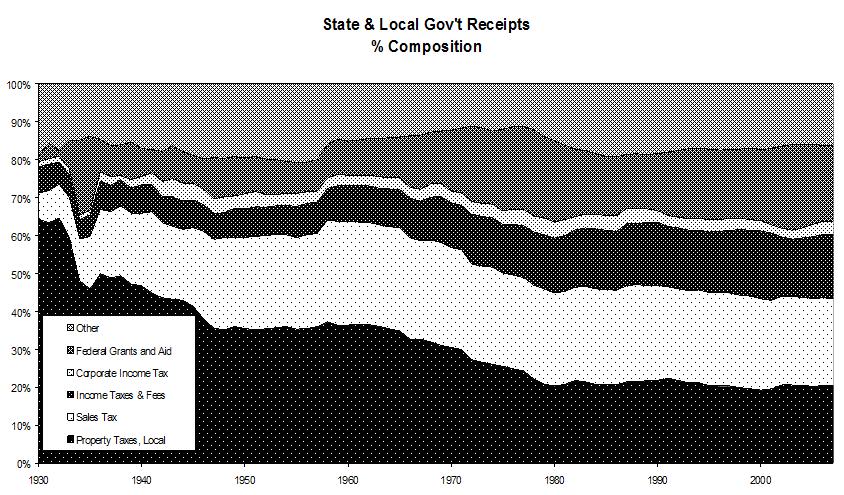 Untaxing real estate has served mortgage bankers by freeing more rental income (the land’s site value) to be paid as interest. Property taxes have not absorbed anywhere near the rise in debt-leveraged housing and commercial prices. However, this has not lowered the cost of housing for most people. New buyers must pay a price that capitalizes the property’s rental value. Less and less of this payment has taken the form of local property taxes. More and more has been paid to mortgage lenders as interest. So cutting property taxes has simply left more revenue to be capitalized into higher debt-financed prices. While homeowners saw their carrying charges rise, they nonetheless felt more affluent as real estate prices rose – inflated on easier and easier credit terms. Prices rose faster than mortgage debt as long as (1) interest rates were declining; (2) loan maturities were stretched out (ultimately reaching the point of zero amortization rather than the old-fashioned 30-year self-amortizing mortgages); (3) down payments were shrinking toward zero (rather than requiring 20 percent equity as used to be the case) and indeed as “liars’ loans” led prices to be bid up recklessly; and finally (4) cities refrained from raising property taxes as fast as market prices were rising. This left more revenue to be capitalized into higher prices, providing capital gains that home owners were encouraged to treat like “money in the bank” – by taking out home equity loans. This rising mortgage debt was increasingly important in enabling people to maintain their living standards, especially as they had to pay more for housing. So what appeared to be affluence and rising net worth from the value of one’s home on the asset side of the balance sheet found its counterpart in debt on the liabilities side. From the local fiscal vantage point, these debt-leveraged price gains represented uncollected user fees for the site value provided by public infrastructure and rising prosperity. The bankers ended up with the rising flow of rental value, not the cities. This obliged tax collectors to look to other sources of revenue. So homeowners paid out what they seemed to be saving in modest property taxes in the form of rising sales taxes and income taxes. By 2008 these financial system’s easing of credit terms had reached its limit. No more room for credit inflation remained, so speculators began to withdraw from the market. (They accounted for about one-sixth of demand for housing.) When the credit spigot was turned off, prices plunged – leaving the debts in place. (So taking out a home-equity mortgage was not really like drawing down money from a piggy bank after all. Years of future income had to be diverted to spend for past shortfalls.) Now that federal aid is falling – along with revenue from sales and income taxes – local budgets are falling into deficit. But for many cities and states, their constitutions and regulations prevent them from running deficits. So they face a number of hard choices. It is hard to raise property taxes back toward earlier rates, because the rental income already has been pledged to the mortgage bankers. To tax heavily indebted property would lead to more foreclosures and abandonment. And the Obama Administration’s hope that banks somehow will use the Federal Reserve’s tsunami of cheap (0.25%) reserves and credit to re-inflate a new real estate bubble is in vain, because bankers have little interest in lending to property that is still sinking in market price. It is easier to speculate on interest-rate arbitrage with the BRICS and get a foreign-exchange premium as well, or simply to play the market. Banks report winnings in the derivatives trade day after day, with nary a loss – an indication of how poorly their hapless customers and other outsiders must be doing! So the path of least resistance for most cities and states is to cut back spending on public services, and above all on pension plan contributions. The ultimate sacrifice (and the aim of financial predators) is to sell off public land and buildings, roads and other transportation services, sewer systems and other basic infrastructure. In this aim, the investment bankers are being aided and abetted by the credit ratings industry, threatening to downgrade cities that do not sell off their public domain. In this respect the financial end-game of privatization is similar in the United States to pressures by the European Central Bank to force the indebted PIIGS economies to engage in privatization sell-offs, Third World and post-Soviet style. Just as in Europe, when revenues are squeezed and something must give – either debt service, payment to pensioners or current payments to labor – the financial sector is seeking to take all the available surplus for itself. This puts creditors in the forefront of today’s class war against labor. On the eve of the September 2008 financial crash, cities such as Birmingham, Alabama and Chicago already were looking for ways to cope with the fiscal squeeze imposed by political pressures from the major local campaign contributors – the real estate and banking sectors – to cut property taxes. One seeming path of little resistance was to gamble in the Wall Street financial casino, hoping to make easy gains rather than making landlords, wage earners or consumers pay higher taxes. Landlords and bankers encouraged this speculation as an alternative to taxing property. Landlords wanted to pay less in property taxes, and banks knew that whatever rental value buyers could save in the form of lower taxes would end up being used to bid up prices to capitalize into debt service for mortgages to buy properties up for sale. Here is the dilemma that states and cities now face: So much urban property is sinking into negative equity territory that a rise in property taxes will lead to even more foreclosures and abandonments, and hence even lower fiscal returns. To avoid this, cities are seeing Chapter 9 bankruptcy as the main route to free themselves, especially from problems that stem from an unwarranted trust in bankers to help them out of the earlier fiscal squeeze by putting them into losing financial gambles. Orange County in California successfully sued Merrill Lynch to recover damages, and Birmingham also was awarded recovery payments from JP Morgan Chase.
Birmingham and Chicago as microcosms of the national debt squeeze
Now that financial fraud has been decriminalized for all practical purposes, most financial victims are obliged to sue for reimbursement in civil court without much help from prosecutors. Alabama’s state capital Birmingham is a case in point. After a predatory financing arrangement to upgrade its sewers in 2008 forced its Jefferson County into bankruptcy, the Securities and Exchange Commission (S.E.C.) negotiated $75 million in fines and reimbursement of fees to be paid by JP Morgan Chase as lead lender and negotiator for the complex interest-rate swaps they had advised the country to take, ostensibly to protect its economic interest. The banks also forfeited nearly ten times this sum ($647 million) in termination fees. But the court-appointed receiver grabbed the $75 million settlement for payment on the debts the country still owed. As usual, the banks had paid the fine and made reimbursement without admitting any wrongdoing. To the financial sector, deception and fraud is part of the game, after all, not a tactic that can be prosecuted as criminal. They paid their fines without admitting any wrongdoing, and without even admitting the S.E.C. charges. They merely paid up and kept silent – while the Justice Department and Internal Revenue Service were still in the time-taking process of ruling on legal claims brought by Jefferson County. The case prompted bankers and bondholders to bring pressure on the state of Alabama to take responsibility (that is, take on the debt liability) all on behalf of statewide taxpayers, and to demand that all lawsuits brought for financial fraud to be dropped.[1] “Responsibility” is supposed to be only for debtors, not for the financial sector itself. This is how the banks have managed to rewrite the laws, after all. Jefferson County is now debating whether to declare Chapter 9 bankruptcy to free itself from debts that can be paid only at the cost of disrupting economic continuity and living standards. The city’s debt quandary is a microcosm for the U.S. economy as a whole. Its lowest-income residents are burdened with financialized charges for sewer-system debt payments so far beyond their ability to pay that they face the same fate as Latvians, Irish and Greeks: As the local economy shrinks, they must move in order to find jobs – in places less debt-burdened and hence lower-cost. The “free market” choice is to emigrate to flee the debts imposed on their economies and on themselves personally. Well-to-do Birmingham families have yards large enough to have their own septic tanks as an alternative to paying for access to sewers, but lower-income families living in small houses or apartment buildings lack this option. One county commissioner asked: “Why should the poor have to pay for the ill-gotten gain of some of these banks who poisoned the well in the very first place?”[2] Other commissioners demanded that bondholders “bear the entire cost of a $20 million fund that is being created to help low-income residents pay their sewer bills.”[3] But the government usually provides relief only for creditors – above all, relief from criminal prosecution for their business plan that involved making loans beyond the debtors’ ability to pay. Some states have fraudulent conveyance laws to prevent this, as well as to prevent banks from misrepresenting the quality of their loans to outside investors. There are laws to punish appraisers who give false appraisals, and mortgage brokers who fill in false income reports to qualify for loans. But the S.E.C. has seen its staff and budget slashed and deregulators appointed to oversee its affairs. It has no authority to prosecute, only to make recommendations to the Justice Department, where Attorney General Eric Holder has followed the Obama Administration’s support of Wall Street, feeling no obligation to live up to the promises to make that a change from the Bush Administration’s similar lax behavior. The financial sector recognizes a dimension of economic behavior that textbooks politely refrain from citing: the ability to capture regulatory agencies, gain control of the courts and buy control of politics. The Supreme Court has ruled that corporations have the same rights as individuals to contribute to campaigns, a euphemism for buying the loyalty of politicians and judges, and obtaining veto power over regulatory appointees. Corporations pay lower income-tax rates and are free of value-added and excise or other sales taxes paid by consumers. Unlike real people, corporations cannot be sent to jail. Corporate shells shield owners and managers from criminal prosecution for the wholesale frauds that have left Countrywide Financial, Bank of America, Citibank, JP Morgan Chase and other pillars of the banking community free to make civil settlements for deceptive policies without admitting wrongdoing. And whereas individual crooks need to pay their own lawyers, corporations pick up the tab for their managers, while contributing generously to politicians who rewrite the laws to decriminalize fraud and deceptive business dealing. The corporate-backed media applaud politicians who insist that families “take responsibility” for their unemployment risk, debts and health care – while bailouts free the wealthy from having to suffer losses on bad loans. Rhode Island recently rewrote its laws to place bondholders ahead of other creditors, including pension recipients. Under the new law, “city officials who intentionally fail to pay bondholders can be removed from office or held personally liable for the payments.”[4] In contrast to the pro-debtor trend of legislation since the 13th century, wealth at the top of the pyramid takes precedence over retired schoolteachers and other public employees. The effect has been for the city of Central Falls, Rhode Island, to seek Chapter 9 bankruptcy protection to avert a 34 percent cut in pensions to its retirees in order to pay bondholders. Rhode Island is not alone in giving legal priority to bondholders. “Illinois has some of the strongest bondholder protections anywhere, which explains how a state that began its fiscal year with $3.8 billion in unpaid bills from last year – and whose pension system has less than half of the money it needs – is able to keeping selling bonds. State law requires Illinois to make ‘an irrevocable and continuing appropriation’ of tax revenues into a special fund every month that can be used only to pay bondholders.”[5] Chicago has balanced its budget not by taxing finance and real estate gains, but by selling off its roads and other basic infrastructure. Much as in feudal Europe, the leverage is financial. Privatizers are charging tolls and even installing parking meters on the city’s sidewalks to charge cars for parking by the minute. New York City has slashed is public subway and bus service, extending commuting times and making life harder. It has privatized its television and radio, replacing public airtime with commercial advertising. The ending of federal revenue sharing will exacerbate local budget constraints. The fact that many cities and states have constitutional requirements of balanced budgets – just as Republicans advocated for the federal government in the 2011 debt-ceiling agreement – requires that taxes be raised, public services cut, or assets sold off. California’s Proposition 13 prevents the state from raising property taxes in keeping with market prices, tying its hands fiscally and obliging it to commercialize its once-great university system. Students must now take on enormous education debt for what formerly was free or subsidized. New York City’s real estate tax likewise favors large investors and wealthy homeowners, at the expense of co-ops and condominium owners in apartment buildings. The rising rental value that local tax collectors relinquish does not lower housing costs; it merely enables the land’s site value to be paid to bankers. Rising debt-inflated housing prices have priced the city out of the market as the manufacturing center it formerly was. Its textile buildings and other industrial properties have been gentrified, leaving it a one-industry (finance) town focused on Wall Street. At the international level, Irish voters confirmed the policy of taking bad European Central Bank advice to put the interest of bondholders first by taking bad bank loans onto the government’s balance sheet and taxing the population to make up the losses, even at the cost of imposing a generation of debt-strapped depression on their economy. This is the self-destructive road to debt peonage that the IMF and World Bank forced Third World countries to follow for many decades. The fact that this ethic reverses centuries-long social values promises to make the great debate of the 21st century over the issue of which debts are paid and which will not be – and how much debts should be written down. Notes [1] Mary Williams Walsh, “A County in Alabama Puts Off Bankruptcy,” The New York Times, August 13, 2011.
[2] Michael Corkery and Kelly Nolan, “Alabama Bankruptcy Fight Hinges on Sewer-Rate Increase; Impact on Poor Bedevils Deal,” Wall Street Journal, August 11, 2011.
[3] Michael Corkery and Michael Aneiro, “Alabama County Rejects Creditor Plan but Delays Bankruptcy Decision,” Wall Street Journal, August 13, 2011.
[4] Michael Corkery, “Bondholders Win in Rhode Island,” Wall Street Journal, August 4, 2011.
[5] Mary Williams Walsh and Michael Cooper, “Faltering Rhode Island City Tests Vows to Pensioners,” The New York Times,
August 13, 2011. The article adds that: “The federal bankruptcy code
says pensioners and general-obligation bondholders are both unsecured
creditors, stuck at the back of the line and treated as equals. But
there is maneuvering room in the welter of state and federal laws.”
| |
Monday, August 22, 2011
Goldman Sachs CEO Blankfein hires criminal attorney
Goldman Sachs confirms its CEO hired criminal defense attorney


Here's what a spokesman for the firm said in a statement:
"As is common in such situations, Mr. Blankfein and other individuals who were expected to be interviewed in connection with the Justice Department’s inquiry into certain matters raised in the PSI report hired counsel at the outset."
The PSI is the Senate subcommittee that investigated wrongdoing during the financial crisis and pointed a finger at Goldman.
Goldman shares plunged in the final minutes of trading, after the initial report on Reuters. The stock ended down $5.25, or 4.7%, at $106.51, its lowest close since March 2009.
-- Nathaniel Popper
Photo: Goldman Sachs Chief Executive Officer Lloyd C. Blankfein testifies on Capitol Hill in Washington in 2009. Credit: Haraz N. Ghanbari / AP Photo
Goldman CEO hires prominent defense lawyer
WASHINGTON (Reuters) - Goldman Sachs Chief Executive Lloyd Blankfein has hired high-profile Washington defense attorney Reid Weingarten, according to a government source, as the Justice Department continues to investigate the bank.
Blankfein, 56, is in his sixth year at the helm of the largest U.S. investment bank, which has spent two years fending off accusations of conflicts of interest and fraud.
The move to retain Weingarten comes as investigations of Goldman and its role in the 2007-2009 financial crisis continue.
The news spooked already jittery investors. Goldman shares fell sharply in the final minutes of regular trading after Reuters reporting the hiring, finishing down 4.7 percent at $106.51, their lowest level since March 2009.
They slipped further in after-hours trade to $105.45.
The Senate's Permanent Subcommittee on Investigations (PSI) in April released a scathing report that criticized Goldman for "exploiting" clients by unloading subprime loan exposure onto unsuspecting clients in 2006 and 2007, and concluded that its top executives misled Congress during testimony in 2010.
Goldman has said it disagreed with many of the report's conclusions, but took seriously the issues addressed. The Justice Department launched its investigation in late April.
On Monday, Goldman said: "As is common in such situations, Mr. Blankfein and other individuals who were expected to be interviewed in connection with the Justice Department's inquiry into certain matters raised in the PSI report hired counsel at the outset."
Blankfein has not been charged in any civil or criminal case.
"Why do you bring in someone like that?" said the source, who was not authorized to speak publicly, about Weingarten. "It says one thing: that they're taking it seriously."
Robert Hillman, law professor at the University of California at Davis, said the move showed that the CEO "has some concern over action that is likely to be taken, presumably by the Justice Department." But he added, "It does not signify that he is guilty, or that any action is definitely going to be taken."
Weingarten, whose past clients include a former Enron accounting officer, was in a federal court in New York on Monday for the sentencing of another client, Anthony Cuti, the former CEO of the Duane Reade chain of drugstores, who was convicted of accounting fraud last year. Cuti was sentenced to three years in prison and a $5 million fine.
Weingarten did not respond to requests for comment. The Justice Department declined to comment.
"This was the last thing that Goldman Sachs or any institutions in the sector needed," said Peter Kenny, managing director of Knight Capital in Jersey City, NJ. "There is zero tolerance for risk or perceived risk right now."
HIGH-PROFILE CLIENTS
A partner with Steptoe & Johnson LLP, Weingarten has represented a wide array of clients in criminal cases. They include former WorldCom Inc chief Bernard Ebbers, who was later convicted, and former Enron accounting officer Richard Causey, who pleaded guilty in exchange for a 5 to 7-year prison term.
In May, his client, former GlaxoSmithKline lawyer Lauren Stevens, was acquitted of charges of lying and obstructing a probe into the company's marketing practices.
"I'm used to these monstrously difficult cases where everybody hates my clients," Weingarten told AmericanLawyer.com in May, although he described Stevens as a "beloved figure."
Controversy has continued to swirl around Goldman Sachs and Blankfein in the aftermath of the credit crisis in which Goldman was accused of favoring some clients over others, and of sometimes trading against the interest of clients.
The U.S. Securities and Exchange Commission scored a $550 million settlement against the bank in a fraud lawsuit in July 2010, but other investigations continue.
In June, New York prosecutors subpoenaed the bank to explain its actions in the run-up to the financial crisis. In addition to the Justice Department, the New York Attorney General and the Securities and Exchange Commission are also investigating.
It was not immediately clear what charges, if any, Blankfein could face personally.
One former federal prosecutor, who was not authorized to speak publicly, said Blankfein may have hired outside counsel after receiving a request from investigators for documents or other information.
The Senate report raised questions about inconsistencies between testimony from Blankfein and other Goldman executives to Congress and emails unearthed in the Senate investigation. The subcommittee's chairman, Senator Carl Levin, has said the question of whether Blankfein and others committed perjury is up to the relevant federal agencies.
The former prosecutor cautioned that perjury cases were difficult to prove, adding that prosecutors would not bring charges unless they had a "rock solid case."
Goldman earlier in August lowered its estimate for future legal costs to $2 billion from its $2.7 billion estimate three months earlier. It said it expects such costs to remain high for the foreseeable future.
(Reporting by Andrea Shalal-Esa; Additional reporting by Carlyn Kolker, Andrew Longstreth and Jonathan Stempel; Editing by Tim Dobbyn)
Friday, August 19, 2011
BofA Said to Weigh Foreclosure Pact That Allows New York Probe
By Hugh Son, Cheyenne Hopkins and Lorraine Woellert - Aug 16, 2011 11:00 PM CT
ideos You May Like
Bank of America Corp. (BAC) may settle a state and federal probe of foreclosure practices in a deal that lets New York proceed with an inquiry into securitizations, according to two people with direct knowledge of the talks.
The firm may pursue an accord with most of the 50 state attorneys general, even if it omits New York’s Eric Schneiderman and at least two other states who are opposed because a deal would impede related inquiries, said one of the people. Negotiations on a broad settlement stalled after Schneiderman indicated he wouldn’t let it block his probe into the bundling and sale of mortgages, said the people, who declined to be identified because talks are private.
Chief Executive Officer Brian T. Moynihan, seeking to reverse a 44 percent stock slide this year, has booked about $30 billion in settlements and writedowns to clean up mortgage liabilities at the biggest U.S. bank since the start of 2010. One of the largest legal matters still pending is the multi- state probe into whether firms servicing mortgages used bogus documents to justify foreclosures.
“They need to resolve this because it’s looming out there as an unknown liability,” said Brian Chappelle, a partner at mortgage-finance consultancy Potomac Partners LLC in Washington and former executive at the Mortgage Bankers Association. “It’s harming the housing recovery because the large institutions are reluctant to originate new loans because of the uncertainty.”
Bank of America executives, concerned that a delay in resolving the case is hurting the firm’s stock, are open to a deal that would resolve most of it, even if some mortgage investigations continue, said one of the people. The bank has been pushing for liability releases for loan activities besides servicing, such as securitization and lending.
Other States
Attorneys general from Delaware, Massachusetts and Nevada have also voiced concern that a proposed settlement would protect banks from mortgage investigations that aren’t yet finished. Nevada Attorney General Catherine Cortez Masto, whose office sued Bank of America and is conducting civil and criminal foreclosure probes, said in an interview this week that she will be “very cautious” about agreeing to a settlement that hinders those inquiries.
Danny Kanner, a spokesman for Schneiderman, and Melissa Karpinsky, a spokeswoman for Massachusetts Attorney General Martha Coakley, declined comment on Bank of America’s settlement talks. Edie Cartwright, a spokeswoman for Masto, didn’t comment. Jason Miller, a spokesman for Delaware Attorney General Beau Biden, didn’t respond to an e-mail.
Global Settlement
Negotiations with regulators and the five largest mortgage servicers including Bank of America, JPMorgan Chase & Co., Citigroup Inc., Wells Fargo & Co. and Ally Financial Inc. have bogged down over details of the proposed deal, which may cost the firms a total of more than $20 billion, people with knowledge of the talks have said. At least one of the banks objected to the size of its share of the settlement, arguing that its practices were better than others.
The holdup has spurred Bank of America to pursue talks with some states separately from the larger group, two people with knowledge of the matter said earlier this month. A settlement is probably still at least weeks from being completed, one person said.
The bank’s preference is still for a “global settlement,” said Dan Frahm, a spokesman for the Charlotte, North Carolina- based lender, who declined to comment further.
Moynihan, 51, met with Treasury Secretary Timothy F. Geithner and Federal Reserve governor Daniel Tarullo in Washington last week to press for a resolution to the foreclosure talks, said the people. Moynihan had argued that delays were interfering with a housing market’s recovery.
Servicing Standards
Officials are seeking a deal that sets standards for how the banks service loans, interact with borrowers and conduct foreclosures, according to terms proposed in March. They are also seeking payments including fines.
“Attorney General Schneiderman remains concerned by any settlement agreement that would preclude state attorneys general from conducting comprehensive investigations of the mortgage crisis,” his spokesman, Kanner, said last month in an e-mailed statement.
Bank of America shares have been dogged by concerns that mortgage expenses and a stagnating U.S. economy will crimp profit and force it to bolster capital by selling new shares. Moynihan has repeatedly said this year that the firm won’t need to issue common stock. The company plunged 20 percent on Aug. 8 after a ratings downgrade of U.S. debt sparked concern that the economy may stall into recession.
To contact the reporters on this story: Hugh Son in New York at hson1@bloomberg.net; Cheyenne Hopkins in Washington at chopkins19@bloomberg.net; Lorraine Woellert in Washington at lwoellert@bloomberg.net.
Tuesday, August 16, 2011
More on Goldman Sachs
Wrangling The Giant Vampire Squid
 Matt Taibbi has been waiting to watch Goldman Sachs executives go to jail for a while–at least since 2009 when he called Goldman the “great vampire squid wrapped around the face of humanity relentlessly jamming its blood funnel into anything that smells like money.”
Released today, the latest installment of Taibbi’s manifesto against all things Goldman sets up a pretty simple proposition based on the recently released 650-page report from Senator Carl Levin’s Subcommittee on Investigations, detailing the collapse of the American financial system. Taibbi wastes no time with whodunnit paragraphs, instead setting the smoking gun on the doorstep of the Department of Justice. Like a rewriting of the Senate investigator’s above quote, Taibbi declares, “Everything’s fucked up, and it’s time for Goldman Sachs to go to jail. You don’t even have to investigate because the Senate did it for you. Just issue those subpoenas.” (The Atlantic Wire)
Apparently the vampire squid also has an appetite for metal. Goldman Sachs is making an estimated $165 million per year though Detroit warehouses jam-packed with more than a million tons of industrial metal aluminum or about a “quarter of global reported inventories,” reports Reuters. The news service’s fascinating investigation finds that by simply storing the metals in its warehouses, the investment bank reaps tens of millions of dollars in rental revenues every year. The warehousing business takes advantage of a regulation imposed by the London Metal Exchange that allows warehouses to release “only a tiny fraction of their inventories per day, much less than the metal that is regularly taken in for storage.” (The Atlantic Wire)

Saturday, April 30, 2011
Danny Schechter : Why Wall Street is Winning:
Rag Blog

Why Wall Street is winning
The hated financial center is bouncing back. How did they do it?By Danny Schechter / The Rag Blog / April 26, 2011
Two years ago, as financial reform was put on the U.S. Congressional agenda, a skeptical Senator, Dick Durbin of Illinois, spoke of the power of the banks over the country’s legislative process.
“They run the place,” he said matter-of-factly.
The comment was then treated as a sidebar in the few newspapers that carried it, perhaps because it hinted at how interests, not ideology, dictate what happens on Capital Hill.
The remark about a shadowy power structure far more important than all the partisan in-fighting that dominates the news is worth recalling as a way of explaining how little has been done to rein in Wall Street in the years since its crash virtually wrecked the global economy.
It is also worth realizing that the people who “run the place” usually do so in ways that rarely get high profile media scrutiny or even public attention.
During the deliberations on re-regulating banks, they mounted a formidable army of lobbyists. It was reported that as many as 25 industry lobbyists were assigned to each member of Congress.
Even as new laws passed to satisfy an angry public, the industry dominated the process of what the laws would cover and how.
They also spread money around to help politicians who helped them. For years those donations were made on a nonpartisan basis, with Democrats as well as Republicans the beneficiaries of carefully-targeted help. Today, they are cutting off the Democrats who pushed financial reform.
The corporate sector is following suit. Nominally “liberal” companies like BP, sharply criticized by the White House for the Gulf Oil spill, are pouring money, not oil, into GOP coffers.
As bipartisanship fades, and certain ideological lines are drawn more sharply, the bankers are now favoring the Republicans financially, perhaps to thank them for erecting a unified wall against tighter rules for banks.
The GOP, led by the pro-free market slogans of the Tea Party, are busy defunding regulators as well.
Right-wingers in turn are being funded by wealthy billionaire backers including the shadowy Koch Brothers who are responsible for backing the anti-union programs of governors like Scott Walker in Wisconsin. These campaigns are designed to neuter all opposition to a conservative agenda.
Meanwhile, President Obama reaches into the corporate sector for “help” on his economic “recovery” agenda. In recent months, he named Jeffrey R. Immelt, president of General Electric, a company known for outsourcing jobs, as his jobs advisor.
He plucked William Daley from the American Chamber of Commerce to become his Chief of Staff.
Daley recently scolded politicians for calling for the prosecution of Wall Street criminals. He said that job belongs to producers in Hollywood, not lawmakers.
These efforts have emboldened other arms of Wall Street to intervene in politics. The most visible last week was the statement by the ratings agency Standard and Poor's that it was revising the country’s credit rating to “negative,” warning that it will consider lowering the long-term rating of the United States “within two years.”
Many stocks fell, but bond markets ignored it. Former International Monetary Fund economist Simon Johnson raised questions about their decision of a kind absent in most media outlets.
Writing on his website Baseline Scenario, Johnson noted that few outlets pointed out how inaccurate the ratings agencies had been at the height of the crisis, and how irresponsibly they hyped worthless bonds packed with sub prime junk. Yet once again they were treated as credible, despite their sloppy analysis.
The main problem is that S&P did not lay out even the most basic numbers or even point readers towards the nonpartisan and definitive Congressional Budget Office analysis of medium -- and longer-term budget issues. This matters, because the CBO numbers definitely do not show debt exploding upwards immediately from today...Bloggers like Cannonfire go further arguing that
The revised credit rating is meant to push the administration and lawmakers into going after Social Security and Medicare. The right-wing now has an additional propaganda tool to push for draconian cuts in areas that will most hurt working and middle class Americans.Here's the kicker: Standard and Poor's and Moody's are private firms. They don't work for the United States; they serve the interest of Wall Street banks. 2008 taught us that they are completely unaccountable.”
Doug Smith adds on the influential Naked Capitalism blog that Wall Street should know that joining the Tea Party jihad on government spending will be counterproductive for economic recovery.
We know the banksters control both parties and are immune from any threats to their bonuses or their liberty. Still, even on the banksters’ own terms of extend-and-pretend, these cuts are idiotic.Despite all of its frauds and deceptions, Wall Street has bought its way out of the many pressures that it change its ways. In a special issue, New York Magazine concludes that in this economic war, “Wall Street Won.”
Their editors write,
In the political realm, Wall Street faced the prospect of root-and-branch reregulation, up to and including the potential nationalization of the industry’s largest players, and in the cultural realm its transfiguration into a kind of pariah state. Once upon a time, the Street’s leading lights had been glamorized and admired to the point of worship; now the likes of Robert Rubin, Lloyd Blankfein, and Richard Fuld were relentlessly pilloried and demonized...A retired well-known journalist, James Clay Fuller, notes that media coverage of these issues adds to the confusion because it is often superficial and misleading.
Yet today on Wall Street, all of that seems a very long time ago. Not only are the banks rolling in dough again, but their denizens’ customs and sense of self-esteem have largely reverted to the status quo ante.
Corporate media refuse to tell many of the stories of bank fraud, as they decline to tell many of the stories that would show the public the corporate takeover of government, but the facts are available to those who recognize that they won't learn much of importance from CNN.The public is not just uninformed; it is unorganized on these issues and not fighting back. The power of the bank lobby can be compared to the pro-Israel lobby in the sense it dominates the discourse.
With a besieged Democratic administration siding with the banks, unions and activists may not be willing or able to challenge Wall Street. They are so desperate to hold on to the White House, they seem willing to pull any potential punches to make Wall Street a target.
Only a national high profile and populist campaign will be able to stop the financial industry from consolidating its clout. The banks are banking on their ability to stop such a campaign before it starts or gains any traction.
[News Dissector and blogger Danny Schechter made the film, Plunder The Crime of Our Time, treating the financial crisis as a crime story. Comments to dissector@mediachannel.org. Read more by Danny Schechter on The Rag Blog.]
Subscribe to:
Posts (Atom)