The State and Local Budget Crisis
By Michael Hudson
|
|
URL of this article: www.globalresearch.ca/index.
|
|
Global Research, September 6, 2011
|
|
The
cost of the 2011 cutbacks in federal spending will fall most directly
on consumers and retirees by scaling back Social Security, Medicare,
Medicaid and social spending programs. The population also will suffer
indirectly, by lower federal revenue sharing with U.S.
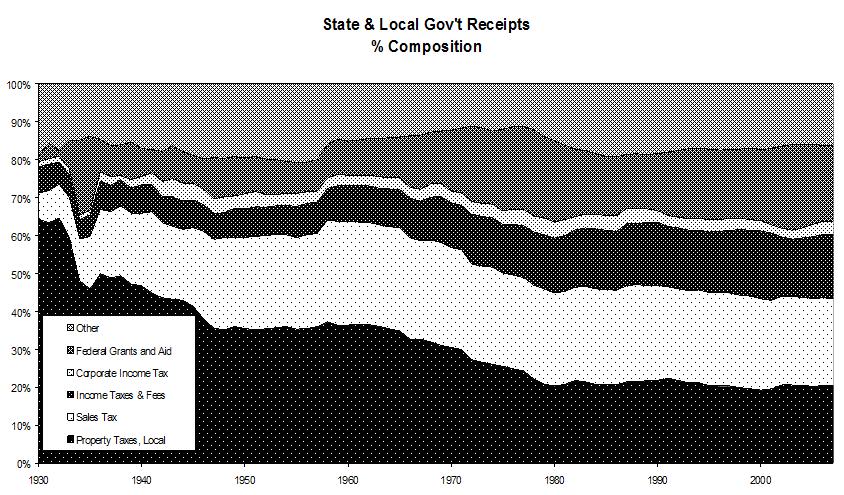
states and cities. The following chart from the National Income and
Product Accounts (NIPA, Table 3.3) shows how federal financial aid has
helped cities shift the tax burden off real estate, although the main
shift has been off property taxes onto income – and onto consumption
(sales) taxes.
State and local revenue, 1930-2007.
 Untaxing real estate has served mortgage bankers by freeing more rental income (the land’s site value) to be paid as interest. Property taxes have not absorbed anywhere near the rise in debt-leveraged housing and commercial prices. However, this has not lowered the cost of housing for most people. New buyers must pay a price that capitalizes the property’s rental value. Less and less of this payment has taken the form of local property taxes. More and more has been paid to mortgage lenders as interest. So cutting property taxes has simply left more revenue to be capitalized into higher debt-financed prices. While homeowners saw their carrying charges rise, they nonetheless felt more affluent as real estate prices rose – inflated on easier and easier credit terms. Prices rose faster than mortgage debt as long as (1) interest rates were declining; (2) loan maturities were stretched out (ultimately reaching the point of zero amortization rather than the old-fashioned 30-year self-amortizing mortgages); (3) down payments were shrinking toward zero (rather than requiring 20 percent equity as used to be the case) and indeed as “liars’ loans” led prices to be bid up recklessly; and finally (4) cities refrained from raising property taxes as fast as market prices were rising. This left more revenue to be capitalized into higher prices, providing capital gains that home owners were encouraged to treat like “money in the bank” – by taking out home equity loans. This rising mortgage debt was increasingly important in enabling people to maintain their living standards, especially as they had to pay more for housing. So what appeared to be affluence and rising net worth from the value of one’s home on the asset side of the balance sheet found its counterpart in debt on the liabilities side. From the local fiscal vantage point, these debt-leveraged price gains represented uncollected user fees for the site value provided by public infrastructure and rising prosperity. The bankers ended up with the rising flow of rental value, not the cities. This obliged tax collectors to look to other sources of revenue. So homeowners paid out what they seemed to be saving in modest property taxes in the form of rising sales taxes and income taxes. By 2008 these financial system’s easing of credit terms had reached its limit. No more room for credit inflation remained, so speculators began to withdraw from the market. (They accounted for about one-sixth of demand for housing.) When the credit spigot was turned off, prices plunged – leaving the debts in place. (So taking out a home-equity mortgage was not really like drawing down money from a piggy bank after all. Years of future income had to be diverted to spend for past shortfalls.) Now that federal aid is falling – along with revenue from sales and income taxes – local budgets are falling into deficit. But for many cities and states, their constitutions and regulations prevent them from running deficits. So they face a number of hard choices. It is hard to raise property taxes back toward earlier rates, because the rental income already has been pledged to the mortgage bankers. To tax heavily indebted property would lead to more foreclosures and abandonment. And the Obama Administration’s hope that banks somehow will use the Federal Reserve’s tsunami of cheap (0.25%) reserves and credit to re-inflate a new real estate bubble is in vain, because bankers have little interest in lending to property that is still sinking in market price. It is easier to speculate on interest-rate arbitrage with the BRICS and get a foreign-exchange premium as well, or simply to play the market. Banks report winnings in the derivatives trade day after day, with nary a loss – an indication of how poorly their hapless customers and other outsiders must be doing! So the path of least resistance for most cities and states is to cut back spending on public services, and above all on pension plan contributions. The ultimate sacrifice (and the aim of financial predators) is to sell off public land and buildings, roads and other transportation services, sewer systems and other basic infrastructure. In this aim, the investment bankers are being aided and abetted by the credit ratings industry, threatening to downgrade cities that do not sell off their public domain. In this respect the financial end-game of privatization is similar in the United States to pressures by the European Central Bank to force the indebted PIIGS economies to engage in privatization sell-offs, Third World and post-Soviet style. Just as in Europe, when revenues are squeezed and something must give – either debt service, payment to pensioners or current payments to labor – the financial sector is seeking to take all the available surplus for itself. This puts creditors in the forefront of today’s class war against labor. On the eve of the September 2008 financial crash, cities such as Birmingham, Alabama and Chicago already were looking for ways to cope with the fiscal squeeze imposed by political pressures from the major local campaign contributors – the real estate and banking sectors – to cut property taxes. One seeming path of little resistance was to gamble in the Wall Street financial casino, hoping to make easy gains rather than making landlords, wage earners or consumers pay higher taxes. Landlords and bankers encouraged this speculation as an alternative to taxing property. Landlords wanted to pay less in property taxes, and banks knew that whatever rental value buyers could save in the form of lower taxes would end up being used to bid up prices to capitalize into debt service for mortgages to buy properties up for sale. Here is the dilemma that states and cities now face: So much urban property is sinking into negative equity territory that a rise in property taxes will lead to even more foreclosures and abandonments, and hence even lower fiscal returns. To avoid this, cities are seeing Chapter 9 bankruptcy as the main route to free themselves, especially from problems that stem from an unwarranted trust in bankers to help them out of the earlier fiscal squeeze by putting them into losing financial gambles. Orange County in California successfully sued Merrill Lynch to recover damages, and Birmingham also was awarded recovery payments from JP Morgan Chase.
Birmingham and Chicago as microcosms of the national debt squeeze
Now that financial fraud has been decriminalized for all practical purposes, most financial victims are obliged to sue for reimbursement in civil court without much help from prosecutors. Alabama’s state capital Birmingham is a case in point. After a predatory financing arrangement to upgrade its sewers in 2008 forced its Jefferson County into bankruptcy, the Securities and Exchange Commission (S.E.C.) negotiated $75 million in fines and reimbursement of fees to be paid by JP Morgan Chase as lead lender and negotiator for the complex interest-rate swaps they had advised the country to take, ostensibly to protect its economic interest. The banks also forfeited nearly ten times this sum ($647 million) in termination fees. But the court-appointed receiver grabbed the $75 million settlement for payment on the debts the country still owed. As usual, the banks had paid the fine and made reimbursement without admitting any wrongdoing. To the financial sector, deception and fraud is part of the game, after all, not a tactic that can be prosecuted as criminal. They paid their fines without admitting any wrongdoing, and without even admitting the S.E.C. charges. They merely paid up and kept silent – while the Justice Department and Internal Revenue Service were still in the time-taking process of ruling on legal claims brought by Jefferson County. The case prompted bankers and bondholders to bring pressure on the state of Alabama to take responsibility (that is, take on the debt liability) all on behalf of statewide taxpayers, and to demand that all lawsuits brought for financial fraud to be dropped.[1] “Responsibility” is supposed to be only for debtors, not for the financial sector itself. This is how the banks have managed to rewrite the laws, after all. Jefferson County is now debating whether to declare Chapter 9 bankruptcy to free itself from debts that can be paid only at the cost of disrupting economic continuity and living standards. The city’s debt quandary is a microcosm for the U.S. economy as a whole. Its lowest-income residents are burdened with financialized charges for sewer-system debt payments so far beyond their ability to pay that they face the same fate as Latvians, Irish and Greeks: As the local economy shrinks, they must move in order to find jobs – in places less debt-burdened and hence lower-cost. The “free market” choice is to emigrate to flee the debts imposed on their economies and on themselves personally. Well-to-do Birmingham families have yards large enough to have their own septic tanks as an alternative to paying for access to sewers, but lower-income families living in small houses or apartment buildings lack this option. One county commissioner asked: “Why should the poor have to pay for the ill-gotten gain of some of these banks who poisoned the well in the very first place?”[2] Other commissioners demanded that bondholders “bear the entire cost of a $20 million fund that is being created to help low-income residents pay their sewer bills.”[3] But the government usually provides relief only for creditors – above all, relief from criminal prosecution for their business plan that involved making loans beyond the debtors’ ability to pay. Some states have fraudulent conveyance laws to prevent this, as well as to prevent banks from misrepresenting the quality of their loans to outside investors. There are laws to punish appraisers who give false appraisals, and mortgage brokers who fill in false income reports to qualify for loans. But the S.E.C. has seen its staff and budget slashed and deregulators appointed to oversee its affairs. It has no authority to prosecute, only to make recommendations to the Justice Department, where Attorney General Eric Holder has followed the Obama Administration’s support of Wall Street, feeling no obligation to live up to the promises to make that a change from the Bush Administration’s similar lax behavior. The financial sector recognizes a dimension of economic behavior that textbooks politely refrain from citing: the ability to capture regulatory agencies, gain control of the courts and buy control of politics. The Supreme Court has ruled that corporations have the same rights as individuals to contribute to campaigns, a euphemism for buying the loyalty of politicians and judges, and obtaining veto power over regulatory appointees. Corporations pay lower income-tax rates and are free of value-added and excise or other sales taxes paid by consumers. Unlike real people, corporations cannot be sent to jail. Corporate shells shield owners and managers from criminal prosecution for the wholesale frauds that have left Countrywide Financial, Bank of America, Citibank, JP Morgan Chase and other pillars of the banking community free to make civil settlements for deceptive policies without admitting wrongdoing. And whereas individual crooks need to pay their own lawyers, corporations pick up the tab for their managers, while contributing generously to politicians who rewrite the laws to decriminalize fraud and deceptive business dealing. The corporate-backed media applaud politicians who insist that families “take responsibility” for their unemployment risk, debts and health care – while bailouts free the wealthy from having to suffer losses on bad loans. Rhode Island recently rewrote its laws to place bondholders ahead of other creditors, including pension recipients. Under the new law, “city officials who intentionally fail to pay bondholders can be removed from office or held personally liable for the payments.”[4] In contrast to the pro-debtor trend of legislation since the 13th century, wealth at the top of the pyramid takes precedence over retired schoolteachers and other public employees. The effect has been for the city of Central Falls, Rhode Island, to seek Chapter 9 bankruptcy protection to avert a 34 percent cut in pensions to its retirees in order to pay bondholders. Rhode Island is not alone in giving legal priority to bondholders. “Illinois has some of the strongest bondholder protections anywhere, which explains how a state that began its fiscal year with $3.8 billion in unpaid bills from last year – and whose pension system has less than half of the money it needs – is able to keeping selling bonds. State law requires Illinois to make ‘an irrevocable and continuing appropriation’ of tax revenues into a special fund every month that can be used only to pay bondholders.”[5] Chicago has balanced its budget not by taxing finance and real estate gains, but by selling off its roads and other basic infrastructure. Much as in feudal Europe, the leverage is financial. Privatizers are charging tolls and even installing parking meters on the city’s sidewalks to charge cars for parking by the minute. New York City has slashed is public subway and bus service, extending commuting times and making life harder. It has privatized its television and radio, replacing public airtime with commercial advertising. The ending of federal revenue sharing will exacerbate local budget constraints. The fact that many cities and states have constitutional requirements of balanced budgets – just as Republicans advocated for the federal government in the 2011 debt-ceiling agreement – requires that taxes be raised, public services cut, or assets sold off. California’s Proposition 13 prevents the state from raising property taxes in keeping with market prices, tying its hands fiscally and obliging it to commercialize its once-great university system. Students must now take on enormous education debt for what formerly was free or subsidized. New York City’s real estate tax likewise favors large investors and wealthy homeowners, at the expense of co-ops and condominium owners in apartment buildings. The rising rental value that local tax collectors relinquish does not lower housing costs; it merely enables the land’s site value to be paid to bankers. Rising debt-inflated housing prices have priced the city out of the market as the manufacturing center it formerly was. Its textile buildings and other industrial properties have been gentrified, leaving it a one-industry (finance) town focused on Wall Street. At the international level, Irish voters confirmed the policy of taking bad European Central Bank advice to put the interest of bondholders first by taking bad bank loans onto the government’s balance sheet and taxing the population to make up the losses, even at the cost of imposing a generation of debt-strapped depression on their economy. This is the self-destructive road to debt peonage that the IMF and World Bank forced Third World countries to follow for many decades. The fact that this ethic reverses centuries-long social values promises to make the great debate of the 21st century over the issue of which debts are paid and which will not be – and how much debts should be written down. Notes [1] Mary Williams Walsh, “A County in Alabama Puts Off Bankruptcy,” The New York Times, August 13, 2011.
[2] Michael Corkery and Kelly Nolan, “Alabama Bankruptcy Fight Hinges on Sewer-Rate Increase; Impact on Poor Bedevils Deal,” Wall Street Journal, August 11, 2011.
[3] Michael Corkery and Michael Aneiro, “Alabama County Rejects Creditor Plan but Delays Bankruptcy Decision,” Wall Street Journal, August 13, 2011.
[4] Michael Corkery, “Bondholders Win in Rhode Island,” Wall Street Journal, August 4, 2011.
[5] Mary Williams Walsh and Michael Cooper, “Faltering Rhode Island City Tests Vows to Pensioners,” The New York Times,
August 13, 2011. The article adds that: “The federal bankruptcy code
says pensioners and general-obligation bondholders are both unsecured
creditors, stuck at the back of the line and treated as equals. But
there is maneuvering room in the welter of state and federal laws.”
| |
USuncutMN says: Tax the corporations! Tax the rich! Stop the cuts, fight for social justice for all. Standing in solidarity with http://www.usuncut.org/ and other Uncutters worldwide. FIGHT for a Foreclosure Moratorium! Foreclosure = homelessness. Resist the American Legislative Exchange Council, Grover Norquist and Citizen's United. #Austerity for the wheeler dealers, NOT the people.

USuncutMN supports #occupyWallStreet, #occupyDC, the XL Pipeline resistance Yes, We, the People, are going to put democracy in all its forms up front and center. Open mic, diversity, nonviolent tactics .. Social media, economic democracy, repeal Citizen's United, single-payer healthcare, State Bank, Operation Feed the Homeless, anti-racism, homophobia, sexISM, war budgetting, lack of transparency, et al. Once we identify who we are and what we've lost, We can move forward.
Showing posts with label corporate tax rates. Show all posts
Showing posts with label corporate tax rates. Show all posts
Thursday, September 8, 2011
The State and Local Budget Crisis: Micheal Hudson


Monday, August 15, 2011
Bachmann Makes Her Move
Bachmann Makes Her Move
Aug 15, 2011 | By Jeff Spross
GOP presidential contender Rep. Michele Bachmann (R-MN) won the Republican straw poll in Ames, Iowa on Saturday with 4,823 votes; more than twice that of any other candidate save Rep. Ron Paul (R-TX), whom she beat by just under 200 votes. However, neither former Massachusetts Gov. Mitt Romney, nor current Texas Gov. Rick Perry — who announced his candidacy for the nomination the same day — made any serious commitment of time or resources to the poll (though Perry supporters were in evidence on the ground in Ames). It’s not clear how much, if anything, the poll actually reveals about Bachmann’s political odds. Still, the event was decisive enough to drive third place finisher and former Minnesota Gov. Tim Pawlenty from the race, and served as a symbolic capstone to Bachmann’s dramatic rise through the GOP ranks.
As Ryan Lizza summed up in his recent New Yorker profile, “Bachmann belongs to a generation of Christian conservatives whose views have been shaped by institutions, tracts, and leaders not commonly known to secular Americans, or even to most Christians. Her campaign is going to be a conversation about a set of beliefs more extreme than those of any politician of her stature.” But while her political career originated and remains steeped in culture war politics, this has not prevented her from staking out an exceptionally hard-line on economic issues: She came out against the plan put forward by House Speaker John Boehner (R-OH) to end the debt ceiling stand-off, advocated blanket opposition to an increase in the debt ceiling under any circumstances, and has called for making more than a $1 TRILLION in cuts in just one year to balance the budget immediately, to take just the most recent examples.
BACHMANN’S INFLUENCES: Among Bachmann’s influences is a series of evangelical films by Francis Schaeffer titled How Should We Then Live?, which she has cited on the campaign trail as a profound influence, and a biography of Confederate General Robert E. Lee by author J. Steven Wilkins, which was listed as a recommended read on Bachmann’s personal website for a number of years. Schaeffer, whom Bachmann praised as “a tremendous philosopher” to Lizza, is striking for his hard-line right-wing evangelical stances on everything from politics to philosophy to art. His film series condemned the Italian Renaissance, the Enlightenment, Darwin, secular humanism, and postmodernism as morally corrosive and oppositional to a God-centered worldview, while asserting the inerrancy of the Bible and the moral imperative of a biblical worldview. According to Lizza’s interview with Schaefer’s son Frank, the Roe v. Wade decision held particular prominence in his father’s thinking, marking a critical turn in America towards moral degeneracy. Still, all of this is small potatoes compared to J. Steven Wilkins book Call of Duty: The Sterling Nobility of Robert E. Lee, which describes slavery as an institution fostering “mutual respect” between black slaves and the white South, and one that left slaves “immeasurably better off” than they were in Africa. Wilkins goes on to argue against abolitionism, saying time was needed for the “sanctifying effects of Christianity” to take hold — presumably through slavery’s institutional causeways — before emancipation would be appropriate. Lizza correctly described the book as “objectively pro-slavery” and called Bachmann’s recommendation of the tome “one of the most startling things I learned about her.” The book’s bizarre moral inversion has carried over into other areas of Bachmann’s political activity, when in one instance she signed onto a marriage pledge by the FAMiLY LEADER that included language suggesting African-American children were better off under two-parent households during slavery than they are under one-parent households in modern America.
SOCIAL EXTREMISM: Bachmann’s commitment to the goals of the far right on social issues has not wavered as she has climbed the political ladder. Her early success in conflating educational activism with right-wing culture war issues was helped along by a now-disbanded group called EdWatch, which promoted everything from the teaching of creationism, to climate change denial, to opposition to gay rights and equality. Considered its “prized pupil,” EdWatch provided Bachmann with critical support in both her 2000 run for the Minnesota state Senate and her 2006 run for Congress. She retains the group’s two founders as staff members, and actively campaigns against the “homosexual agenda” in public schools. In 2004, Bachmann voiced concerns that the arrival of gay marriage in Massachusetts would lead Minnesotan couples to marry there, return to the state, and then “group marriage, polygamy, and things much worse may not be far behind.” Bachmann has both endorsed and received the endorsement of pastors who have advocated “ex-gay” therapy, called homosexuality immoral and unnatural, and dismissed recent concerns over the effects of anti-gay bullying in schools. The pledge by the FAMiLY LEADER which Bachmann signed included assertions that homosexuality was both a chosen lifestyle and a health risk, and Bachmann herself recently stated that the military’s Don’t Ask, Don’t Tell policy “worked very well,” and if president, she would “probably” reinstate it. Finally, her husband Marcus Bachmann runs a clinic providing “ex-gay” reparative therapy — which runs counter to the American Psychological Association’s conclusions concerning the appropriate therapeutic response to sexual orientation. To hear Bachmann tell it, she is “very proud” of the clinics, despite repeatedly dodging more pointed questions about the issue, particularly after scrutiny turned to her husband for referring to gays as “barbarians” and for taking over $137,000 in Medicaid funds over the past five years. In fact, the resulting scrutiny has become sufficiently intense that Marcus Bachmann has been forced to backtrack, claiming his clinic has never been involved with reparative therapy and suggesting the “barbarians” incident was the result of an interview doctored to embarrass the campaign.
ECONOMIC PRIORITIES REWARD THE WEALTHY: Bachmann’s economic views are no less striking for being relatively new-formed and often incoherent. She ended the recent debate over the debt ceiling increase with a move to the most extreme position possible, namely blanket opposition to any increase under any circumstances. When reminded that reaching America’s borrowing limit while preserving all payments to Social Security, Medicare, the military, and America’s creditors — as Bachmann has insisted — would mathematically require gargantuan and immediate cuts to every other area of government, Bachmann has responded with platitudes and obfuscation. When Fox News’ own Chris Wallace recently pressed Bachmann on this same point, she insisted that the budget gap be closed with “pro-growth policies” to increase revenue without altering the tax system — nevermind that a growth in revenue necessary to close the deficit, even if possible, would require time, and thus borrowing would have to continue in the interim if massive cuts are to be avoided. As for those pro-growth policies, they seem to consist of lowering the corporate tax rate from 35 to 9 percent and eliminating the capital gains tax entirely, all at a cost to the federal budget of multiple trillions in revenue over 10 years. And all while calling for an increase in taxes on the working poor. Last year, Bachmann decried President Obama’s payroll tax cut for people lower down the economic ladder as an unaffordable increase in the deficit while simultaneously defending the need and legitimacy of much greater tax cuts for the rich regardless of their budgetary effect — all within the same interview, no less. And she has bizarrely claimed an extension of unemployment benefits, at a cost of only $34 billion for six months, would be unaffordable, even as she advocates tax policies that would decimate the government’s revenue stream. As for the recent downgrade of the United States credit rating by Standard & Poor’s, Bachmann laid claim to the downgrade as a validation of her position in the debt ceiling debate, while directly denying and contradicting the analysis Standard & Poor’s offered to explain the downgrade — and analysis whose cited reasons included the Republicans’ intransigent refusal to raise tax revenue, as well as the rhetoric offered by some, including Bachmann herself, suggesting the consequences of not raising the debt ceiling would not be particularly severe. Whether Bachmann is simply being disingenuous and politically opportunistic, or if she actually believes lightening the tax burden on the rich while increasing it for the poor is defensible on moral and policy grounds, or if she genuinely does not understand the economic consequences of her stated positions, or if she simply assumes anything advocated by Republicans is by definition good for the country while anything advocated by President Obama is by definition destructive, remains unclear.
Friday, July 15, 2011
Fiscal FactCheck
Fiscal FactCheck
Does Washington have a spending problem or an income problem? We offer some key facts.
July 15, 2011
Summary
So does the U.S. have "a spending problem," as Republicans keep repeating in the current debate over how to reduce the nation's record deficits? Or is the problem that taxes are not high enough? Those questions frame a long-running partisan debate, and as usual we won't offer an opinion one way or the other. But for those seeking their own answers, we can offer some fiscal history and factual context.
Some key facts we think are worth considering:
* Federal spending ("outlays" in budget jargon) is expected to equal 24.1 percent of the nation's gross domestic product in the current fiscal year, which ends Sept. 30. The figure was 25 percent in fiscal year 2009, highest since 1945.
* On the other hand, federal revenues are expected to drop to 14.8 percent of GDP this year, lower even than the 14.9 percent attained in both 2009 and 2010. There has been only one year since World War II when revenues have been as low as in any of these years: 1950, when the figure was 14.4 percent.
* These historically high rates of spending and low rates of taxation have combined to produce a chain of deficits that are also the highest since WWII. The deficit was 10.0 percent of GDP in fiscal 2009. It declined to 8.9 percent last year as the economy started to recover, but is projected to go up to over 9 percent this year. Each of these deficits is larger than in any year since 1945, measured as a percentage of GDP.
* The U.S. is borrowing about 36 cents of every dollar spent so far this year. It borrowed 37 cents on the dollar last year, and 40 cents in fiscal 2009.
* The largest components of federal spending are Social Security and Medicare programs for the elderly (33.5 percent of total outlays in 2010) and national defense (20.1 percent). Interest payments on the federal debt alone accounted for 5.7 percent of all federal spending, and that percentage is rising.
* The federal income tax accounted for 41.5 percent of federal receipts in 2010 (down from 49.6 percent prior to the Bush tax cuts of 2001 – 2003). Corporate taxes brought in only 8.9 percent, also down sharply since the recent recession. Payroll taxes and other "social insurance" payments accounted for 40 percent of total receipts in 2010.
It's easy to argue one side or the other by just citing facts that support a particular view, and omitting others. In the Analysis that follows, we offer some graphics, details and documentation in an attempt to give our readers a quick look at the entire picture — both where the money goes, and where it comes from.
Analysis
A glance at this chart quickly puts our current fiscal mess in historical context. We created it using historical budget data from the federal Office of Management and Budget, updated with the most recent estimates of the current fiscal year's outlays and receipts from the nonpartisan Congressional Budget Office, issued June 22 as part of CBO's 2011 long-term budget outlook.
.png)
Not since the enormous effort required to defeat Nazi Germany and Japan in WWII has the gap between Washington's spending and its revenues been so large, as a portion of the economy. Then, taxes were increased sharply to pay for the war, but spending increased even faster. In recent years, Washington has increased spending while cutting taxes.
The current situation is a marked change from the booming 1990s. In those years revenues increased, due to a 1993 tax increase, which fell most heavily on those making more than $200,000 a year. Meanwhile spending decreased relative to the rapidly growing economy, partly because of an absolute decline in military spending following the collapse of the Soviet Union in 1991. Deficits were erased, and the government posted surpluses in fiscal 1998, 1999, 2000 and 2001.
But then a string of deficits began in the fiscal year 2002, and there is no end in sight. For the current year, the administration originally projected in February a deficit equal to 10.9 percent, a new postwar record. The Congressional Budget Office in April, using different economic assumptions, projected that enacting the president's budget would produce a deficit of 9.5 percent of GDP, and that making no changes to current law would result in a deficit of 9.3 percent of GDP.
What has produced these huge budget gaps? Tax cuts and wars have been big factors, as have recessions and expanded spending for health care in both Republican and Democratic administrations. For example:
- Income-tax receipts are down sharply since the Bush tax cuts. In fiscal 2000, the year before the cuts began to take effect, receipts from the federal income tax on individuals amounted to 10.2 percent of GDP. That figure was down to 6.2 percent of GDP last year.
- Spending for the military and for homeland security has risen substantially since the attacks of Sept. 11, 2001. Spending for national defense rose from 3.0 percent of GDP that year to 4.8 percent last year.
- Non-military spending also has continued to rise. President George W. Bush pushed through an expensive prescription drug benefit for seniors in 2003, the largest expansion of Medicare in its history. In the financial crisis of 2008, Bush also pushed for and signed for a massive banking bailout. In early 2009, President Barack Obama pushed for and signed an expensive stimulus measure, and after a long fight in Congress he signed another expensive plan, the health care law, in March of last year, aimed at expanding coverage for millions who lack health insurance.
- Two economic recessions have had their effect. The recession of 2001 began in March and lasted until November. And the worst downturn since the Great Depression began in December 2007 and continued until June 2009. In both cases unemployment remained high for long after business activity began to recover, holding back both wages and the taxes that jobless workers would have paid on them.
We won't attempt to assign blame to one party or the other for the deficits. There is plenty of blame to go around, some of which rests with an American public that won't accept cuts in the largest categories of public spending, and also resists tax increases on anybody but "the rich."
Where Does It Go?
The biggest share of federal spending now goes for Social Security (20.4 percent in 2010) and Medicare (13.1 percent), the two entitlement programs that big majorities of Americans want to protect from any reductions, according to a recent poll. Together these two programs for senior citizens consume more than one-third of spending, far more than national defense, which accounts for just 20.1 percent, despite the increases of recent years.

Some categories that are unpopular with much of the public turn out to represent a fairly small part of total spending. Foreign aid, for example, amounts to less than 1 percent of the entire budget — even counting in military assistance to Israel, Egypt, Iraq and Afghanistan. All agriculture programs — including farm subsidies — make up just over one-half of 1 percent.
Where Did It Go? Major components of the $3.5 trillion spent in fiscal 2010 | |
| Social Security | 20.4% |
| National Defense | 20.1% |
| Medicare | 13.1% |
| Medicaid/CHIP | 8.1% |
| Interest | 5.7% |
| Low-Income Assistance | 5.3% |
| Unemployment Compensation | 4.6% |
| Education & Training | 3.7% |
| Federal Employee Retirement | 3.5% |
| Veterans | 3.1% |
| Transportation | 2.7% |
| Other health care | 2.6% |
| Parks & natural resources | 1.3% |
| Space/Science | 0.9% |
| Foreign aid | 0.9% |
| Agriculture | 0.6% |
| Everything else | 3.5% |
The wildly unpopular TARP program, used to finance banks, a big insurance company and two U.S. auto companies, is now actuallybringing billions back into the Treasury, as old loans are repaid and government-owned stock is sold to the public. The nonprofit investigative project Pro Publica figures that $322 billion has now flowed back into the Treasury, of the $573 billion loaned, invested or spent originally. And even the Obama administration's $787 billion stimulus program, so excoriated by Republicans, has nearly run its course. It was enacted in 2009, and according to the official Recovery.gov website, had spent 84 percent of the total as of June 30. That included 90 percent of the tax benefits, 83 percent of entitlements, and 78 percent of contracts, grants and loans.
Borrowing 36 Cents on the Dollar
The current gap between tax revenue and congressionally approved spending is so great that so far this fiscal year the federal government has borrowed an average of 36 cents of every dollar paid out. According to the most recent "Monthly Budget Review," issued by the Congressional Budget Office on July 8, the total spent through the end of June (the first nine months of the current fiscal year) was estimated at $2.705 trillion. But government receipts fell $973 billion short of spending, CBO estimates.
The good news — if it can be called that — is that the huge deficit is running at $31 billion lower than last year at this time. Spending is higher (Medicaid is up 6 percent over last year, for example), but federal income tax receipts are running higher as well. CBO credited "higher wages and more employment" than last year for the increase in tax revenue. And borrowing 36 cents on the dollar is an improvement of sorts. For all of fiscal 2009, the deficit amounted to 40 cents of every dollar spent, and it was 37 cents in fiscal 2010.
Where the Money Comes From
Taxes make up the vast bulk of federal revenues, of course. Individual income-tax payers supplied 41.5 percent of all federal revenues in fiscal 2010, but Social Security and Medicare payroll taxes paid both by workers and their employers made up nearly as much. Combined with federal unemployment insurance taxes and a few others, these social insurance taxes made up 40 percent of revenues. The income tax on corporations brought in just under 9 percent, while excise taxes, on such things as gasoline and diesel fuel, alcoholic beverages and telecommunications services, brought in just over 3 percent.

We found a surprising bit of news buried in the "other" category, which made up 6.5 percent of all revenue.
| Breakdown of "other" in 2010 | |
| (Percent of total revenues) | |
| Federal Reserve | 3.5% |
| Customs | 1.2% |
| Misc | 1.0% |
| Estate & Gift | 0.9% |
| Total "Other" | 6.5% |
It turns out that in 2010, more than half of that category came from profits made by the Federal Reserve System, whose lending operations expanded dramatically to address the financial crisis that started in 2007. The Fed's payments to the Treasury made up 3.5 percent of all federal revenue in 2010 — nearly $76 billion. The rest of the "other" category is made up of customs duties (1.2 percent of all revenue), federal estate and gift taxes (0.9 percent), and miscellaneous sources.
Who Pays?
Who pays all of these taxes? The best information on thatcomes from the Congressional Budget Office, which has tracked the tax burden for many years. The most recent complete data cover 2007. CBO figured in that year more than half of all federal taxes was paid by the top 10 percent of income earners. They paid 55 percent of all federal taxes in 2007, CBO said.
That's a comprehensive figure, counting the income tax, payroll taxes, excise taxes and even the corporate income tax (borne by stockholders in the form of reduced dividends and appreciation). And perhaps surprisingly, the top 10 percent of earners pay a greater share of federal taxes now than they did before the Bush tax cuts, which Democrats constantly criticize as a giveaway to "the rich." The top 10 percent paid 50 percent of all federal taxes in 2001.
However, that comes in spite of lower tax rates at the top, not because of it. The reason the most affluent 10 percent pay a greater share of taxes is that they are getting a greater share of all income. Their share of all pre-tax income went from 37.5 percent in 2001 to 42 percent in 2007.
One figure that gets a lot of attention is the percentage of individuals and married couples who pay zero federal income taxes. Those figures come from the nonpartisan Tax Policy Center. The TPC's most recent report was released June 14, and it shows that this year 46.4 percent of "tax units" (individuals or married couples) had zero federal income tax liability. That's because of various exemptions and tax credits aimed at reducing the income-tax burden on lower-income workers and families with children. The figure is down from 2008 and 2009, when the percentage topped out at 50.8 percent.
But practically all workers (and their employers) pay Medicare taxes on every dollar of wages, and Social Security taxes on every dollar of wages up to $106,800. Consequently, those who pay no federal income or payroll taxes at all amount to only 18.1 percent this year, the Tax Policy Center figures.
There's plenty more where these figures came from. We could focus more closely on what was paid and earned by the top 1 percent, for example. Or we could zoom in to examine the role of rising medical and drug costs in pushing up spending for Medicare and Medicaid. We may well visit those subjects in future articles. For now, we've tried to give a quick, accurate and balanced look at the big picture: Both where Washington spends, and where its money comes from.
– by Brooks Jackson
Sources
Office of Management and Budget. "Fiscal 2012 Budget of the United States, Historical Tables:Table 1.3—Summary Of Receipts, Outlays, And Surpluses Or Deficits (−) In Current Dollars, Constant (Fy 2005) Dollars, And As Percentages Of Gdp: 1940–2016" 14 Feb 2011.
Congressional Budget Office. "CBO's Long-Term Budget Outlook: Supplemental Data" 22 Jun 2011.
U.S. Congress, Joint Committee on Taxation, "Estimated Budget Effects of the Revenue Provisions of H.R. 2264. (The Omnibus Budget Reconciliation Act of 1993) As Agreed to by the Conferees" 4 Aug 1993.
Office of Management and Budget. "Fiscal 2012 Budget of the United States, Historical Tables:Table 2.3—Receipts by Source as Percentages of GDP: 1934–2016 " 14 Feb 2011.
Office of Management and Budget. "Fiscal 2012 Budget of the United States, Historical Tables:Table 3.1—Outlays by Superfunction and Function: 1940–2016" 14 Feb 2011.
Connolly, Ceci and Mike Allen "Medicare Drug Benefit May Cost $1.2 Trillion; Estimate Dwarfs Bush's Original Price Tag" Washington Post. 9 Feb 2005.
Johnson, Allen "Bush signs $700 billion financial bailout bill" MSNBC.com. 3 Oct 2008.
The Associated Press, "Obama: Stimulus lets Americans claim destiny: President signs $787 billion program into law in Denver Tuesday" 17 Feb 2009.
Stolberg, Sheryl Gay and Robert Pear, "Obama Signs Health Care Overhaul Bill, With a Flourish" New York Times. 23 Mar 2010.
National Bureau of Economic Research, "US Business Cycle Expansions and Contractions" undated. Accessed 15 Jul 2011.
King, Jr., Neil and Scott Greenberg "Poll Shows Budget-Cuts Dilemma: Many Deem Big Cuts to Entitlements 'Unacceptable,' but Retirement and Means Testing Draw Support" Wall Street Journal 3 March 2011.
Cohen, Jon and Dan Balz, "Poll shows Americans oppose entitlement cuts to deal with debt problem," Washington Post. 20 Apr 2011.
U.S. Department of State, "Foreign Assistance Budget" undated. Accessed 11 Jul 2011.
U.S. Treasury, "$1.7 Billion Additional TARP Funds Returned to Taxpayers, Positive Return on TARP Bank Programs Reaches $10 Billion" press release. 5 Jul 2011.
Pro Publica, "The State of the Bailout" undated. Accessed 11 Jul 2011.
U.S. Government, Recovery.gov "Overview of Funding" undated. Accessed 11 Jul 2011.
Congressional Budget Office, "Monthly Budget Review" 8 Jul 2011.
Congressional Budget Office, "Monthly Budget Review" 5 Nov 2010.
Office of Management and Budget. "Fiscal 2012 Budget of the United States, Historical Tables:Table 2.5—Composition of "Other Receipts": 1940–2016" 14 Feb 2011.
Board of Governors of the Federal Reserve System, "What does it mean that the Federal Reserve is 'independent within the government'?" 17 Jun 2010.
Congressional Budget Office, "Average Federal Taxes by Income Group" Jun 2011.
Congressional Budget Office, "Shares of Federal Tax Liabilities for All Households, by Comprehensive Household Income Quintile, 1979-2007" Jun 2010.
Congressional Budget Office, "Pre-Tax Income Shares All Households, by Household Income Category, 1979-2007" Jun 2010.
Urban-Brookings Tax Policy Center, "T11-0173 – Tax Units with Zero or Negative Tax Liability, Current Law, 2004-2011" 14 Jun 2011.
Monday, July 11, 2011
Another example of Republican LIES ..
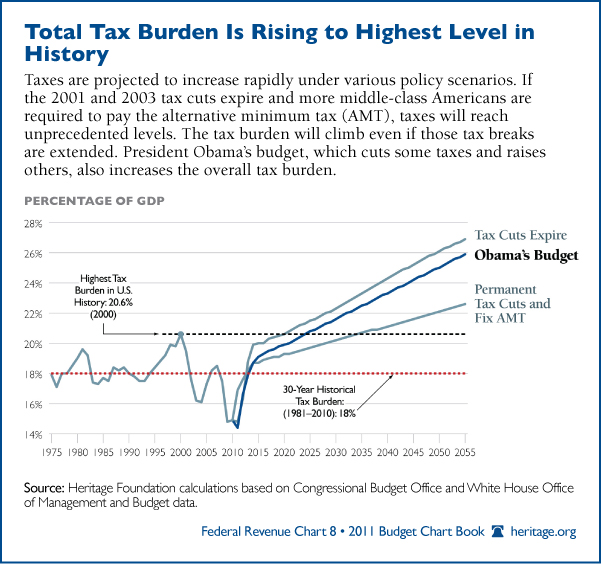
Chart of the Week: Tax Burden Is Rising to Highest Level in History
Subscribe to:
Posts (Atom)