USuncutMN says: Tax the corporations! Tax the rich! Stop the cuts, fight for social justice for all. Standing in solidarity with http://www.usuncut.org/ and other Uncutters worldwide. FIGHT for a Foreclosure Moratorium! Foreclosure = homelessness. Resist the American Legislative Exchange Council, Grover Norquist and Citizen's United. #Austerity for the wheeler dealers, NOT the people.


We Are The 99% event

USuncutMN supports #occupyWallStreet, #occupyDC, the XL Pipeline resistance Yes, We, the People, are going to put democracy in all its forms up front and center. Open mic, diversity, nonviolent tactics .. Social media, economic democracy, repeal Citizen's United, single-payer healthcare, State Bank, Operation Feed the Homeless, anti-racism, homophobia, sexISM, war budgetting, lack of transparency, et al. Once we identify who we are and what we've lost, We can move forward.


Please sign and SHARE

Showing posts with label populism. Show all posts

Monday, March 19, 2012

How America's Obsession with Money Deadens Us

http://www.alternet.org/economy/154469/how_america's_obsession_with_money_deadens_us/

By Bruce E. Levine

How America's Obsession With Money Deadens Us 

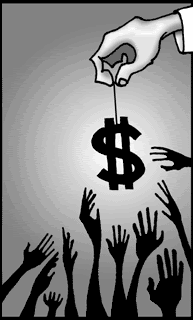
In a society that worships "one market under God," we are forced to be somewhat money-centric in order to survive. At what cost?

March 18, 2012 | 


Photo Credit: Shutterstock

A preoccupation with money is nothing new in our culture, but have Americans become even more “money-centric,” and does this deaden us, making us incapable of resisting injustices?

 A money-centric society is one in which money is at the center of virtually all thoughts, decisions and activities. While capitalism certainly gives rise to money-centrism, any society in which individuals have little know-how and lack supportive community—and are thus totally dependent on money for their survival—will create a money-centric society.

Such a society coerces even the non-greedy to focus on money at the expense of damn near everything else in order to survive.

 Have We Become More Money-Centric?

Sociologist Robert Putnam reported in Bowling Alone (2000) that when American adults were asked in 1975 to identify the elements of "the good life,” 38 percent chose “a lot of money,” compared to 63 percent who chose “a lot of money” in 1996. Since then, from my experience, this focus on money has only increased. Both greed and fear make one more money-centric, and in recent years, it has become more socially acceptable to be greedy and increasingly commonplace to be financially insecure.

 When I began my clinical psychology private practice nearly three decades ago, my clients who worked for major Cincinnati corporations such as Procter and Gamble felt secure in their employment, but that security began disappearing two decades ago. Nowadays, nearly everybody, even teachers and postal workers, lacks job security. Today, I see money worries, more than anything else, triggering panic attacks, depression, and alcohol abuse. Money discussions have even come to dominate family counseling sessions, where high school students increasingly talk about their fear of becoming financial losers, and parents fear their children will ruin their lives by accumulating student-loan debt while pursuing fields where there are few decent-paying jobs.

Between my clients and my own money preoccupations, the dead shit of money routinely deadens me, especially when I lose my sense of humor about it. It is difficult to maintain a sense of humor about all of this, so for most of us, having a stash of money feels increasingly important—and money accumulation has increasingly become the center of our lives.

 In 1900, only 1 percent of Americans was in the stock market; by 1950, this had increased to only 4 percent; but by 2000, more than 50 percent of Americans were in the stock market. While some of these people merely have pensions that own shares on their behalf, many Americans have in fact chosen to invest in the stock market. How many of those people are investing their money in companies whose products they believe in? Almost none. 

 For those Americans not in the stock market and who are living from paycheck to paycheck or on public assistance, they also are assured by the state that it is quite okay to gamble where the odds are more stacked against them than in the stock market. Many state governments not only offer lotteries but advertise them heavily on television, radio, billboards, and with mass mailing coupons—and this today is socially acceptable.

 Younger generations are increasingly told they won’t have job security in their working years or Social Security later on. So, while many young people would rather be gaining life experiences, they feel pressure early on to accumulate a large pile of cash.

 When Did Greed Become Respectable? 

 Money has always been a big deal in America, but through much of history, the money-centrism of the greedy has not had the social acceptability that it has recently gained. For the non-elite, greed was seen as the practice of villains such as Charles Dickens’ money-obsessed Scrooge, a psychologically and spiritually sick man in need of conversion. As late as 1936, a sitting president of the United States running for reelection knew that that it was quite popular to blast the greedy, selfish elite:

 We know now that Government by organized money is just as dangerous as Government by organized mob.
Never before in all our history have these forces been so united against one candidate as they stand today. They are unanimous in their hate for me—and I welcome their hatred. I should like to have it said of my first Administration that in it the forces of selfishness and of lust for power met their match. I should like to have it said of my second Administration that in it these forces met their master. 

 That was Franklin D. Roosevelt on Oct. 31, 1936.

Contrast FDR’s speech with President Barack Obama’s response in an interview excerpted by Bloomberg Businessweek and the Wall Street Journal in February 2010. When asked about Goldman Sachs CEO Lloyd Blankfein’s $9 million bonus and JPMorgan Chase CEO Jamie Dimon’s $17 million bonus, Obama responded:

First of all, I know both those guys. They’re very savvy businessmen. And I, like most of the American people, don’t begrudge people success or wealth. That’s part of the free market system. I do think that the compensation packages that we’ve seen over the last decade at least have not matched up always to performance...

Listen, $17 million is an extraordinary amount of money. Of course, there are some baseball players who are making more than that who don’t get to the World Series either.

 How did greed come to be so respectable? 

What Paul of Tarsus, in the first century after the death of Jesus, was to the dissemination and legitimization of Christianity, Ayn Rand, in the last half of the 20th century, was to the dissemination and legitimization of money-centrism and greed. Rand ends her novel Atlas Shrugged with this image of its hero John Galt:

“He raised his hand and over the desolate earth he traced in space the sign of the dollar.” 

Rand exhorted her followers to believe in what she called “radical capitalism,” and she lived—and even died—in radical money-centrism. At Rand’s funeral, in accordance with her specified arrangements, a six-foot floral arrangement in the shape of a dollar sign was placed near her casket.

 Money-centrism, of course, has been caused by many other forces and perpetuated by many other people.

How Money-Centrism Deadens Us and Makes Us Incapable of Resistance 

 When one cares only about money, one neglects everything else necessary to build and maintain self-respect. Neglecting other aspects of our humanity results in destroying our integrity, and integrity is necessary for strength. And when one is willing to do whatever it takes to make money, one assumes others are acting similarly, which destroys trust and makes it impossible to create the solidarity necessary to successfully challenge illegitimate authorities.

 Money-centrism is especially malevolent when it attacks societal forces that are potentially liberating.

Much has been written about how spiritual revolts (such as those begun by Jesus and other rebels) eventually morph into organized religions, which are then driven by money and used by the elite as an “opiate of the masses.” The elite in religious hierarchies have routinely commercialized spirituality, and by so doing have reduced the power of spirituality as a potent force to take down the ruling elite. But spirituality is not the only potentially rebellious force that has been destroyed by money-centrism. Commercializing any powerful idea, belief or emotion deadens its power.

Even the rebellion of folk/protest music and rock-and-roll has been increasingly commercialized, resulting in a dissipation of actual rebellious energy. In 1998, Bob Dylan and his son Jakob were paid $1 million to play for 15,000 employees of the Silicon Valley semiconductor company Applied Materials, and that’s not the only “corporate gig” on Dylan’s résumé. Next time you hear Dylan’s “Blowin’ in the Wind,” how energizing will that be for you?

And for quite some time, the aim of many rock-and-roll bands has been to exploit and commercialize the idea of rebellion. So, it should surprise no one that the Rolling Stones do corporate gigs, including one a decade ago in which they took in $2 million to entertain Pepsi bottlers in Hawaii. Equally widespread and probably even more responsible for dissipating rebellious energy is when songs of perceived rebellious artists are used as background music in commercials used to propagandize listeners into associating their rebellious urges with consumer products. Dylan’s “Times They Are a-Changin’” has been used by accounting firm Coopers & Lybrand and by the Bank of Montreal; and the Rolling Stones’ “Start Me Up” has been used by Microsoft. Of course it is unfair to pick on only Dylan and the Rolling Stones, but it’s simply too depressing for me to go through the entire list.

 To defeat the elite, the rest of us need energy.

Rebellion is a powerful idea, but when rebellion is used merely to attract an audience for financial profit, the idea itself becomes less powerful. So, whether it is spirituality, folk/protest music, or rock-and-roll, when rebellious energy is commercialized, that energy dissipates. Spirituality, music, theater, cinema, and other arts can be revolutionary forces, but the gross commercialization of these has deadened their capacity to energize rebellion. So now damn near everything—not just organized religion—has become an “opiate of the masses.” In a radically capitalist society that worships “one market under God” (as Thomas Frank called it), we are all forced to be somewhat money-centric in order to survive. No shame here.

But since money is not alive, to the extent that we become radically money-centric and money is at the center of all of our thoughts, decisions, and activities, we are dead and incapable of any resistance to injustices.

 Bruce E. Levine is a clinical psychologist and author of Get Up, Stand Up: Uniting Populists, Energizing the Defeated, and Battling the Corporate Elite (Chelsea Green, 2011).

Wednesday, August 10, 2011

Citigroup's Shocking 'Plutonomy' Reports -- h/t Michael Moore REPOST

I went to see Michael Moore's new movie, "Capitalism - A Love Story".
It was moving, funny, and educational, all rolled into one. It made me feel both, proud and sad, to be an American. ... but it's recommended viewing if you still want to take OUR Country back, from the Powers that Be.
There are many lessons to be learned from the film -- But the one that struck me, the one I'm motivated to write about now --
Is the Lesson of Plutonomy ... aka. that Top One Percent ...
Plutonomy, perhaps like me, you've not heard much about this term, except in the occasional poorly defined rant. Well it's a word we should all learn more about -- since it's one of the new "code words" the uber-rich use to maintain their "high stations" in life.
Plutonomy
n. An economy that is driven by or that disproportionately benefits wealthy people, or one where the creation of wealth is the principal goal.
[Blend of pluto- (wealth) and economy.]
http://www.wordspy.com/...


In a report called "The Plutonomy Symposium Rising Tides Lifting Yachts," Ajay Kapur, Citigroup's global strategist, says the balance sheets of the rich are "in great shape, and will get much better," which is why he recommends going out and buying stocks of companies that cater to that very select market.
Spending by the uber-rich overwhelms that of the average consumer and helps explain why the U.S. economy has continued to do well and the U.S. dollar hasn't collapsed even in the face of the current federal budget deficit, a negative savings rate, global imbalances and high energy prices, he says. The United States is one of the plutonomy countries countries whose economies are powered by a relatively small number of rich people.

- Angela Barnes, "Want wealth? Invest in the uber-rich," The Globe and Mail, October 2, 2006
http://www.wordspy.com/...

You see Michael Moore highlights a confidential report that Citigroup initially circulated only to it's wealthiest customers. Those reports, since leaked, plainly discuss the power of the Plutonomy in America, and how it would only strengthen, as long as the "the rest us" (the non-plutonics) could be kept in the dark about the Plutonomy existence, its role, and its over-arching control in the American Economy.
Even though the Plutonomy (the top 1%) control over 50% of the net worth in America -- they don't control the Votes!
The thing they most fear is the principle of "one person -- one vote".
You see despite their extreme wealth and power, they only have 1% of the vote; "the rest us" control the other 99% of the votes. So if we ever caught on and, I don't know, maybe raised their taxes back to where it use to be (40-90% range), well maybe they couldn't have a Yacht in every city, or a Mansion in a half dozen states.  Maybe they couldn't "lose count" of how many homes they owned.


Well I tried to locate the confidential Citigroup reports cited in the film, and think that these next two links are them. Remember these Reports were NOT meant for consumption by us "common folk".
Citigroup Plutonomy Report Part 1
Oct 16, 2005
- The World is dividing into two blocs - the Plutonomy and the rest.   The U.S., UK, and Canada are the key Plutonomies - economies powered by the wealthy. Continental Europe (ex-Italy) and Japan are in the egalitarian bloc.
- Equity risk premium embedded in "global imbalances" are unwarranted.   In plutonomies the rich absorb a disproportionate chunk of the economy and have a massive impact on reported aggregate numbers like savings rates, current account deficits, consumption levels, etc.
This imbalance in inequality expresses itself in the standard scary "global imbalances". We worry less.
- There is no "average consumer" in a Plutonomy.  
[...]
Indeed, traditional thinking is likely to have issues with most of it.  We will posit that:  
  1. the world is dividing into two blocs - the plutonomies, where economic growth is powered by and largely consumed by the wealthy few, and the rest.  
Plutonomies have occurred before in sixteenth century Spain, in seventeenth century Holland, the Gilded Age and the Roaring Twenties in the U.S.
What are the common drivers of Plutonomy?
Disruptive technology-driven productivity gains,
creative financial innovation,
capitalist-friendly cooperative governments,
an international dimension of immigrants and
overseas conquests invigorating wealth creation,
the rule of law, and
patenting inventions.
Often these wealth waves involve great complexity, exploited best by the rich and educated of the time.        
  1. We project that the plutonomies (the U.S., UK, and Canada) will likely see even more income inequality, disproportionately feeding off a further rise in the profit share in their economies, capitalist-friendly governments, more technology-driven productivity, and globalization.
[...]
  1. In a plutonomy there is no such animal as "the U.S. consumer" or "the UK consumer", or indeed the "Russian consumer".  
There are rich consumers, few in number, but disproportionate in the gigantic slice of income and consumption they take. There are the rest, the "non-rich", the multitudinous many, but only accounting for surprisingly small bites of the national pie.  [...] i.e., focus on the "average" consumer are flawed from the start.
http://www.scribd.com/...
Here's the key part, mentioned in the Moore film, where CitiGroup frets about us pesky "laborers" could some day push-back, that we might demand fair treatment and pay for all our productivity:
Citigroup Plutonomy Report Part 2
Mar 5 2006
RISKS -- WHAT COULD GO WRONG?
Our whole plutonomy thesis is based on the idea that the rich will keep getting richer. This thesis is not without its risks. For example, a policy error leading to asset deflation, would likely damage plutonomy. Furthermore, the rising wealth gap between the rich and poor will probably at some point lead to a political backlash. Whilst the rich are getting a greater share of the wealth, and the poor a lesser share, political enfrachisement remains as was -- one person, one vote (in the plutonomies). At some point it is likely that labor will fight back against the rising profit share of the rich and there will be a political backlash against the rising wealth of the rich. This could be felt through higher taxation on the rich (or indirectly though higher corporate taxes/regulation) or through trying to protect indigenous [home-grown] laborers, in a push-back on globalization -- either anti-mmigration, or protectionism. We don’t see this happening yet, though there are signs of rising political tensions. However we are keeping a close eye on developments.
http://www.scribd.com/...
The arrogance displayed, as Citigroup sees their iron grip, slipping, yet scheming to hang on to that Plutonic Control -- is truly appalling ... and a bit frightening too. It's as if we, the other 99%, are merely the cogs in their grand design. And as long as any worker push-back, can be held in check -- well No Worries, then. They get to keep that Capitalistic Money Machine humming along fine, Cha-Ching!


This Citigroup message of catering to the needs of the Plutonomy, once it got out, hasn't been lost on the Wall Street Journal crowd, although our National News Media, hasn't really reported on it much, have they?
The Wealth Report
Plutonomics
Robert Frank looks at the lives and culture of the wealthy.
By Robert Frank, Wall Street Journal - Jan 8, 2007
It’s well known that the rich have an outsized influence on the economy.
The nation’s top 1% of households own more than half the nation’s stocks, according to the Federal Reserve. They also control more than $16 trillion in wealth — more than the bottom 90%.
Yet a new body of research from Citigroup suggests that the rich have other, more-surprising impacts on the economy.
[...]
"The Plutonomy is here, is going to get stronger, its membership swelling" he wrote in one research note. "Toys for the wealthy have pricing power, and staying power."
[...]
Of course, Kapur says there are risks to the Plutonomy, including war, inflation, financial crises, the end of the technological revolution and populist political pressure. Yet he maintains that the "the rich are likely to keep getting even richer, and enjoy an even greater share of the wealth pie over the coming years."
All of which means that, like it or not, inequality isn’t going away and may become even more pronounced in the coming years. The best way for companies and businesspeople to survive in Plutonomies, Kapur implies, is to disregard the "mass" consumer and focus on the increasingly rich market of the rich.
A tough message — but one worth considering.
http://blogs.wsj.com/...
Nice, eh!?   ... well not really.
What was it they fear most, again?
The principle of "one person -- one vote"?
Say, NOW that's NICE!  ... that could one day be the People taking our Country back.


......................... also posted on DocuDharma
......................... and on on ProgressiveBlue

Originally posted to Digging up those Facts ... for over 4 years. on Sun Oct 04, 2009 at 05:10 AM PDT.

Thursday, February 17, 2011

US Uncut – James Meredith didn’t sit quietly, and neither can we

US Uncut – James Meredith didn’t sit quietly, and neither can we

Posted on February 17, 2011 by Carl Gibson | 
Carl Gibson is the founder of US Uncut and CIVIL USA, the US Uncut chapter in Jackson, Mississippi.

Marchers in Mississippi, 1966, carrying a "We March With Meredith" banner

On the night before James Meredith was admitted to the University of Mississippi as the school’s first black student, Segregationist Mississippi Governor Ross Barnett addressed a crowd of 41,000 Ole Miss Rebel fans at the Ole Miss vs. Kentucky football game. As thousands of young people waved Confederate flags under the blinding white lights of the stadium, Governor Barnett took the microphone and gave his famous 15-word “I Love Mississippi” speech. 

“I love Mississippi! I love her people! Our customs. I love and respect our heritage.” — Mississippi Governor Ross Barnett, 1962
The speech was light. Its implications were heavy.

Eventually, Gov. Barnett was forced to acquiesce to the U.S. Supreme Court ruling favoring Meredith after reaching a deal with U.S. Attorney General Robert F. Kennedy. And on October 1st, 1962, after more than a year making his case to the courts, James Meredith became Ole Miss’s first black student.

Meredith is still alive, and still lives in Jackson. He and I share the same ZIP code. I ran into him at the library yesterday and told him about the UK Uncut/US Uncut movements, and what we’re trying to accomplish through international nonviolent direct action on February 26, 2011. We exchanged contact information and then he put his hand on my shoulder to say something before walking away.

“You’re doing good work, young man. Keep fighting.”

Meredith’s fight is not unlike our fight. We’re both asking for simple requests – he wanted the opportunity to attend the same school as a white man, and we want to make sure our corporate citizens are paying their fair share in taxes to their government like everyone else. We’re likely to encounter staunch opposition from the proponents of the status quo, as Meredith did with Barnett and the charged climate of racial division in the South. Meredith succeeded in overcoming the odds and achieving his goal. Our goal of ending corporate tax evasion has yet to be seen, and is completely dependent on the efforts of local organizers in the 25 states where local chapters have formed.
 
I’ve been asked about the rising tide of populism possibly being detrimental to the need for businesses to invest and create jobs. The implication is that somehow, because we’re coming together to demand that the 16th Amendment to the U.S. Constitution also be followed by the ruling corporate elite, that we’re causing an anti-business climate. I’ve been told that our organizing efforts shouldn’t be publicized, that the movement should try to remain invisible lest we invite the fury, money and lawyers from billionaire tax dodgers like Bank of America.

In today’s economy, American workers are being told that those lucky enough to have jobs had better not do anything to rock the boat or piss off the boss, especially in a right-to-work state. The implication is that exercising our First Amendment rights of free speech and peaceful assembly could endanger our careers, especially if we live in a right-to-work state.

I’m through sitting quietly, aren’t you? I’m through watching decent, hard-working public school teachers lose their jobs to budget cuts, file for unemployment and EBT and live in poverty, especially while 2/3rds of American corporations are shirking their duty to their country by exploiting corporate tax loopholes. If we want a business climate that fosters job growth and economic opportunity, we have every reason to assemble and demand that our corporate owners pay income taxes to the United States for the opportunity to earn income here.

I don’t think that’s an unreasonable request. I don’t think that position should have to draw partisan ire or controversy. I’d like to think making everyone pay their fair share in taxes would be an easy position upon which both sides can reach consensus. 

Business owners have to learn the way of the world – if they don’t pay taxes, budgets get slashed and workers get fired. If workers get fired, then there’s less money spent in local economies and less demand for local goods and services. Without the necessary demand, local small business owners have to also cut costs and fire workers, adding to unemployment and worsening the problem.

If the richest of the rich truly care about this country, they must realize they have an explicit obligation to pay their taxes like the rest of us. If they don’t, and if our leaders refuse to act, then its incumbent upon the people to take the message to the streets and tell everyone we can to come aboard and demand economic justice.
Stand with us on February 26th. If you’re interested in starting or joining a local movement in your community, email usuncut@gmail.com or visit www.usuncut.org

Let’s get to work.
“Success is to be measured not so much by the position that one has reached in life as by the obstacles which he has overcome while trying to succeed.” — Booker T. Washington
Actions against tax-dodging banks will also be taking place in the UK on the same day, Saturday February 26th. Find your local UK Uncut event at www.ukuncut.org.uk.