USuncutMN says: Tax the corporations! Tax the rich! Stop the cuts, fight for social justice for all. Standing in solidarity with http://www.usuncut.org/ and other Uncutters worldwide. FIGHT for a Foreclosure Moratorium! Foreclosure = homelessness. Resist the American Legislative Exchange Council, Grover Norquist and Citizen's United. #Austerity for the wheeler dealers, NOT the people.


We Are The 99% event

USuncutMN supports #occupyWallStreet, #occupyDC, the XL Pipeline resistance Yes, We, the People, are going to put democracy in all its forms up front and center. Open mic, diversity, nonviolent tactics .. Social media, economic democracy, repeal Citizen's United, single-payer healthcare, State Bank, Operation Feed the Homeless, anti-racism, homophobia, sexISM, war budgetting, lack of transparency, et al. Once we identify who we are and what we've lost, We can move forward.


Please sign and SHARE

Showing posts with label CEO pay. Show all posts

Tuesday, October 25, 2011

MN Peoples' Assembly Take Your Money Outta the Bank!

MN Peoples' Assembly 

Take Your Money Outta the Bank!


Saturday, November 5 · 9:30am - 12:30pm


MN State Capitol

Downtown Saint Paul
75 Rev. Dr. Martin Luther King Jr. Blvd., 
Directions: North of downtown St. Paul, accessible from I-94 and I-35E.
Saint Paul, MN


Wells Fargo, Clean up Your Act!
 

(Bring mops, brooms, buckets, sponges, noisemakers!)

Donations will be taken to buy toys for homeless children, please contribute. 

Money will be accounted.

Assembly 9:30 - Floyd B. Olson statue

Rally 10:00 - The People speak!
 

We don't want a stadium.  Shelter Not a Stadium!

We want coop housing for the homeless!
We want an end to endless student debt!
We want money outta politics!
End foreclosures! Jail the crooked bank$t4er$
Stop the bank fees ripoff!

Quit funding companies that spoil our planet!
The poor contribute to our society, 

stop the demonization!
Don't let one child or adult freeze outside this winter!

30 speeches, 2-minutes each and THEN ...

March/Parade 


Dorothy Day Center/Listening House/Mary Hall
Where people sleep in the rough every night as there are NOT enough beds. Let's speak to our poorest citizens (the MN Legislature doesn't!)

March to Wells Fargo, Saint Paul 


Wells Fargo! Clean up your act!
 

Demand that John Stumpf use his EXCE$$IVE executive compensation, paid by his tax evading bank give #MNpeoplesassembly $1 million dollars (chump change to HIM) to do the feasibility study to remodel the old Ramsey County jail as a shelter. We also want a center to come up with SUSTAINABLE cooperative social housing pronto! 
See www.takethesquare.net. 

Stumpf gave Habitat Saint Paul $1mm - 
WHY NOT THOSE HE FORECLOSED ON?

People will be urged to put their money in credit unions AND establish a state bank. (WWW.WEBOFDEBT.ORG)  

http://www.seiu.org/a/profilewells.php - 
profile of Wells Fargo

And THEN

March to Pioneer Press, and past MPR

We demand that all media in MN cover the real #occupy issues - including our calls for economic democracy and moneyouttapolitics.org / www.movetoamend.org

Stories from victims of the corporate GREED systems victims will be presented to them as well The Peoples' solutions! Media, clean up your acts!

Move your money and then!!


At 4:30 pm we to the Capitol South Lawn to hold a MN Peoples' Assembly

We will discuss General Assembly rules AND our proposals for economic democracy and Next Steps to get economic predators to clean up their acts!


How about YOU, Mark Dayton? 
Care about our homeless crisis? 

And the 6 billionaire$ in the state of MN - 
how about YOU?

If you do, contribute to remodel the old jail to accommodate the homeless NOW and develop sustainable cooperative housing.  
Give homeless children some toys, too!

#USDORMN            #MNPeoples                  #5NovMN

DORMN@gmail.com               USuncutMN#gmail.com


www.USuncutMN.blogspot.com

Daily #occupy newspaper, US Days of Rage Minnesota Daily: http://www.paper.li/USuncutMN/1312728764

Coming Soon: Minnesota People's Mic on blogtalk radio. One citizen, one vote, one dollar!


FOR MORE INFO: http://facebook.com/nov.fifth

Together we can ensure that these banking institutions will ALWAYS remember the 5th of November!! 
If the 99% removes our funds from the major banking institutions to non-profit credit unions on or by this date, we will send a clear message to the 1% that conscious consumers won't support companies with unethical business practices.

• Research your local credit union options
• Open an account with the one that best suits your needs
• Cancel all automatic withdrawals & deposits
• Transfer your funds to the new account
• Follow your bank's procedures to close your account before 11/05

FIND A CREDIT UNION
USA: http://www.findacreditunion.com/
 To help out or donate, call 612 492 1411 


Monday, July 4, 2011

We Knew They Got Raises. But This?: NYT


Photograph by Daniel Acker/Bloomberg News
Philippe Dauman of Viacom led the executive pay list in 2010. The median was $10.8 million.
T turns out that the good times are even better than we thought for American chief executives.
Multimedia
 Weekend Business

Related

Anindito Mukherjee/European Pressphoto Agency (Top); Paul Sakuma/Associated Press (Center); Kim White/Reuters (Bottom)
Among the executives who registered huge gains in the value of their company stock and options in 2010 were Warren E. Buffett, the chief executive of Berkshire Hathaway, top, Lawrence J. Ellison of Oracle, center, and Jeffrey P. Bezos of Amazon.com. Together, the three men's holdings climbed by more than $13 billion for the year.
A preliminary examination ofexecutive pay in 2010, based on data available as of April 1, found that the paychecks for top American executives were growing again, after shrinking during the 2008-9 recession.
But that study, conducted for The New York Times by Equilar, an executive compensation data firm based in Redwood City, Calif., was just an early snapshot, and there were even more riches to come. Some big companies had not yet disclosed their executive compensation.
So Sunday Business asked Equilar to run the numbers again.
Brace yourself.
The final figures show that the median pay for top executives at 200 big companies last year was $10.8 million. That works out to a 23 percent gain from 2009. The earlier study had put the median pay at a none-too-shabby $9.6 million, up 12 percent.
Total C.E.O. pay hasn’t quite returned to its heady, prerecession levels — but it certainly seems headed there. Despite the soft economy, weak home prices and persistently high unemployment, some top executives are already making more than they were before the economy soured.
Pay skyrocketed last year because many companies brought back cash bonuses, says Aaron Boyd, head of research at Equilar. Cash bonuses, as opposed to those awarded in stock options, jumped by an astounding 38 percent, the final numbers show.
Granted, many American corporations did well last year. Profits were up substantially. As a result, many companies are sharing the wealth, at least with their executives. “We’re seeing a lot of that reflected in the pay,” Mr. Boyd says.
And at a time of so much tumult in the media business, it might be surprising that some executives in media and communications were among the most richly rewarded last year.
The preliminary and final studies put Philippe P. Dauman, the chief executive of Viacom, at the top of the list. Mr. Dauman made $84.5 million last year, after signing a new long-term contract that included one-time stock awards.
Leslie Moonves, of the CBS Corporation, got a 32 percent raise and reaped $56.9 million. Michael White of DirecTV was paid $32.9 million, while Brian L. Roberts of the Comcast Corporation and Robert A. Iger of the Walt Disney Company each received pay packages valued at $28 million.
“Media firms seemed to be paying a lot,” said Carol Bowie, head of compensation policy development at ISS Governance, which advises large investors on corporate governance issues like proxy votes. “Media companies in general tend to be high-payers, and they tend to feed off each other.”
Other big payers included oil and commodities companies like Exxon Mobil and a few technology giants like Oracle and I.B.M.
Some of the other highly paid executives on the new list who were not in the April survey are Gregg W. Steinhafel of Target, who had a $23.5 million pay package; Michael E. Szymanczyk of Altria, $20.77 million; and Richard C. Adkerson of Freeport-McMoRan Copper & Gold, $35.3 million.
Most ordinary Americans aren’t getting raises anywhere close to those of these chief executives. Many aren’t getting raises at all — or even regular paychecks. Unemployment is still stuck at more than 9 percent.
In some ways, chief executives seem to live in a world apart when it comes to pay. As long as shareholders think that the top brass is doing a good job, executives tend to be well paid, whatever the state of the broader economy. And some corporate boards were probably particularly generous in 2010 after a few relatively lean years for their top executives. In other words, some of this was makeup pay.
“What is of more concern to shareholders is that it looks like C.E.O. pay is recovering faster than company fortunes,” says Paul Hodgson, chief communications officer for GovernanceMetrics International, a ratings and research firm.
According to a report released by GovernanceMetrics in June, the good times for chief executives just keep getting better. Many executives received stock options that were granted in 2008 and 2009, when the stock market was sinking.
Now that the market has recovered from its lows of the financial crisis, many executives are sitting on windfall profits, at least on paper. In addition, cash bonuses for the highest-paid C.E.O.’s are at three times prerecession levels, the report said.
Of course, these sorts of pay figures invariably push the buttons of many ordinary Americans. Yes, workers’ 401(k)’s are looking better than they did in some recent years, but many investors still have not recovered from the hit they took during the financial crisis. And, of course, millions are out of work or trying to hold on to their homes — or both.
And it’s not as if most workers are getting fat raises. The average American worker was taking home $752 a week in late 2010, up a mere 0.5 percent from a year earlier. After inflation, workers were actually making less.
On the flip side, some chief executives have consistently taken token salaries — sometimes, $1 — choosing instead to rely on their ownership stakes for wealth. These stock riches don’t show up on the current pay lists, but they can be huge.
Multimedia
 Weekend Business
Warren E. Buffett, for instance, saw his stock holdings rise last year by 16 percent, to $46 billion. Other longtime chief executives or founders who are sitting on billions of paper profits include Jeffrey P. Bezos of Amazon.com and Michael S. Dell, the founder of Dell.
Resurgent executive pay has some corporate watchdogs worried that companies have already forgotten the lessons of the bust. Boards have promised to tie executive pay to company success, but by some measures pay is rising faster than performance. The median pay raise for chief executives last year — 23 percent — was roughly in line with the increase in net corporate profits. But it far exceeded the median gain in shareholders’ total return, which was 16 percent, as well as the median gain in revenue, which was 7 percent.
FOR the moment, shareholders aren’t storming executive suites. And while they received a say on pay under new federal rules last year, their votes are nonbinding. In other words, boards can still do as they please.
Pay specialists say companies are taking a hard look at these votes. Still, only about 1.5 percent of the 200 companies in the Equilar study were rebuffed by their shareholders on pay. A vast majority of the votes passed overwhelmingly, with 80 percent or 90 percent support, according to Mr. Boyd of Equilar.
Mr. Boyd says companies are making an effort to explain their pay plans. “We saw companies take it very seriously,” he says of the new rule.
In some respects, the mere possibility that shareholders might reject a proposed pay plan is enough to make corporate executives think again. Ms. Bowie of ISS says that outrageous payouts — such as so-called tax gross-ups, in which companies cover executives’ tax bills on perks like corporate jets — are becoming rarer.
Disney for instance, eliminated tax gross-ups this year in the face of shareholder ire, she said.
Company directors have the power to rein in runaway executive pay, but it is unclear whether either they or shareholders will do so in 2012. “It can be done if there is the will,” Ms. Bowie says.

Wednesday, June 8, 2011

For your Income dispartity toolkit

This is a FAVORITE of mine.  A keeper!

It's the Inequality, Stupid

Eleven charts that explain everything that's wrong with America.

How Rich Are the Superrich?

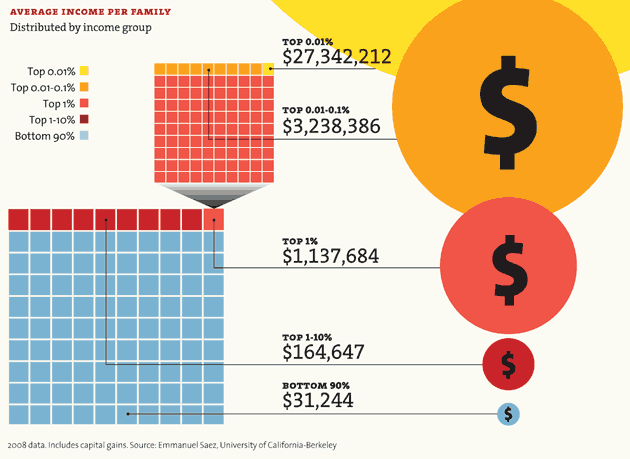
A huge share of the nation's economic growth over the past 30 years has gone to the top one-hundredth of one percent, who now make an average of $27 million per household. The average income for the bottom 90 percent of us? $31,244.

Average Income by Family, distributed by income group.
The richest controls 2/3 of America's net worth

Note: The 2007 data (the most current) doesn't reflect the impact of the housing market crash. In 2007, the bottom 60% of Americans had 65% of their net worth tied up in their homes. The top 1%, in contrast, had just 10%. The housing crisis has no doubt further swelled the share of total net worth held by the superrich.

Winners Take All

The superrich have grabbed the bulk of the past three decades' gains.

Aevrage Household income before taxes.

Out of Balance

A Harvard business prof and a behavioral economist recently asked more than 5,000 Americans how they thought wealth is distributed in the United States. Most thought that it’s more balanced than it actually is. Asked to choose their ideal distribution of wealth, 92% picked one that was even more equitable.

Average Income by Family, distributed by income group.

Capitol Gain

Why Washington is closer to Wall Street than Main Street.

median net worth of american families, median net worth for mebers of congress, your odds of being a millionaire, member of congress's odds of being a millionaire
member max. est. net worth
Rep. Darrell Issa (R-Calif.) $451.1 million
Rep. Jane Harman (D-Calif.) $435.4 million
Rep. Vern Buchanan (R-Fla.) $366.2 million
Sen. John Kerry (D-Mass.) $294.9 million
Rep. Jared Polis (D-Colo.) $285.1 million
Sen. Mark Warner (D-Va.) $283.1 million
Sen. Herb Kohl (D-Wisc.) $231.2 million
Rep. Michael McCaul (R-Texas) $201.5 million
Sen. Jay Rockefeller (D-W.Va.) $136.2 million
Sen. Dianne Feinstein (D-Calif.) $108.1 million
combined net worth: $2.8 billion
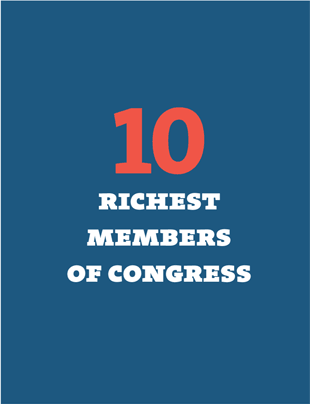
10 Richest Members of Congress 100% Voted to extend the cuts
Congressional data from 2009. Family net worth data from 2007. Sources: Center for Responsive Politics; US Census; Edward Wolff, Bard College.

Who's Winning?

For a healthy few, it's getting better all the time.

Gains and Losses in 2007-2009, Average CEO Pay vs. Average Worker Pay

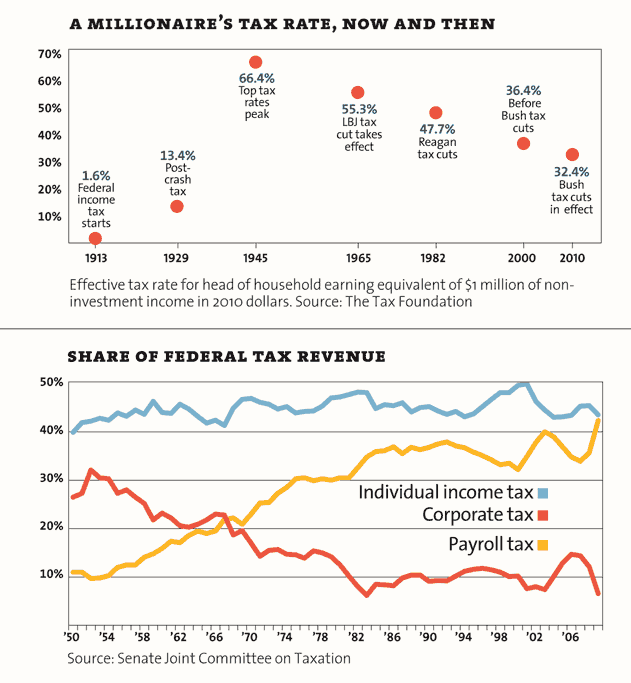
A millionaire's atx rate, now and then. Share of Federal Tax revenue

YOUR LOSS,THEIR GAIN

How much income have you given up for the top 1 percent?

 
Sources

Income distribution: Emmanuel Saez (Excel)

Net worth: Edward Wolff (PDF)
Household income/income share: Congressional Budget Office
Real vs. desired distribution of wealth: Michael I. Norton and Dan Ariely (PDF)
Net worth of Americans vs. Congress: Federal Reserve (average); Center for Responsive Politics (Congress)
Your chances of being a millionaire: Calculation based on data from Wolff (PDF); US Census (household and population data)  
Member of Congress' chances: Center for Responsive Politics
Wealthiest members of Congress: Center for Responsive Politics
Tax cut votes: New York Times (Senate; House)
Wall street profits, 2007-2009: New York State Comptroller (PDF)
Unemployment rate, 2007-2009: Bureau of Labor Statistics
Home equity, 2007-2009: Federal Reserve, Flow of Funds data, 1995-2004 and 2005-2009 (PDFs)
CEO vs. worker pay: Economic Policy Institute
Historic tax rates: Calculations based on data from The Tax Foundation
Federal tax revenue: Joint Committee on Taxation (PDF)

Read also: Kevin Drum on the decline of Big Labor, the rise of Big Business, and why the Obama era fizzled so soon.
More Mother Jones charty goodness: How the rich get richer; how the poor get poorer; who owns Congress?

Dave Gilson is a senior editor at Mother Jones. For more of his stories, click here. Get Dave Gilson's RSS feed.