
Posted: 06 Nov 2011 09:49 PM PST
Corrente has a post up by Affinis on a potentially important, and troubling development at OccupyOakland, namely, the fact that the movement has a relatively small group within it that believes in the use of violence to achieve its ends. It numbers are roughly 200 members out of an estimated 7,000 to 40,000 that have participated in demonstrations. However, they have disproportionate influence on the decisions made at the General Assembly, since many of the Occupy participants are transient (as in participate in demonstrations only or only occasionally show up for GA) while the black bloc is a much bigger proportion of the group that stays overnight on a consistent basis.
Affinis give some insight into why this is view is being tolerated:
From postings by OO participants at various sites/forums, several lines of thought seem to be contributing to tolerance of black bloc. I see a lot of posts arguing that destruction of property is not violence – and this position seems common among certain anarchists, even if they’re not actively in agreement with use of black bloc tactics currently. Some are arguing that since this movement is nascent, now is not the time for violence since it would alienate the mainstream – but that they would support its use once events have advanced sufficiently. Others more fundamentally disagree with the use of violence/vandalism, but are not willing to oppose/condemn black bloc since that would be siding with the “enemy” over other protesters. I also see a lot of condemnation of those who intervened to stop black bloc vandalism on Wednesday (e.g. at Whole Foods) – they’re being referred to as “peace police”, and there seems to be particularly strong anger against those who tried to physically restrain or physically block the black bloc individuals (even some commenters who appear relatively unsupportive of black bloc are condemning “peace police” actions as coercive and as failing to respect “diversity of tactics”).
Some of the proposals passed at previous OO GA meetings seem to have opened the door to the events of early Thursday morning. See here for a list of decisions passed as of October 31. Number 4 on the list is “diversity of tactics”.
For example, during marches: when confronted by police, some people may want to attempt to have calm conversations with them, urging them to be non-violent. some people may want to sit down in front of lines of police. some people may want to express their anger by yelling at the police. some people may want to attempt to remove police barriers. some people may want to disrupt traffic or banks. some people may prefer to remain on the sidewalk. We should be tolerant of each other’s approaches and respect different forms of protest, while being aware of our privilege or lack of it, especially when engaging with the police.
So the coded idea is that if you are against destruction of property, you are aligning with those of privilege.
This argument simply show a stunning ignorance of the lives of the 1%. Folks. the odds you can get at them via street level actions are pretty much nada, unless, like the driver of the hapless Archduke of Ferdinand, one happens to take a wrong turn. The people you are hurting are petit bourgious to maybe upper middle class. And when you hurt them, you are just as likely to hurt their workers, who if they are paid at typical wage rates, are much more peers than part of the problem. And what about the risk of loss of life, of, say, the smashing of a window cutting a big artery of a bystander? Stuff like this happens. It suggests that the this crowd isn’t just against the top 1%, the professed target of the movement, but that they are against the interests of the broad middle class, when in fact many see the pursuit of a just society, which includes reorienting the economy to serve a broad population rather than the needs of the few, as the overarching goal.
Affinis seems to agree:
It appears that the vast majority of people partipitating in Occupy Oakland events comdemn the black block actions. Tens of thousand participated in the demonstrations ….
But there appears to actually be a serious split among the core occupiers and in the general assembly regarding black bloc and use of violence/vandalism. I suppose this is not necessarily surprising. It makes sense that people who are able/willing to indefinately camp out under difficult conditions and constant threat of police raid, and those who are able/willing to consistently attend long GA meetings, may have different demographics and more radicalized beliefs than people who are more sporadically involved. I’ve seen this at prior occupations I’ve been involved in…
But we have a governance issue. Just as Washington is run by a political class, we may have a political class emerging at the Oakland GA that is not representing the interests of the broader movement. Yet thy are sufficiently influential as to prevent the Occupy Oakland GA from renouncing violence/vandalism as a tactic (it actually distanced itself from a media committee statement taking an anti-violence position).
More troubling, Affinis describes how they were successful in effectively recruiting other demonstrators to participate in an attack on Whole Foods, which was erroneously depicted as directing employees not to participate in the march after Iraq war veteran Scott Olsen was critically injured. Note how this works: a few violent people, operating in isolation, are much easier to identify and be subdued. If they are in the front or midst of a large crowd, which by virtue of its size may not even know what they are doing, it becomes much harder for anyone other than the other demonstrators to stop them. That did happen at Whole Foods: some of the marchers did try to restrain the vandals, but the store was still damaged. And of course, the instigators hope to get others to join in their attacks.
This is obviously far more pernicious that outside infiltrators, who are allegedly a common feature of anti-globalism demonstrations, and are paid to pretend to be members of the movement and engage in destruction in order to discredit it. The reason the Occupations have captured the public imagination is in no small measure due to using non-violent strategies that have again and again proven to be effective, with Tahir Square and the indignacios in Spain the models for many of the Occupy practices. But Affinis tells us how one set of Occupy precepts, of inclusiveness, is being used to undermine what many would see as higher order principles.


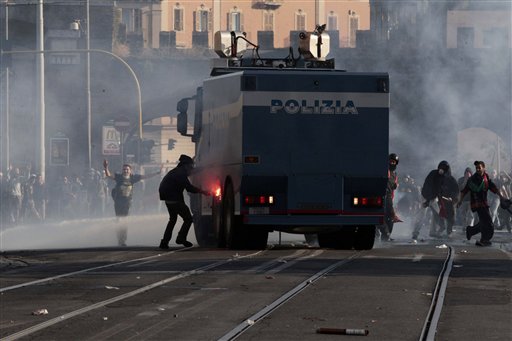
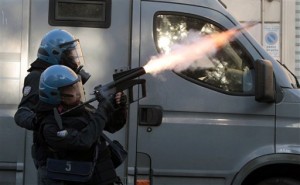 Following
the script of similar manifestations throughout the world on October
15, Rome’s planned non-violent manifestation was infiltrated by from
500-1500 violent, self-proclaimed revolutionaries who were mixed among
the huge formations of singing and chanting non-violent marchers. In a
well-planned and coordinated action the organized violent infiltrators
overcame both police and the peaceful demonstrators alike and stormed
and devastated the city center, spreading fire and destruction.
Following
the script of similar manifestations throughout the world on October
15, Rome’s planned non-violent manifestation was infiltrated by from
500-1500 violent, self-proclaimed revolutionaries who were mixed among
the huge formations of singing and chanting non-violent marchers. In a
well-planned and coordinated action the organized violent infiltrators
overcame both police and the peaceful demonstrators alike and stormed
and devastated the city center, spreading fire and destruction.