USuncutMN says: Tax the corporations! Tax the rich! Stop the cuts, fight for social justice for all. Standing in solidarity with http://www.usuncut.org/ and other Uncutters worldwide. FIGHT for a Foreclosure Moratorium! Foreclosure = homelessness. Resist the American Legislative Exchange Council, Grover Norquist and Citizen's United. #Austerity for the wheeler dealers, NOT the people.


We Are The 99% event

USuncutMN supports #occupyWallStreet, #occupyDC, the XL Pipeline resistance Yes, We, the People, are going to put democracy in all its forms up front and center. Open mic, diversity, nonviolent tactics .. Social media, economic democracy, repeal Citizen's United, single-payer healthcare, State Bank, Operation Feed the Homeless, anti-racism, homophobia, sexISM, war budgetting, lack of transparency, et al. Once we identify who we are and what we've lost, We can move forward.


Please sign and SHARE

Showing posts with label police brutality. Show all posts

Friday, May 4, 2012

DAVID GRAEBER: New police strategy in NYC sex ASSAULT

http://www.nakedcapitalism.com/2012/05/david-graeber-new-police-strategy-in-new-york-sexual-assault-against-peaceful-protestors.html


David Graeber: New Police Strategy in New York – Sexual Assault Against Peaceful Protestors

By David Graeber, a Reader in Social Anthropology at Goldsmiths, University of London, and an author and activist currently based in New York
A few weeks ago I was with a few companions from Occupy Wall Street in Union Square when an old friend — I’ll call her Eileen — passed through, her hand in a cast.
“What happened to you?” I asked.
“Oh, this?” she held it up. “I was in Liberty Park on the 17th [the Six Month Anniversary of the Occupation]. When the cops were pushing us out the park, one of them yanked at my breast.”
“Again?” someone said.
We had all been hearing stories like this. In fact, there had been continual reports of police officers groping women during the nightly evictions from Union Square itself over the previous two weeks.
“Yeah so I screamed at the guy, I said, ‘you grabbed my boob! what are you, some kind of fucking pervert?’ So they took me behind the lines and broke my wrists.”
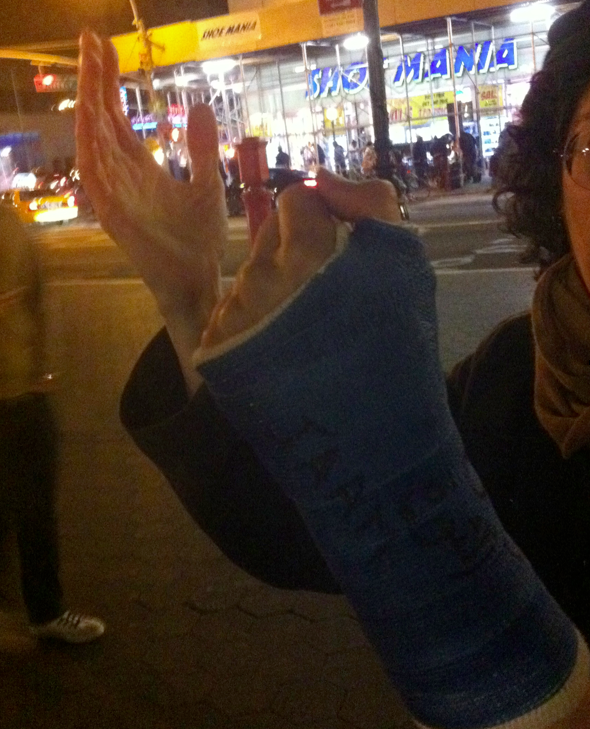
Actually, she quickly clarified, only one wrist was literally broken. She proceeded to launch into a careful, well-nigh clinical blow-by-blow description of what had happened. An experienced activist, she knew to go limp when police seized her, and how to do nothing that could possibly be described as resisting arrest. Police dragged her, partly by the hair, behind their lines and threw her to the ground, periodically shouting “stop resisting!” as she shouted back “I’m not resisting!” At one point though, she said, she did tell them her glasses had fallen to the sidewalk next to her, and announced she was going to reach over to retrieve them. That apparently gave them all the excuse they needed. One seized her right arm and bent her wrist backwards in what she said appeared to be some kind of marshal-arts move, leaving it not broken, but seriously damaged. “I don’t know exactly what they did to my left wrist—at that point I was too busy screaming at the top of my lungs in pain. But they broke it. After that they put me in plastic cuffs, as tightly as they possibly could, and wouldn’t loosen them for at least an hour no matter how loud I screamed or how much the other prisoners begged them to help me. For a while everyone in the arrest van was chanting ‘take them off, take them off’ but they just ignored them…”
On March 17, several hundred members of Occupy Wall Street celebrated the six month anniversary of their first camp at Zuccotti Park by a peaceful reoccupation of the park—a reoccupation broken up within hours by police with 32 arrests. Later that evening a break-away group moved north, finally establishing itself on the southern end of Union Square, two miles away, even sleeping in park—though the city government soon after decided to defy a century-old tradition and begin closing the park every night just so they would not be able to establish a camp there. Since then, occupiers have taken advantage of past judicial rulings to continue to sleep on sidewalks outside the park, and more recently, on Wall Street itself.
During this time, peaceful occupiers have been faced with continual harassment arrests, almost invariably on fabricated charges (“disorderly conduct,” “interfering with the conduct of a police officer”—the latter a charge that can be leveled, for instance, against those who try to twist out of the way when an officer is hitting them.) I have seen one protestor at Union Square arrested, by four officers using considerable force, for sitting on the ground to pet a dog; another, for wrapping a blanket around herself (neither were given warnings; but both behaviors were considered too close to “camping”); a third, an ex-Marine, for using obscene language on the Federal steps. Others were reportedly arrested on those same steps for singing a satirical version of the “Officer Krumpke” song from West Side Story. Almost no march goes by without one or two protestors, at least, being hurled against vehicles or have their heads bashed against the ground while being arrested for straying off the sidewalk. The message here is clear. Law has nothing to do with it. Anyone who engages in Occupy Wall Street-related activity should know they can be arrested, for virtually any reason, at any time.
Many of these arrests are carried out in such a way to guarantee physical injury. The tone was set on that first night of March 17, when my friend Eileen’s wrists were broken; others suffered broken fingers, concussions, and broken ribs. Again, this was on a night where OWS actions were confined to sitting in a park, playing music, raising one or two tents, and marching down the street. To give a sense of the level of violence protestors were subjected to, during the march north to Union Square, we saw the first major incident of window-breaking in New York. The window in question was broken not by protestors, but by police—using a protestor’s head. The victim in this case was a street medic named José (owing to the likelihood of physical assault and injuries from police, OWSers in New York as elsewhere have come to carry out even the most peaceful protests accompanied by medics trained in basic first aid.) He offered no resistance.
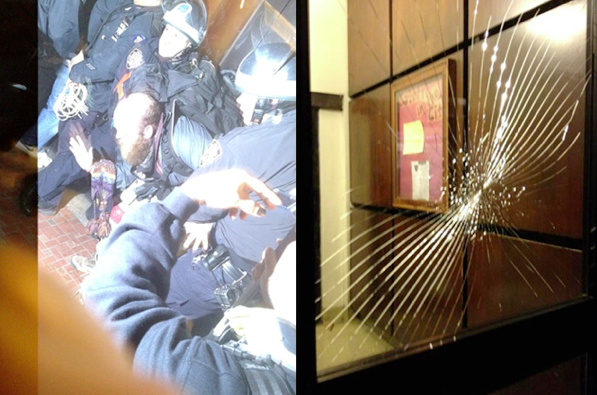
Here is a video of the incident. The window-breaking begins at 3:45.
Police spokesmen later claimed this incident was a response to a bottle that was hurled at a police vehicle used to transport arrestees. Such claims are made almost automatically when videos appear documenting police assaults on non-violent protestors, yet, despite the presence of cameras everywhere, including those wielded by the police themselves, no actual documentation of any such claims ever seems to appear. This is no exception. In fact numerous witnesses confirmed this simply isn’t true, and even if a bottle had been thrown at an armored vehicle, not even the police have suggested they had any reason to believe the medic whose head was smashed into the window was the one who threw it.
Arbitrary violence is nothing new. The apparently systematic use of sexual assault against women protestors is new. I’m not aware of any reports of police intentionally grabbing women’s breasts before March 17, but on March 17 there were numerous reported cases, and in later nightly evictions from Union Square, the practice became so systematic that at least one woman told me her breasts were grabbed by five different police officers on a single night (in one case, while another one was blowing kisses.) The tactic appeared so abruptly, is so obviously a violation of any sort of police protocol or standard of legality, that it is hard to imagine it is anything but an intentional policy.
For obvious reasons, most of the women who have been victims of such assaults have been hesitant to come forward. Suing the city is a miserable and time-consuming task and if a woman brings any charge involving sexual misconduct, they can expect to have their own history and reputations—no matter how obviously irrelevant—raked over the coals, usually causing immense damage to their personal and professional life. The threat of doing so operates as a very effective form of intimidation. One exception is Cecily McMillan, who was not only groped but suffered a broken rib and seizures during her arrest on March 17, and held incommunicado, denied constant requests to see her lawyer, for over 24 hours thereafter. Shortly after release from the hospital she appeared on Democracy Now! And showed part of a handprint, replete with scratch-marks, that police had left directly over her right breast. (She is currently pursuing civil charges against the police department):

I’d like to emphasize this because when I first mention this, the usual reaction, from reporters or even some ordinary citizens, is incredulity. ‘Surely this must be a matter of a few rogue officers!’ It is difficult to conceive of an American police commander directly telling officers to grope women’s breasts—even through indirect code words. But we know that in other countries, such things definitely happen. In Egypt, for example, there was a sudden spate of sexual assaults by security forces against protestors in November and December 2011, and followed a very similar pattern: while women activists affirmed there had been beatings, but relatively few specifically sexual assaults during the height of the protests, starting in November, there were dozens of reports of women being groped or stripped while they were being beaten. The level of the violence in Egypt may have been more extreme, but the circumstances were identical: an attempt to revive a protest movement through re-occupation is met by a sudden ratcheting up of tactics by the security forces, and in particular, the sudden dramatic appearance of a tactic of sexual attacks on women. It is hard to imagine in either case it was a coincidence. In Egypt, no serious observer is even suggesting that it was.
Of course we cannot how such decisions are made, or conveyed; in fact, most of us find it unpleasant even to contemplate the idea of police officials ordering or encouraging sexual assault against the very citizens they are sworn to protect. But this seems to be precisely what is happening here.
.
For many, the thought of police officials ordering or condoning sexual assault—even if just through a nod or a wink—seems so shocking that absolute proof would be required. But is it really so out of character? As Naomi Wolf has recently reminded us, the US security apparatus has long “used sexual humiliation as a tool of control.” Any experienced activist is aware of the delight police officers so often take in explaining just how certainly they will be raped if placed in prison. Strip searches—which the Supreme Court has recently ruled can be deployed against any citizen held for so much as a traffic violation—are often deployed as a tool of humiliation and punishment. And one need hardly remark on well-documented practices at Guantanamo, Bagram, or Abu Ghraib. Why target women in particular? No doubt it’s partly simply the logic of the bully, to brutalize those you think are weak, and more easily traumatized. But another reason is, almost certainly, the hope of provoking violent reactions on the part of male protestors. I myself well remember a police tactic I observed more than once during the World Economic Forum demonstrations in New York in 2002: a plainclothes officer would tackle a young female marcher, without announcing of who they were, and when one or two men would gallantly try to come to her assistance, uniforms would rush in and arrest them for “assaulting an officer.” The logic makes perfect sense to someone with military background. Soldiers who oppose allowing a combat role for women almost invariably say they do so not because they are afraid women would not behave effectively in battle, but because they are afraid men would not behave effectively in battle if women were present—that is, that they would become so obsessed with the possibility of women in their unit being captured and sexually assaulted that they would behave irrationally. If the police were trying to provoke a violent reaction on the part of studiously non-violent protestors, as a way of justifying even greater brutality and felony charges, this would clearly be the most effective means of doing so.
There’s a good deal of anecdotal evidence that would tend to confirm that this is exactly what they are trying to do. One of the most peculiar incidents took place on a recent march in New York where police seem to have simulated such an assault, arresting a young women who most activists later concluded was probably an undercover officer (no one had seen her before or has seen her since), then ostentatiously groping her as she was handcuffed. Reportedly, several male protestors had to physically restrained (by other protestors) from charging in to help her.
Why is all this not a national story? Back in September, when the now famous Tony Bologna arbitrarily maced several young women engaged in peaceful protest, the event became a national news story. In March, even while we were still hearing heated debates over a single incident of window-breaking that may or may not have been by an OWS activist in Oakland four months earlier, no one seems to have paid any significant attention to the first major incident of window-breaking in New York—even though the window was broken, by police, apparently, using a non-violent protestors’ head!
I suspect one reason so many shy away from confronting the obvious is because it raises extremely troubling questions about the role of police in American society. Most middle class Americans see the primary role of police as maintaining public order and safety. Instances when police are clearly trying to foment violence and disorder for political purposes so fly in the face of everything we have been taught that our instinct is to tell ourselves it isn’t happening: there must have been some provocation, or else, it must have just been individual rogue cops. Certainly not something ordered by the highest echelons. But here we have to remember the police are an extremely top-down, centralized organization. Uniformed officers simply cannot behave in ways that flagrantly defy the law, in full public view, on an ongoing basis, without having at least tacit approval from those above.
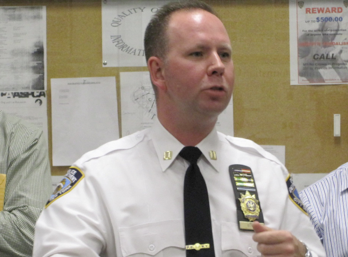
In this case, we also know precisely who those superiors are. The commander of the First Precinct, successor to the disgraced Tony Bologna, is Captain Edward J. Winski, whose officers patrol the Financial District (that is, when those very same officers are not being paid directly by Wall Street firms to provide security, which they regularly do, replete with badges, uniforms, and weapons). Winski often personally directs groups of police attacking protestors:
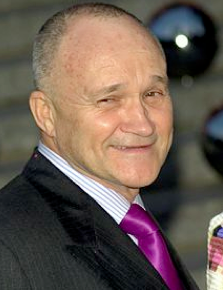
Winsky’s superior is Police Commissioner Raymond Kelly, former director of global security of the Wall Street firm Bear Stearns:
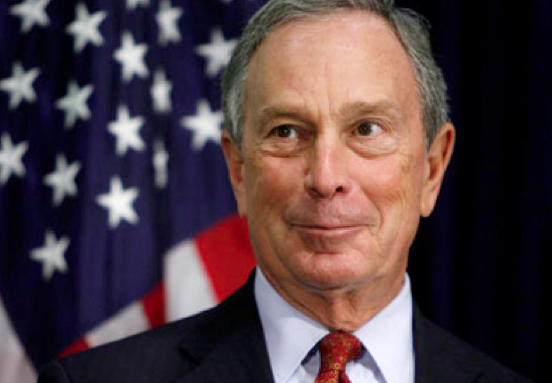
And Kelly’s superior, in turn, is Mayor Michael Bloomberg – the well-known former investment banker and Wall Street magnate. The 11th richest man in America, he has referred to the New York City Police Department as his own personal army:
One of the great themes of Occupy Wall Street, of course, is the death of US democracy—the near-total capture of our political system by Wall Street firms and the financial power of the 1%. In the beginning the emphasis was on political corruption, the fact that both parties so beholden to the demands of Wall Street and corporate lobbyists that working within the political system to change anything has become simply meaningless. Recent events have demonstrated just how much deeper the power of money really goes. It is not just the political class. It is the very structure of American government, starting with the law and those who are sworn to enforce it—police officers who, as even this brief illustration makes clear, are directly in the pay of and under the orders of Wall Street executives, and who, as a result, are willing to systematically violate their oaths to protect the public when members of that public have the temerity to make a public issue out of exactly these kind of arrangements.
As Gandhi revealed, non-violent protest is effective above all because it reveals how power really operates: it lays bare the violence it is willing to unleash on even the most peaceful citizens when they dare to challenge its moral legitimacy. And by doing so, it reveals the true moral bankruptcy of those who claim authority to rule us. Occupy Wall Street has demonstrated this time and time again. What the current spate of assaults shows is just how low, to what levels of utter moral degradation, such men are really willing to sink.
Update (3:40 PM): In comments, a reader asked why I did not go to the media. My response:
To be honest my first impulse was to call a sympathetic Times reporter. He said he was going to see if he could spin a story out of it. Apparently his editors told him it wasn’t news.

Monday, April 9, 2012

Occupy Minneapolis ARREST report; Scott


Hello everyone,
 
Yesterday several OSP activists were present for the Re-Occupy event at Peavey Plaza and Loring Park in Minneapolis. As planned, members of OSP Tactical contributed to this event by providing non-violent bodyguard protection for citizen media. Unfortunately, that protection definitely turned out to be needed, as Minneapolis PD attacked not only citizen media but even the mainstream press:
 
 
Once again, the bodyguard tactic was a success- every media person with a bodyguard was able to avoid arrest and keep filming despite multiple arrests going on all around them.
 
The first action I participated in was the march to the home of US Bank CEO Richard Davis. The callous indifference of some members of the 1% was on full display on a Mazda Miata we passed in Mr. Davis' neighborhood. In the midst of the most protracted economic crisis in many decades, the owner of this vehicle still displays a bumper-sticker with the phrase "will work for hundreds of thousands of dollars."
 
When we reached the mansion belonging to Mr. Davis, there were twenty-two police squad cars, a police SUV and a paddy wagon in the immediate vicinity. I think we all know that you or I would not receive protection like that if we requested it!
 
Later that day at Peavey Plaza, we were informed that the police had dusted off an obscure ordinance from the early 70s to ban us from having any structures up in Peavey Plaza despite a prior court ruling that such structures were protected speech. The courts have already ruled that Occupy can put up tents in public spaces for the purpose of protest- the city can prevent us from sleeping in them, but not from putting them up. However, the Minneapolis PD apparently decided that their "public nuisance" ordinance trumped both the First Amendment and the courts.
 
When the police arrived to enforce this ordinance later that evening, we began to march through the streets carrying the tents in protest. Occupy marches in the street have always previously been tolerated by the Minneapolis PD. We reached Loring Park, where we found out that three Occupiers had been cited and released on arbitrary charges such as riding a bicycle in an area designated as a walkway. We were informed that the police intended to evict us from Loring Park, and there were a number of squad cars present.
 
We decided to march back to Peavey to try to re-claim that space. This was when we began using bodyguards for citizen media. I was watching out for Nick Rogue of Rogue Media, and one other member of OSP Tactical was watching out for an OSP livestreamer. (I'm not using names here because I haven't asked them if that would be okay.) At Peavey, there were approximately thirty police on foot in the vicinity of the Plaza, along with three mounted police, many squad cars and a huge mobile command center.
 
After they informed us again that we would not be allowed to have tents in the park, we once again resumed marching. At a certain point, the police began to form a "kettle." This is a police tactic where all escape routes are blocked off so protesters can either be trapped in one place or subjected to mass arrests. One of the prime duties of a non-violent bodyguard is to keep the livestreamers from getting caught in a kettle. I was able to spot the kettle forming and keep Nick Rogue on the outside of it so he could keep filiming.
 
At this point, the mounted police suddenly flanked the marchers and blocked off the street, and the other police attacked the march from behind. One officer assaulted the Channel 5 cameraman as he was doing his job, destroying a video camera worth tens of thousands of dollars. Another video camera belonging to citizen media was also destroyed. Eleven Occupiers were arrested, and several sustained minor injuries from being tackled and slammed to the ground.
 
Nick Rogue showed great boldness in getting extremely close to the arrests in order to document what was happening. One mounted officer repeatedly rammed into him with her horse to try to intimidate him into moving away- the horse was actually so close to him at one point that it started trying to eat his hair, and he was only able to keep filming by holding on to a lamp-post with one arm. I confronted her verbally and insisted that she stop bumping the horse into him. Once he had the footage he needed, we got out of there.
 
The rest of the night was a vigil in front of the jail until we had succeeded in bailing out all of our arrested comrades by about six AM.
 
The events at Re-Occupy demonstrate that the determination of authorities to crush dissent extends even to physically assaulting members of the mainstream media and destroying their equipment. The importance of the bodyguard initiative for our own media is also going to be increasingly important as we move on into the spring.
 
I'll close with a brief anecdote about our presence at this event. At one point when conferring with another member of OSP Tactical on the street, I heard one member of Occupy Minneapolis say to another: "Oh, those guys are from Occupy Saint Paul?"
 
The other guy replied "They're all over the place, there's a ton of them here tonight!"
 
In reality, there were only several of us, but I believe we made a real and valuable contribution.
 
Here is some more of Nick Rogue's footage:
 
 
You can find photos of the arrests here:
 
 
Thanks for your time,
Tall Scott 

Sunday, December 18, 2011

Operation Shield for Occupation safety - more to follow

Operation SHIELD for Occupation Safety

ShareThis25


The following is from the Operation SHIELD website:

We have ALL sat back for weeks and watched a good amount of police brutality occur. We have all sat back furious and frustrated, and with no outlet for our frustration. OcPo would like to introduce you to Operation SHIELD. Occupy Police has thought long and hard for week on our next move, and we’ve finally solidified our resolve to combat police brutality directly with Operation SHIELD. Police should expect SHIELD members to appear when police are on site, SHIELD members will act honorably, if you are an officer, you can expect, not to be attacked, cursed or yelled at, spit on, or harmed by a SHIELD member, there will be a contact number if this occurs. You can also expect SHIELD members to be interlocked together creating a barrier which separates protestors from police.

  • Operation SHIELD is a non-violent 2 phase defensive operation aimed at combating police brutality on a national level
  • Operation SHIELD Phase 1 is Operation ARMORUP
  • Operation SHIELD Phase 2 is Operation SHIELD (Active) and is briefly layed forth below
  • OP SHIELD (Active) if implemented at your occupation will be a (Warrior Class) 1-2 person barrier which surrounds protestors when a large police force is on site. Should protestors go on a march or should an encampment be raided, SHIELD members will implement OP SHIELD (Active) immediately to protect protestors.
  • Operation SHIELD will be layed out and further explained for your GA’s approval; further down on this page
  • Operation SHIELD participation and membership is open to both civilians and ex/retired police & military. Membership requirements and the SHIELD oath are layed forth further down on this page
  • Operation ARMORUP is the organizational phase of Operation SHIELD
  • Operation ARMORUP consists of the 5 Parts listed (In Order) below
  • Part 1.) Member sign up / Oath taking / Member ID # Issued
  • Part 2.) Individual GA Approval of Operation SHIELD (Active)
  • Part 3.) Members are issued shirts which define them as SHIELD members
  • Part 4.) SHIELD Members will link up at their local occupations and coordinate OP SHIELD drills as defined below (COMING)
  • Part 5.) Operation ARMORUP concludes and becomes: Operation SHIELD (Active)
  • Part 6.) See more on Phase 2: OP SHIELD (Active) below (COMING)
  • Link to Document Describing Operation SHEILD To Be Read For GA Approval COMING
  • Requirements for hosting a SHIELD Team at your Occupation listed below
  • 1.) I can provide an address for the delivery of ARMORUP/SHIELD Shirts for members
  • 2.) I will inform Occupiers at our GA that they may become SHIELD members, should they agree with the “Membership Requirements”
  • 3.) I will integrate at least 3 ARMORUP drills into our schedule, and inform both my occupation and the OcPo Secretary of the times as outlined in the “OP SHIELD Drills” section of the GA Approval Document
  • 4.)I will inform OcPo of any member that does not meet or has broken the SHIELD Membership Requirements Agreement
  • 5.)I will not interfere with SHIELD Procedures, outside of drill coordination and communication with SHIELD coordinators
  • 6.)I have familiarized myself with and made available to my Occupation the “SHIELD Member Handbook”
  • Below are a list of requirements which must be agreed with before you sign up
  • As a SHIELD Member, I am willing to be arrested for protecting protestors
  • As a SHIELD Member, I understand I may be assaulted by police while protecting protestors, and I am ok with that
  • As a SHIELD Member, I will not assault an active police officer, however I will not allow police to break the SHIELD formation
  • As a SHIELD Member, I realize that I may be called upon in the early hours of the morning, or late in the evening to participate in SHIELD and protect protestors at my Occupation, I am ok with that
  • As a SHIELD Member, I agree to participate in national OP SHIELD discussions
  • I am not an (Active) member of the United States Armed Forces
  • I am not a threat to national security
  • I will not bear arms or weapons of any kind at an “Occupy” Protest, I feel my hand to hand combat skills and/or physical strength are/is sufficient
  • I do not have a criminal record of assault and battery or any type of violent felony
  • I will remain sober during any SHIELD Operation/Procedure, and will wear my SHIELD shirt over any clothing/coat/jacket during any SHIELD Operation/Procedure
  • I am 18 years of age or older
  • I have/will familiarize myself with the “SHIELD Handbook” before participating in SHIELD
  • I speak fluent English
  • I am a citizen of the United States of America
  • I am in good physical health and am able to maintain the integrity of the SHIELD formation
  • I am willing to be recognized both Privately & Publicly as a SHIELD Member
  • I will take the SHIELD oath and register as a member

Wednesday, November 16, 2011

Eviction @ #Occupy Wall Street, LRAD used Journalists kicked out as police beat sitting protestors

http://www.twitter.com/LukeRudkowski

Signs Point to a Coordinated National Program to Try and Unoccupy Wall Street and Other Cities

Police State Tactics: Signs Point to a Coordinated National Program to Try and Unoccupy Wall Street and Other Cities


The ugly hand of the federal government is becoming increasingly suspected behind what appears to be a nationwide attempt to repress and evict the Occupation Movement.
Across the country in recent days, ultimatums have been issues to groups occupying Portland, OR, Chicago, IL, San Francisco, Dallas, TX, Atlanta, GA, and most recently New York, NY, where the Occupation Movement began on September 17. The two most recent eviction efforts, in Oakland and New York, have been the worst.
The police attacks have had a lot in common. They have been “justified” based upon trumped up pre-textural claims that the occupiers are creating a health hazard, or a fire hazard, or a crime problem, generally on little or no evidence, or there has been a digging up of obscure and constitutionally questionable statutes, for example laws outlawing the homeless. Then the police come in, usually in dead of night, dressed in riot gear and heavily armed with mace weapons, batons, plastic cuffs and tear gas, or even assault rifles in some cases and so-called flash-bang stun grenades--all weapons to be used against peaceful demonstrators.
So violent has been the response that some returned veterans have condemned the police for using weapons and tactics that are not even permitted by occupying troops in war-torn countries.
“We definitely feel, especially in a movement like this that has arisen so quickly in a number of cities, that there will be a coordinated national effort to try and shut it down,” says Heidi Bogosian, executive director of the National Lawyers Guild, which has been playing a key role providing legal services to the new movement.
“We see the scapegoating of these movements, the attacks at night, and in general tactics designed to terrorize and to scare protesters away. I can’t see this as anything other than centrally coordinated.”
One indication of that coordination may have been a conference call among 18 city mayors which was confirmed by Oakland Mayor Jean Quan in a radio interview on San Francisco station KALW. Dan Siegel, an Oakland attorney who worked as an advisor to Quan, but who resigned in disgust after Oakland police and law enforcement personnel from a number of surrounding jurisdictions brutally drove occupiers there out of their park using tear gas, supposedly non-lethal ammunition (bean bags and rubber bullets) and flash-bang grenades in a night-time raid in the early hours of November 14, says that phone conference call took place, significantly, while Quan was in Washington, DC.
 it's the national police state on the marchRemember this image: it's the national police state on the march
Shortly afterwards, on Oct. 25, Quan authorized the first brutal police assault on Occupy Oakland. It led, among other things, to the critical wounding of Scott Olsen, an Iraq War veteran who was among the protesters, and was hit in the forehead by a police tear gas cannister fired at close range.
Who organized that critical conference call? Was it Quan or one of the other mayors, or was it someone in the federal government? Siegel says he doesn’t know, and Quan isn’t saying.
But both Siegel and Boghosian say they strongly suspect federal involvement in the planning of the recent spate of police violence against occupiers. Says Siegel, “It’s only logical to assume that the ‘Fusion Centers’ are involved, especially after the Oakland occupiers shut down the port in Oakland.”
Some 72 Fusion Centers, located around the US and funded by the US at a cost of half a billion dollars, are a post 9-11creation of the new Homeland Security Department. Bringing the FBI together with local law enforcement departments, they both collect and share domestic intelligence, and can serve as command centers to direct local law enforcement in helping implement national law enforcement goals. There are also many Joint Terrorism Task Forces, which directly link the FBI with urban police departments.
Says Boghosian, “What we are seeing here is the Miami model, with various levels of law enforcement, local, state and federal, all at work. It would be shocking if federal law enforcement were not seeing this occupy movement now as a national security threat.”
Mara Veheyden-Hilliard, co-chair of the National Lawyers Guild’s National Mass Defense Committee, based in Washington, agrees. “These crackdowns on the occupation movement certainly appear to be part of a national strategy to crush them,” she says. “We haven’t yet found overt evidence of federal involvement, but the fact that in rapid succession local authorities have taken action raises the specter of coordination.”
She adds, “There is absolutely no legal justification for the involvement of the Joint Terrorism Task Forces in this movement. These demonstrations are not terrorist activities, and police should not be treating them as such, yet all over the country the police are treating the protesters as if they are criminals. The similarity of the response everywhere to the movement makes it appear that there is a coordinated strategy.”
Meanwhile, Siegel, now back in private practice, says that since the riots that followed the killing of Oscar Grant by a BART transit cop, who shot Grant fatally in the head after he had been arrested, subdued and handcuffed for a turnstile jumping violation, federal law enforcement officials have been observed actively involved in police activities in the Oakland area.
Some Oakland residents have reported seeing federal vehicles and possibly also National Guard equipment during the police actions against occupation demonstrators, too, though National Guardsmen can only be legally activated by a governor, and California Gov. Jerry Brown, a former mayor of Oakland, has not publicly issued any such order.
Rick Ellis, a journalist with the Minneapolis office of the news outlet Examiner.com, is reporting that an unidentified US Justice Department official has confirmed what Boghosian, Siegel and Veheyden-Hilliard say they suspect is the case: that each of the recent brutal police evictions and attacks on occupation groups “was coordinated with help from Homeland Security, the FBI and other federal police agencies.”
Ellis writes, “According to this official, in several recent conference calls and briefings, local police agencies were advised to seek a legal reason to evict residents of tent cities, focusing on zoning laws and existing curfew rules. Agencies were also advised to demonstrate a massive show of police force, including large numbers in riot gear. In particular, the FBI reportedly advised on press relations, with one presentation suggesting that any moves to evict protesters be coordinated for a time when the press was the least likely to be present.”
According to an AP story published early Wednesday, mayors and city leaders in as many as 40 cities were communicating about coordinating an attack on the occupy movement. Again, this hardly seems like it was on their own initiative.
Given how things have played out, it certainly looks like the suspicions were correct, and that Ellis’s source is telling the truth.
President Obama has a lot to answer for. So do the mayors who have been overseeing the repressive operations locally.

Wednesday, November 9, 2011

DO IT NOW: Berkeley brutality- where to call

Please call Berkeley PD non emergency and demand first amendment rights (510) 642‑6760, Mayor 510-981-7100, Police Chief 510-981-5900
Karen Conley I was told that it is the University police that are doing this. Their number is 510 642 0472.


Tuesday, November 8, 2011

#OccupyOakland and the Power of the Black Bloc

     #OccupyOakland and the Power of the Black Bloc


Posted: 06 Nov 2011 09:49 PM PST

Corrente has a post up by Affinis on a potentially important, and troubling development at OccupyOakland, namely, the fact that the movement has a relatively small group within it that believes in the use of violence to achieve its ends. It numbers are roughly 200 members out of an estimated 7,000 to 40,000 that have participated in demonstrations. However, they have disproportionate influence on the decisions made at the General Assembly, since many of the Occupy participants are transient (as in participate in demonstrations only or only occasionally show up for GA) while the black bloc is a much bigger proportion of the group that stays overnight on a consistent basis.

Affinis give some insight into why this is view is being tolerated:


From postings by OO participants at various sites/forums, several lines of thought seem to be contributing to tolerance of black bloc. I see a lot of posts arguing that destruction of property is not violence – and this position seems common among certain anarchists, even if they’re not actively in agreement with use of black bloc tactics currently. Some are arguing that since this movement is nascent, now is not the time for violence since it would alienate the mainstream – but that they would support its use once events have advanced sufficiently. Others more fundamentally disagree with the use of violence/vandalism, but are not willing to oppose/condemn black bloc since that would be siding with the “enemy” over other protesters. I also see a lot of condemnation of those who intervened to stop black bloc vandalism on Wednesday (e.g. at Whole Foods) – they’re being referred to as “peace police”, and there seems to be particularly strong anger against those who tried to physically restrain or physically block the black bloc individuals (even some commenters who appear relatively unsupportive of black bloc are condemning “peace police” actions as coercive and as failing to respect “diversity of tactics”).

Some of the proposals passed at previous OO GA meetings seem to have opened the door to the events of early Thursday morning. See here for a list of decisions passed as of October 31. Number 4 on the list is “diversity of tactics”.

For example, during marches: when confronted by police, some people may want to attempt to have calm conversations with them, urging them to be non-violent. some people may want to sit down in front of lines of police. some people may want to express their anger by yelling at the police. some people may want to attempt to remove police barriers. some people may want to disrupt traffic or banks. some people may prefer to remain on the sidewalk. We should be tolerant of each other’s approaches and respect different forms of protest, while being aware of our privilege or lack of it, especially when engaging with the police.

So the coded idea is that if you are against destruction of property, you are aligning with those of privilege.

This argument simply show a stunning ignorance of the lives of the 1%. Folks. the odds you can get at them via street level actions are pretty much nada, unless, like the driver of the hapless Archduke of Ferdinand, one happens to take a wrong turn. The people you are hurting are petit bourgious to maybe upper middle class. And when you hurt them, you are just as likely to hurt their workers, who if they are paid at typical wage rates, are much more peers than part of the problem. And what about the risk of loss of life, of, say, the smashing of a window cutting a big artery of a bystander? Stuff like this happens. It suggests that the this crowd isn’t just against the top 1%, the professed target of the movement, but that they are against the interests of the broad middle class, when in fact many see the pursuit of a just society, which includes reorienting the economy to serve a broad population rather than the needs of the few, as the overarching goal.
Affinis seems to agree:

It appears that the vast majority of people partipitating in Occupy Oakland events comdemn the black block actions. Tens of thousand participated in the demonstrations ….

But there appears to actually be a serious split among the core occupiers and in the general assembly regarding black bloc and use of violence/vandalism. I suppose this is not necessarily surprising. It makes sense that people who are able/willing to indefinately camp out under difficult conditions and constant threat of police raid, and those who are able/willing to consistently attend long GA meetings, may have different demographics and more radicalized beliefs than people who are more sporadically involved. I’ve seen this at prior occupations I’ve been involved in…

But we have a governance issue. Just as Washington is run by a political class, we may have a political class emerging at the Oakland GA that is not representing the interests of the broader movement. Yet thy are sufficiently influential as to prevent the Occupy Oakland GA from renouncing violence/vandalism as a tactic (it actually distanced itself from a media committee statement taking an anti-violence position).

More troubling, Affinis describes how they were successful in effectively recruiting other demonstrators to participate in an attack on Whole Foods, which was erroneously depicted as directing employees not to participate in the march after Iraq war veteran Scott Olsen was critically injured. Note how this works: a few violent people, operating in isolation, are much easier to identify and be subdued. If they are in the front or midst of a large crowd, which by virtue of its size may not even know what they are doing, it becomes much harder for anyone other than the other demonstrators to stop them. That did happen at Whole Foods: some of the marchers did try to restrain the vandals, but the store was still damaged. And of course, the instigators hope to get others to join in their attacks.

This is obviously far more pernicious that outside infiltrators, who are allegedly a common feature of anti-globalism demonstrations, and are paid to pretend to be members of the movement and engage in destruction in order to discredit it. The reason the Occupations have captured the public imagination is in no small measure due to using non-violent strategies that have again and again proven to be effective, with Tahir Square and the indignacios in Spain the models for many of the Occupy practices. But Affinis tells us how one set of Occupy precepts, of inclusiveness, is being used to undermine what many would see as higher order principles.